Gavagai
With the 63rd edition of the New York Film Festival kicking off tomorrow (Luca Guadagnino’s After the Hunt is the Opening Night Film), we at Filmmaker offer a list of 20 recommendations, the majority films we’ve seen and reviewed out of other festivals, a list augmented with a couple of strongly anticipated titles. Find below recommendations from Vadim Rizov, Blake Williams, Natalia Keogan, Leonardo Goi, Vikram Murthi, Nicolas Rapold and Sofia Bohdanowicz, with links to their coverage. For more information and tickets, visit the NYFF site.
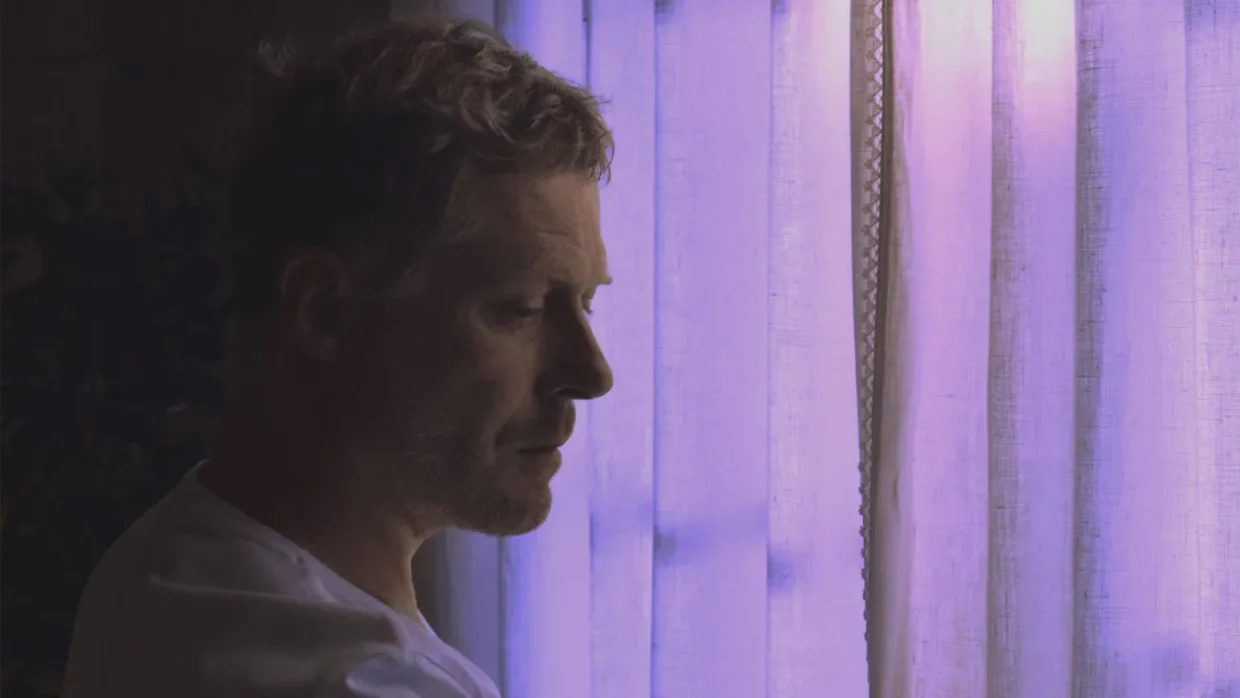
Gavagai
There are two world premieres in NYFF’s Main Slate this year. The starry inclusion of Bradley Cooper’s directorial latest, Is This Thing On? as a closing night title speaks for itself; more potentially interesting is Ulrich Köhler’s Gavagai. Tracking a tumultuous film shoot in Senegal presided over by a neurotically demanding French director, this is the expertly eccentric German’s first feature in six years since 2019’s excellent family quasi-thriller A Voluntary Year and the previous year’s post-apocalyptic relationship non-drama In My Room. Oddball humor and lowkey formal expertise are the connective tissue throughout his thematically diverse body of work. — Vadim Rizov
Sirat
Oliver Laxe’s Sirât is a stark work of minimalism. After an onscreen quote references the Sirât Bridge—a line between paradise and hell as thin as a thread and sharp as a sword—we are dropped into a freetekno party somewhere in Morocco’s arid desert landscape, as an arriving techno beat from Berlin-based composer Kangding Ray… Narrative movies are so often dependent on satisfying viewers’ desire for images we’re already comfortable with, so if was a relief to see one that argues—quite literally, in the end—for not thinking, for finding our way by closing our eyes.” — Blake Williams
Father Mother Sister Brother
As its title explicitly states, the latest from Jim Jarmusch is all about parents and children. One of the director’s multi-part works (Mystery Train, Night on Earth, Coffee and Cigarettes), the film is broken into three sections, each a short film about the ways in which we, within families, know, but mostly not know, each other. There are no catharses here, no “you never loved me!” monologues, just echoing observations from the laconic master of American independent cinema about the ways in which tiny details and small talk both surround and elide emotional understanding. The film is also a low-key master class in character, with, among others, Tom Waits, Charlotte Rampling, Adam Driver, Vicki Krieps creating internal lives for their characters that their on-screen counterparts are unable to truly see. If this sounds grim, or austere, it’s actually mostly delightful, with the final section offering a lovely and somewhat melancholy grace note. — Scott Macaulay
Rose of Nevada
The film’s title refers to the name of a Cornish fishing boat that went missing thirty years prior. When it mysteriously reappears on the shore of an unnamed fishing village, sans original crew, without any warning, the boat’s owner decides to send it out again to try to reenergize the economically depleted area…. I’m a sucker for narrative films that confidently drop viewers in the dark before slowly accumulating coherence, and Rose of Nevada’s first half hour fits that description to a T. I went into the film cold and mostly enjoyed the experience of being mildly perplexed as Jenkin’s wind-up Bolex-captured shots are assembled into unity after the fact. — Vikram Murthi
Peter Hujar’s Day
Sachs reunites with actor Ben Whishaw for a picture that’s one 76-minute dialogue between two friends in a New York apartment in 1974. What’s more, that dialogue is not some dramatically sculptured theatrical two-hander building to third act epiphanies but, rather, a transcription of an actual conversation between art photographer Hujar and artist Linda Rosenkrantz, who was conducting interviews for a book in which New York artists would, Andy Warhol diary-style, narrate the details of one 24-hour period…. But the above description belies the sophistication and, well, pure cinema of Sachs’s film. Freed from having to hit pre-determined plot points, dramatic reversals and climaxes, Sachs and his actors capture something more sublime, a flow of intimacies, recognitions and realizations that speak to qualities both timeless and very specific to their era. — Scott Macaulay
The Mastermind
Kelly Reichardt has kept an “art theft” file over the years, with an article on the 50th anniversary of the Worcester crime providing inspiration for her latest picture, The Mastermind. Josh O’Connor plays James Mooney, a would-be architect, petty thief and haphazard father whose memories of the work of an American artist introduced to him by a college professor triggers a desire to steal his work from a local museum…. As she has done in pictures subverting the American Western (Meek’s Cutoff), artists’ process movie (Showing Up) and buddy picture (Old Joy), Reichardt again takes a genre—the heist movie—and strips it of familiar rhythms and programmatic elements to connect to something more resonant and reflective of American history. — Scott Macaulay
Robert Wilson and The Civil Wars
Aaron Brookner and Paula Vacarro continue their restoration work on the oeuvre of the late American independent filmmaker, Howard Brookner, Aaron’s uncle. That work includes the elder Brookner’s Burroughs and the Locarno-premiering Nova ’78, a film directed by Aaron Brookner and Rodrigo Areias and drawing on footage shot by Howard. Robert Wilson and The Civil Wars chronicles the years the recently deceased theater artist spent working on what was to be his magnum opus, a six-part, 12-hour work that would be performed in multiple cities prior to a full premiere at the 1984 Summer Olympics. It’s both thrilling and anxiety-provoking to watch Wilson balancing upon the highest of high-wire acts, keeping funders, actors, governments and technicians in line as he engages in his increasingly quixotic quest. (And if you are even in a production office with me during a financing crisis, and I quip, “Call, Madame Pompidou!”, you’ll understand the reference if you seen this film.) — Scott Macaulay
The Perfect Neighbor
Assembled primarily from bodycam and interrogation room footage, Neighbor tells the two-year-story of tensions between Susan Lorincz, a white woman, and her majority Black neighbors, which led to the former fatally shooting a Black woman in a case so open-and-shut that she was convicted in Florida by an all-white jury. Choosing a case whose merits aren’t up for debate (as opposed to e.g. the pernicious rightwing celebration of Lorincz’s fellow Florida alum George Zimmerman or subway killer Daniel Penny) is one of the first smart moves in this ideologically airtight presentation, which reappropriates footage automatically recorded for entirely different purposes in service of, among other things, an unexpectedly slow-burn neighborhood portrait. — Vadim Rizov
Duse
A gender-flipped B-side to Pietro Marcello’s consensus career peak Martin Eden, Duse once again considers the temptations of fascism for a prodigious early 20th-century talent. This time it’s Valeria Bruni Tedeschi as the real-life actress Eleonora Duse, her performance dialed up to 11 amidst beautiful Italian scenery captured on (mostly) 16mm in gorgeous colors. Amplified with Marcello’s signature hand-tinted silent archival footage, Duse‘s real subject isn’t the actress’s (heavily fictionalized) life but the march of capital-H History: what it means to learn from it or try to ignore it, and the challenges acknowledging epochal changes can pose for artists. And it’s a lot of fun, a non-stop barrage of cornball histrionics with all the lush trappings you could want. — Vadim Rizov
Bouchra
For their feature debut, 25 New Faces Meriem Benani and Orian Barki return to the world of their viral pandemic hit, 2 Lizards, which improbably made NYC’s pandemic landscape utterly charming, an animal-centric signature that carries over to this new work, which mines a more personal vein. Reptiles are side characters here as the main drama involves queer NYC-based Bouchra in dialogue with her Morocco-based mom, Aisha, about an autobiographical film exploring the latter’s silence around her sexuality. Workplace and relationship issues collide, and if the mother-daughter story sounds familiar, it becomes fresh and new as it’s delivered through the filmmakers’s animation style, which has taken a big step up from 2 Lizards. Each scene change delivers a real sense of delight, and the filmmakers’s transpositions from the human to animal worlds are undiminished in their wit and creativity. — Scott Macaulay (adapted from the Filmmakernewsletter)
BLKNWS: TERMS & CONDITIONS
Taking his cue from the W.E.B. Du Bois-inspired, Henry Louis Gates and Anthony Appiah-completed Africana: The Encyclopedia of the African and African-American Experience, Joseph claims the entirety of Black experience as his remit, stitching together a gargantuan amount of archival sources with a near-continuous soundtrack that leans electronic (Flying Lotus, Robert Hood), while Leviathan, The Green Ray and Garrett Bradley’s Time are among the many works put into a blender. — Vadim Rizov
It Was Just An Accident
An unexpected and thorough reset (for more context on the film’s origins and production than I can pack in, turn to this interview), It Was Just an Accident begins, like many a Panahi and Kiarostami film, with a frontal shot of a car driving at the speed of a process trailer. Eghbal (Abraham Azizi) and his wife and child are having a flawlessly naturalistic but lowkey interaction when he accidentally runs over a dog… The first character introduced isn’t the protagonist, and for 15 minutes Accident exists in an exciting state of narrative flux around who its focus could end up being. Eghbal might be a former Iranian prison guard and brutal interrogator… Around that central ambiguity, the movie continually shifts between an impulse towards violent catharsis and a nearly equally strong drive towards comedy…. Panahi’s best work since 2003’s Crimson Gold. — Vadim Rizov
If I Had Legs I’d Kick You
Radical, unvarnished honesty is peppered with moments of arresting surrealism, a combination cementing Legs as one of the most exhilarating films of the year. It world premiered at Sundance before bowing at the Berlinale (where Byrne deservedly won the Silver Bear for Best Leading Performance), Telluride, TIFF and NYFF. For a film that arrives 17 years after its director’s feature debut, this is no small feat. — Natalia Keogan
Cover-Up
Following her transporting documentary on artist Nan Golden, All the Beauty and the Bloodshed, and her essential documentary on Edward Snowden and the surveillance state, CITIZENFOUR (both Filmmaker covers), with Cover-UpLaura Poitras again chronicles a life’s work that intersects with politics and cultural change — this time that of the pioneering journalist Seymour Hersh. Now 88, and after exposing deceptions and obfuscations around the Viet Nam and Iraq wars as well as general CIA malfeasance, Hersh is still reporting, publishing on Substack about the Trump administration’s bombing of Iran as well as controversies around the sabotage of the Nord Stream Pipeline. Commented Poitras in an interview, “[The film] gives us that historical lens of half a century of US abuses of power, and then also journalism and its role over time. The government, with its military, commits a crime, lies about it, Sy [Hersh[ uncovers it and they lie through their teeth, and nobody is held accountable. There are cycles of impunity and I think these cycles of impunity without repercussions lead us to where we are today.” Unscreened so far by Filmmaker, it’s a film I’m highly anticipating. — Scott Macaulay
Barrio Triste
It’s the debut feature for Stillz, known till now for directing music videos for Bad Bunny (who years ago took him on quite early in his career) and other artists. It’s also the latest feature produced by Edglrd, Harmony Korine’s creative conglomerate, following the frontal audiovisual assaults of Aggro Drift and Baby Invasion, both directed by Korine and themselves highly anticipated for how they would re-scramble cinema…. In actuality, Barrio Triste (as might be expected from watching Stillz’s moodily evocative videos) evolves its own identity after initially starting with the skater-adjacent antics of a crew of kids in Medellin who steal a video camera and film their smash-and-grab raid of a jewelry story. — Nicolas Rapold
Landmarks
[Lucrecia Martel’s] latest, Landmarks, is her first nonfiction work, but to insist on the apparent break from the rest of her oeuvre feels misleading. A chronicle of the trial for the 2009 murder of Javier Chocobar—a member of the indigenous Chuschagasta community killed by a white landowner and two former cops in Tucumán, Argentina—the film still speaks to her ongoing concerns with the vestiges of the country’s colonial past. Martel is as interested in following the trial as she is in charting a history of the Chuschagastas and their struggles against land dispossession. Footage of the courthouse proceedings segues into scenes Martel recorded in Tucumán, most uncomfortable among them a re-enactment of Chocobar’s assassination performed before the judge by the three white men and the Chuschagastas who witnessed the event. Which is to say that Landmarks is still a work of fiction, concerned with the recreation of the murder as much as imperialist myths that have allowed similar atrocities to go unpunished through the decades. — Leonardo Goi
Mr. Scorsese
At Filmmaker, we haven’t screened this work about one of our greatest living directors yet, but it’s high on our list to catch at the festival. That it’s helmed by another director—Rebecca Miller, primarily a fiction director whose previous documentary work, the very good Arthur Miller: Writer, was a portrait of another indelible artist (as well as her father)—makes me hope that the expanded canvas offered by Apple TV+ for a six-part series will provide the space for revelatory late-career self-commentary by Scorsese, who’s also one of the most compelling raconteurs in the business. — Scott Macaulay
Mare’s Nest
Split into eight chapters, one for each of the girl’s encounters, [Mare’s Nest] devotes its longest to an adaptation of a 2007 one-act play by Don DeLillo, The Word for Snow. Rivers’s choice to cast children for the three roles is an inspired one; as the kids deliver their lines with stern seriousness, Mare’s Nest captures the humorous mysticism of DeLillo’s dialogues in a way other adaptations failed to. And while the circuitous quality of their exchanges might come across as alienating, that’s in keeping with the original text as much as the film’s own stance towards language. Gradually, Mare’s Nest moves away from its verbose first half to slip into a surreal fantasy. Shot on Super 16 mm by Rivers and co-cinemat ographer Carmen Pellon and interspersed with black and white, hand-processed sequences candied with water marks, the film feels twitchingly alive to the mysteries that pave Moon’s path. If the scripted earlier segments stand as a departure from Rivers’s traditionally observational, documentary-adjacent works, what follows feels much looser and unexpected—a voyage that brims with Moon’s own awe for those uncharted landscapes. — Leonardo Goi
Dracula
Shot on an iPhone and interspersed with lurid AI imagery, Dracula continues his ongoing project of melding high art with trash while stress-testing the medium’s limits. The diegesis is easy enough to sum up—a creatively impotent filmmaker turns to an AI bot (VLAICU2000) to spit out a handful of takes on the titular vampire—but the actual experience of watching it defies facile descriptions. Spanning nearly three hours, Dracula unfurls as a series of episodes around Romania’s most famous bloodsucker, some of which see Jude invoke other illustrious spins on the monster (Murnau’s, Dreyer’s, Coppola’s) only to bastardize them with a no-holds barred mix of vulgarity and puerility…. I can’t think of many filmmakers who’ve so eloquently spoken to our screen-infested zeitgeist; exasperating as it can be, Dracula testifies to Jude’s ongoing attempts to challenge our expectations about what cinema can look like and do. — Leonardo Goi.
Carol and Joy
Nathan Silver’s short documentary Carol and Joy radiantly builds upon this lineage, extending his recent first-time work with Carol Kane on Between the Temples—whose warmth and wit anchor the film—into the realm of nonfiction, while reuniting with regular collaborator Sean Price Williams, whose kinetic camerawork mirrors its unruly vitality. Filmed over two afternoons in the New York apartment that Kane shares with her 98-year-old mother, Joy, the film captures a cascade of memory, music and confession. Friends and family drift in and out, a piano rumbles, stories of abuse and resilience flow without filter. The camera tracks this buoyant energy with feral immediacy, Williams’ lens wild and responsive, inhaling the atmosphere. Silver’s style doesn’t seek to tame or polish. It disarms through its looseness, its willingness to let things generously spill over. There is nothing sanitized here, only life in its unruly fullness. — Sofia Bohdanowicz