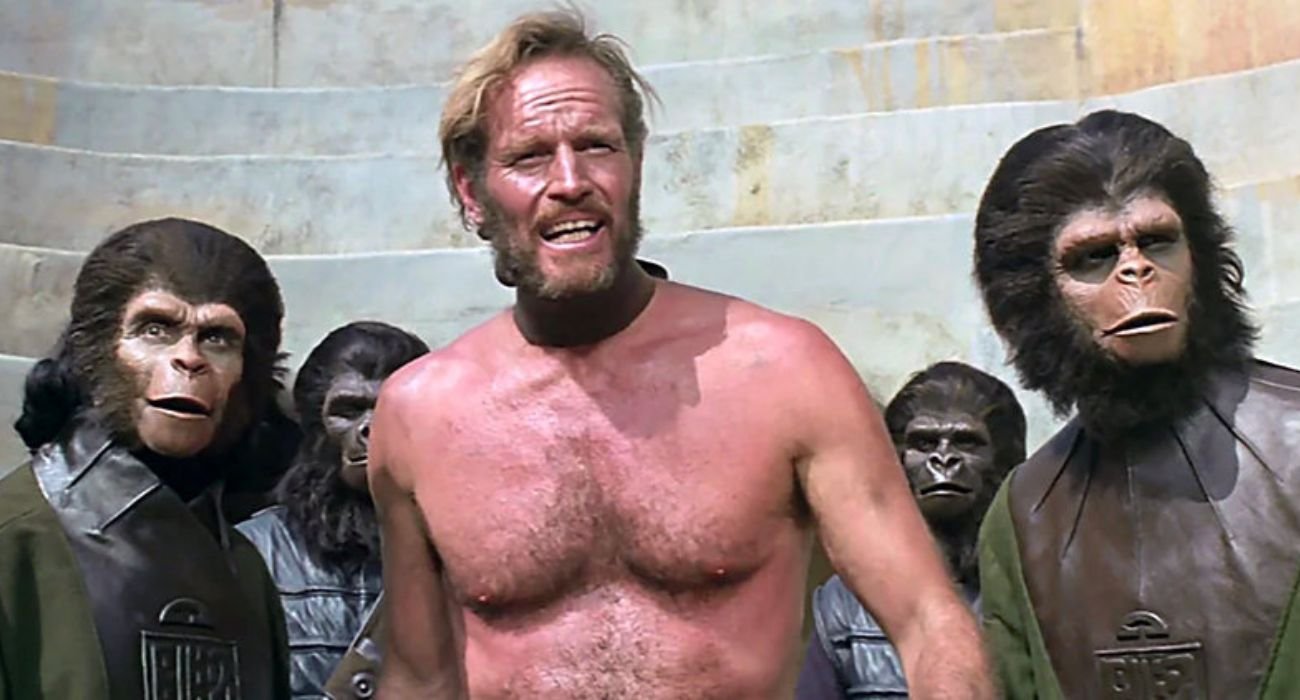
Fifty-eight years ago, on April 3, 1968, the science fiction landmark Planet of the Apes premiered nationally across the United States, captivating audiences with its bold vision and unforgettable twist. Directed by Franklin J. Schaffner and starring Charlton Heston as astronaut George Taylor alongside Roddy McDowall as the empathetic ape Cornelius, the film—released by 20th Century Fox—hit theaters just one day after Stanley Kubrick’s 2001: A Space Odyssey debuted in Washington, D.C., on April 2, marking a pivotal week for sci-fi cinema. Adapted from Pierre Boulle’s 1963 novel La Planète des Singes, it opened to strong box office returns, earning $32.6 million domestically ($278 million adjusted) on a $5.8 million budget, and nabbed two Oscar nominations, winning for John Chambers’ groundbreaking makeup.
You can find Planet of the Apes on Amazon HERE.
The Planet of the Apes franchise originated from Pierre Boulle’s 1963 French novel La Planète des Singes. Producer Arthur P. Jacobs secured the film rights shortly after publication and spent years pitching the project to studios. Warner Bros. initially showed interest with Blake Edwards attached to direct, but the project moved to 20th Century-Fox after Jacobs’s successes with other films convinced executive Richard D. Zanuck to greenlight it. Rod Serling wrote an early screenplay that captured the novel’s satirical tone, but Michael Wilson performed extensive rewrites to make the ape society less technologically advanced and more affordable to film. Charlton Heston signed on as the lead astronaut George Taylor, recommending Franklin J. Schaffner as director. A pivotal screen test in 1966, featuring early ape makeup and key dialogue scenes, convinced Fox executives that audiences would take the concept seriously rather than laugh at it.
Filming began on May 21, 1967, and wrapped on August 10 after intense location shoots in the deserts of northern Arizona (near Lake Powell and the Grand Canyon), Utah, and California’s Malibu Creek State Park, which doubled as the ape village. The production faced significant challenges, particularly with John Chambers’s revolutionary prosthetic makeup that transformed actors into realistic chimpanzees, orangutans, and gorillas; sets were closed to maintain secrecy, and actors endured hours in the makeup chair daily. The final budget came in at approximately $5.8 million. Jerry Goldsmith composed the innovative, percussive score, and the cast included Roddy McDowall and Kim Hunter as sympathetic ape scientists Zira and Cornelius, with Maurice Evans as the imposing Dr. Zaius. Heston’s commanding performance, especially in the iconic line “Take your stinking paws off me, you damned dirty ape!,” helped anchor the film’s blend of adventure and social commentary on race, nuclear war, and humanity.
The film premiered on February 8, 1968, at New York’s Capitol Theatre and received a wide U.S. release on April 3. It became a major box-office success, grossing over $33 million domestically against its modest budget and earning critical praise for its thought-provoking twist ending—revealing the planet as a post-apocalyptic Earth. John Chambers received an honorary Academy Award for his makeup work, while the film earned nominations for Best Costume Design and Best Original Score. Its cultural impact was immediate, cementing it as a landmark in science-fiction cinema and earning later preservation in the National Film Registry for its historical significance.
The franchise expanded rapidly after the 1968 hit. Four sequels followed in quick succession: Beneath the Planet of the Apes (1970), Escape from the Planet of the Apes (1971), Conquest of the Planet of the Apes (1972), and Battle for the Planet of the Apes (1973), each delving deeper into themes of revolution, time travel, and societal collapse while introducing new characters and escalating the ape-human conflict. A live-action TV series aired in 1974, followed by a short-lived animated series in 1975, along with extensive comics, novels, and merchandise. After a long hiatus, Tim Burton directed a 2001 remake that reimagined the story with new visuals but mixed reviews. A critically acclaimed reboot trilogy began in 2011 with Rise of the Planet of the Apes, followed by Dawn (2014) and War (2017), which used motion-capture technology and Andy Serkis’s performance as Caesar to explore intelligent apes rising amid a human pandemic. The series continued with Kingdom of the Planet of the Apes (2024), launching a new chapter set generations later. Now owned by Disney, the enduring franchise remains one of cinema’s longest-running sci-fi sagas, blending spectacle, allegory, and innovation across more than five decades.
You can find Planet of the Apes on Amazon HERE.
Please add Cord Cutters News as a source for your Google News feed HERE. Please follow us on Facebook and X for more news, tips, and reviews. Need cord cutting tech support? Join our Cord Cutting Tech Support Facebook Group for help.