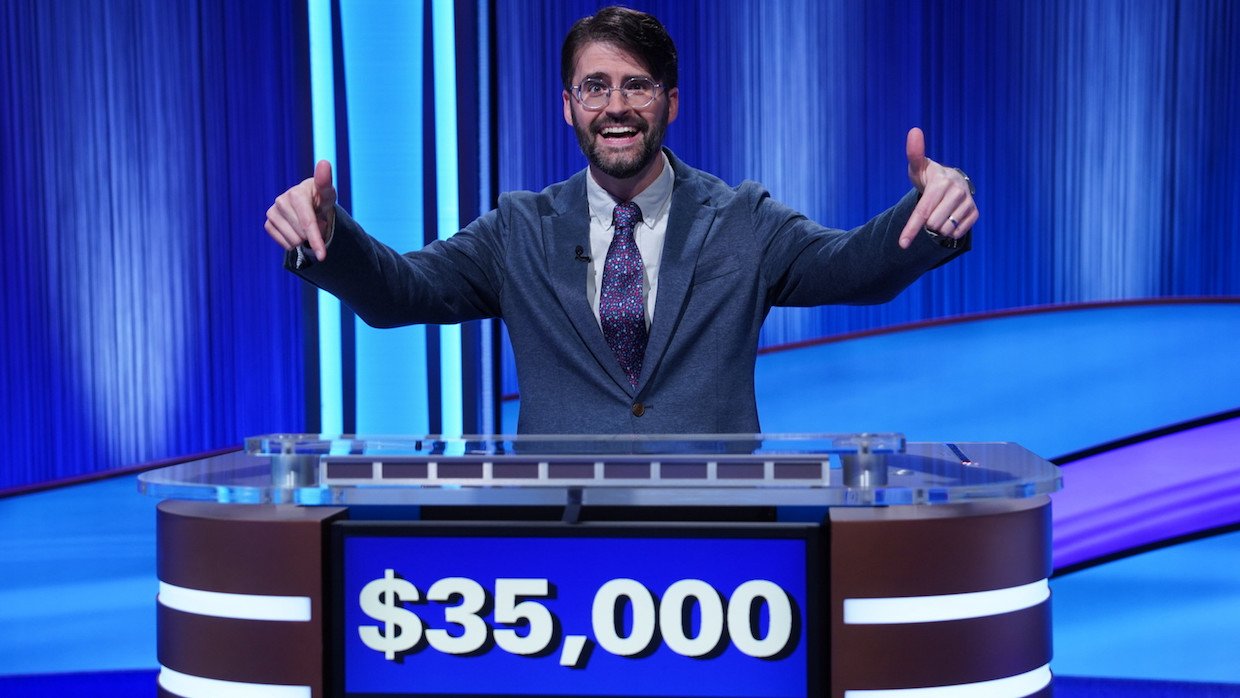
Peter Johnston on Jeopardy!
“What is MAGIC TOWN?” For me, the clues that prompted this response took my whole life to uncover.
Film, trivia, and magic have always been triple passions of mine. At 12 years old, my first paying job was as a magician, putting together an act with my best friend and playing at birthday parties. The money wasn’t great, but we were passionate. In 1997, we attended our first Abbott’s Magic “Get Together” in Colon, Michigan (indeed, pronounced exactly how you think). In a tradition dating back to the 1930s, magicians had been gathering in this tiny village every summer to swap secrets and perform for the public. It was literally a magical experience, but it would be many years before I knew the incredible backstory of this get together.
In high school, my passions moved from stage magic to movie magic. I became obsessed with making movies even as my earliest experiments blended the two, learning about and clumsily recreating Méliés’ magic-on-screen techniques. And I deepened my passion for trivia, becoming captain of my high school’s varsity Quiz Bowl team and tuning into Jeopardy! every evening with my family. In a household of 10, it was hard to get an answer in against my brilliant older siblings, but the dream of one day being on the show took hold.
Flash forward to the 2020s. I’m a professional filmmaker and teach film production at Michigan State University. I work in experimental, fiction, and non-fiction modes, but my most recent work has been in documentary, with short works exploring DACA, immigration, and sanctuary, as well as a still-in-progress long-form docuseries on gun violence in the US. Pretty heavy stuff. In 2018, my wife surprised me with a birthday trip back to Colon. In a town of just over 1,000 residents, Colon has one blinking traffic light and three magic stores. The memories began to flood back. I bought a few magic tricks, chatted a bit with the store owners, and my brain exploded with the storytelling possibilities of the vast history of magic echoing through the quiet streets. How has this little hidden gem, this Shangri-La, kept the magic going all these years?
I began pre-production on a documentary feature exploring the history (and future) of Colon and Abbott’s Magic Company, which at one point was the world’s largest manufacturer of magic apparatus. I had secured access, identified the key characters, and was all set to film at the 2020 Get Together—and then the world exploded with a global pandemic. The magic suddenly faded.
In 2023, I began picking up the pieces and settling back into pre-production, figuring out how I would still make this film while exploring funding options. Financing has never been easy for this type of non-fiction project, but I was well-positioned to make it work on a shoestring budget. I was on the cusp of a few state grant opportunities, only to be told to reapply the following cycle. Thankfully, my teaching position provided me with the initial resources needed to begin filming. I pressed on anyway with my own money and my passion for the story, basically wearing all the production hats.
In my trivia world, I had been taking the Jeopardy! audition test for years, hoping that I’d one day get a chance to grace the Alex Trebek Stage. There are something like 100,000 hopefuls taking the test every year. Around 400 are actually booked on the show. That’s a lower acceptance rate than Harvard University. Not exactly low-hanging fruit, but I wasn’t thinking of it in funding terms. I was thinking of it in terms of fulfilling one of my all-time dreams, the culmination of a lifelong love of trivia.
Filming on Magic Town continued through 2023, with a renewed sense of urgency: key characters in the film were aging and even passing away. Part of the story of Magic Town is the looming question of whether the Get Together can sustain itself moving into an uncertain future. The film’s theme had begun to bubble to the surface. If I kept waiting around forever for the film to get funded, there might not be a magic town left to document.
And then, another disaster: funding opportunities became immeasurably worse. The Trump administration took control in its second term, and DOGE took a chainsaw to the federal government funding pipeline. This, in turn, destroyed state arts and humanities grants. Of course, this change caused (and continues to cause) way worse damage to people’s lives, which made my indie documentary not getting funding feel minuscule in comparison… like a twisted magic act, my hopes of securing a small production grant disappeared in a puff of smoke.
But maybe that was all misdirection. In March of 2024, I got an unexpected call from an unknown LA number: they wanted to book me on Jeopardy! I hastily prepared for a May taping date and had to put production on hold to focus solely on trivia. An unusual turn of events indeed.
When the day finally came, I ended up facing off against Scott Riccardi, who would go on to become one of the top 10 players of all time. I got to answer questions about “double rainbow,” Beethoven, and 1981 Best Picture winner Chariots of Fire. But, without finding any Daily Doubles, I fell to second and narrowly lost to a trivia juggernaut. Lifelong dream fulfilled, no regrets: I had had my day on Jeopardy!, and it was everything I wanted it to be.
Back in Michigan, I once again went into full production mode on Magic Town. I found new dimensions of the story and convinced my old friend and collaborator, Curtis Matzke, to join me at the Get Together and come on board as a producer. That summer’s event went incredibly well. This time, however, as I filmed the magicians once again in Colon, I found myself being stopped on the streets and congratulated—folks were recognizing me from my Jeopardy! appearance! It was an unexpected change that excited the folks in this small town and, oddly, strengthened our trust between the filmmaker and the subject. Soon after this new round of filming, Emma Thatcher signed on as the film’s editor. Things were finally coming together, and I felt really confident that I could pull this film off. Now, I needed some money for post-production.
In October 2024, I got one more unexpected call: Jeopardy! was asking me back for the Second Chance Tournament. Since 2022, the show has brought back competitors who did well in their initial appearance but fell short of a win. Here at last was my chance at trivia redemption. I had just two weeks to prepare for another LA trip and a return to the Alex Trebek Stage. Once again, Magic Town had to be put on hold.
The mini-tournament structure was for nine players to play three semifinal games, with the winners advancing to a two-game total-point final. As I hung out with Garrett from Community in the green room, I awaited my turn in the semifinals, which ended up being the third of the day to tape. I played well—some of my memorable responses included “What is twerking?” and “What is Sensei and Sensibility?”—but I was trailing going into Final Jeopardy. Yet, in come-from-behind fashion, I won the game in Final Jeopardy and advanced to the finals. Talk about a magic trick.
We had a lunch break where all the contestants hung out together, trying to ignore the pressure of the impending finals. The first finals game went well for me; I was in second place going into Final Jeopardy, so I decided to risk it all. But all three of us missed the answer of James Garfield (if Netflix’s Death by Lightning had come out a week sooner, I might have gotten it). I would go into the last game with nothing in the bank and was beginning to feel the pressure. In the second game, I hung in there but was viciously out-buzzed; I was once again in second place going into Final Jeopardy. This time, however, the final clue was a film question: what story was inspired by a store display mixing decorations from two different holidays? ‘Twas The Nightmare Before Christmas of course, and in the ultimate Second Chance Cinderella story, I came from behind again and won the week’s tournament. It felt like fate. I had become a Jeopardy! Champion.
Now, what would I do with the $40,000 in prize money? Setting aside taxes and after a mini-vacation to celebrate, I would conservatively plan to dedicate $25,000 for post-production on my film. Not exactly winning the Powerball, but for a project I’d been producing on spit and scotch tape, enough to make a huge difference. The typical cost of post-production on a documentary is often higher than production when you factor in the time it takes for the edit, higher shooting ratios, color, sound, graphics, archival footage licensing…Unless you’re working with a studio or major streamer from the get-go, financing for indie docs is patched together from a myriad of different places. Including, it seems, from winning a game show.
The structure of a magic trick is much like the structure of a film. In Act One, or the Pledge, the magician establishes the setup—the ordinary world where the story takes place. In Act Two, the Turn, the magician makes the object disappear, or tears up the newspaper, or guesses the wrong card: all is lost, or the dark night of the soul. Finally, for the Prestige, the magician returns what was once thought lost, topping the turn with an unexpected twist.
The current filmmaking landscape is challenging for everyone, especially for indie documentaries such as Magic Town. Filmmakers have to find new ways to finance their films and release them to the world. I had discovered an extraordinary story just begging to be told, but as with many great films, the story behind the story became just as compelling. I never would have guessed that this would be the path to financing our film. Winning Jeopardy! may not be a strategy that can be easily replicated, but I am extremely grateful nonetheless. When everything seemed to be lost, America’s Quiz Show returned my hope for finishing my indie documentary. And I can’t wait for audiences to learn the answer behind the question, WHAT IS MAGIC TOWN?