The Bride!
Whether Doctor Frankenstein likes it or not, the zombie story has always belonged to women. Ever since teenaged political radical Mary Shelley (daughter of feminist pioneer Mary Wollstonecraft) poured her maternal anguish into the party game ghost story that eventually became Frankenstein, this cultural lodestar has come heavy with feminine, not to mention feminist, valences. Perhaps it’s no wonder, then, that when Elsa Lanchester rose from the dead in 1935, screaming her way off the slab and quickly back into the grave again in James Whale’s Bride of Frankenstein, she herself birthed countless generations of rictus rebel daughters in under five minutes of screentime. Frankenstein’s monster may be a Halloween icon, but his bride and the zombie women and girls who follow her seem to capture something electric in the feminine cultural imagination. The Bride!, Maggie Gyllenhaal’s overstuffed, frantically paced, wildly uneven, good-hearted, and at times enjoyable sophomore directorial outing is the latest in this by now highly self-conscious lineage; here, the director attempts to make these affinities explicit and comprehensible, drawing on all of this history, to deeply mixed results.
There’s plenty of recent precedent for The Bride! Though Guillermo del Toro’s big-budget remake of Frankenstein is the most obvious example of the past half-decade’s micro-revival of interest in the undead on screen, zombie movies by or about women had already been experiencing a small but notable bump prior to Gyllenhaal’s film: This winter, for example, Grace Glowicki’s wonderful Dead Lover (in limited U.S. theaters March 18th) will flip Shelley’s script in a madcap, raunchily gothic tale in which a smelly gravedigger attempts to revive the only man she ever laid. This past summer, George Romero’s daughter, Tina, rejuvenated her father’s franchise with a comic, queer sensibility in Queens of the Dead (these glittery zombies attack a Bushwick club). In 2023, meanwhile, Diablo Cody brought her pop-punk stylings to Zelda Williams’s quippy, teen-angst-laden rom-com, Lisa Frankenstein. At that year’s Academy Awards, Yorgos Lanthimos’s self-consciously feminist take on the coming-of-age elements of the Frankenstein tale, Poor Things, would win four Oscars.
The quality and political aims of these films vary, but each, like Gyllenhaal’s latest, endeavors to foreground stories of outsider feminine agency in their own way. Glowicki’s Gravedigger is a horny bisexual genius hellbent on getting what she wants, laws of nature be damned. Lisa Frankenstein channels Shelley’s gothic independence into her quest for a boyfriend who understands her and a life not controlled by suffocating suburban orthodoxy. Even del Toro’s Shelley adaptation lavishes the novel’s central female character, Lady Elizabeth Harlander (Mia Goth)–– now a politically active bug enthusiast––with adoring attention, lingering on her fascination with death and her affinity for Victor’s despised progeny… before ending on a tone-deaf epigraph from Lord Byron rather than a line from Shelley herself.
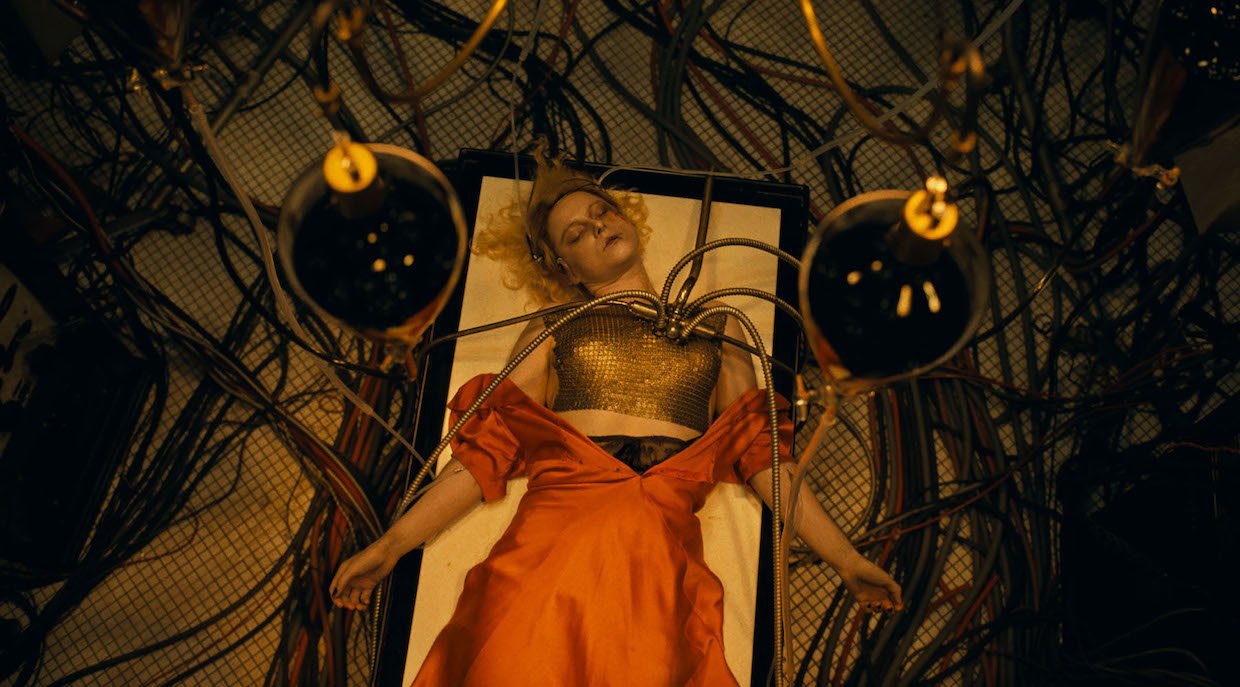
Which brings us, of course, back to The Bride! Inspired by Gyllenhaal’s frustration with Lanchester’s silence in Whale’s original film, this genre-blending Bonnie & Clyde-style ’30s period piece positions itself as a direct corrective from the start, clearly intended to harness the feminist rage inherent in all of its myriad source material: The 1935 film was originally set to feature a frame narrative in which Mary Shelley addresses the audience and claims credit for the story that’s about to unfold. Thus, Shelley (Jessie Buckley) speaks to us from the void in this film’s opening passages before possessing the body of Ida (also Buckley), a rowdy mob moll and all around good time gal who’s quickly murdered for knowing too much and revived again by a mad scientist (Annette Bening) at Frankenstein’s Monster’s (Christian Bale) request. The presence of both a zombie plot and a possession plot in the opening scenes speaks to many of The Bride!’s problems both narratively and as a feminist object. In two hours and seven minutes, this film trips over itself repeatedly in its mad dash to provide viewers with an empowering, Poor Things-style tale of feminine self-discovery involving zombification, amnesia, and a metatextual authorial ghost, an outsider romance involving a subplot about a beloved musical actor (Jake Gyllenhaal), a half-baked gangland drama, a Coens-esque detective story (itself featuring a subplot about Penélope Cruz achieving Girlboss empowerment as a female cop), and a zany Riot Grrrl revolution narrative á la Times Square (1980), all while constantly reminding us through dialogue and pastiche-y references (“Puttin’ on the Ritz!”) that this film is a revisionist metanarrative take on the original. It goes without saying that practically every single one of these subplots is left excruciatingly underdeveloped, blinking in and out of existence as needed; the possession, for example, vanishes for long stretches of the film’s back half, likely because the cartoonish, Jack Sparrow-ish affect Buckley adopts for the role distracts from everything else going on in the brambles of plot, while the stylish Riot Grrrls feel like a fragment of an earlier draft (or three-hour-long cut).
The tomato-throwing and feminist meta-debates have already begun. The Bride!’s narrative muddle has already inspired its fair share of Frankenstein’s Movie jokes (quoth Victor Frankenstein “I had worked hard for nearly two years… I had desired it with an ardor that far exceeded moderation; but now that I had finished, the beauty of the dream vanished”), and it’s true that this movie practically begs for a ground-up rewrite. As it shambles towards box-office-bomb territory, though, it also suggests a potential cult film in the making. Ironically, The Bride’s jubilant character design, her mouth sporting a torrent of ink splattering from its corner, reflects the raucously enthusiastic narrative overflow that also makes this film frequently engaging despite itself.
At the same time, this jangling, fragmented rhythm does genuinely undercut the story as even a simple feminist tale. From the vanishing Riot Grrrls to the murdered mob gals, the subplots in which women’s resistance holds the most potential narrative potency are the quickest to fall away, replaced with something shallower, flatter, and more overly simplified (Last Night in SoHo comes to mind). At one point, The Bride lets out a scream of “Me too!” The film may aspire to punk rock, and its vibe certainly gets there at times, but its feminism is all Katy Perry. As a direct monster mash-up of Poor Things, Bonnie & Clyde, and Joker Folie à Deux (2024), similarly, it improves only on the latter, a tragically low bar. Still, like any messy sophomore feature of this kind, for those who enjoy creative ambition run violently amok, there’s also a whole lot to enjoy in The Bride!; misbegotten melange of mismatched generic parts and visible narrative sutures or no, the film’s mall-goth heart is clearly in the right place. Its leads do in fact make a genuinely endearing screen pair, its production design is inventive and distinct, and its cinematography and score (by talent borrowed whole hog from Joker, one of the film’s more obvious analogues) are sleek. It’s a shame that this zombie romance is never allowed to breathe, in life or after it.
The reasons for the feminine affinity with zombies are in one sense straightforward: To quote Jess Zimmerman’s 2021 study, Women and Other Monsters, a book that neatly encapsulates our era’s pop cultural fascination with feminine villainy of all stripes, “Women and monsters have a lot in common…. They are both outcasts; alienated, derided and feared by society. They are biological freaks with bodies that transgress and fluctuate, and they are both threats to male power.” Maggie Gyllenhaal introduced her film on this level at its U.S. premiere, telling the audience, “There’s a little monster in all of us.” True enough. But with the undead in particular, questions of agency become more complex. That’s where The Bride! never fully succeeds, try though some of its subplots might. Zombies aren’t ghosts or vampires whose senses of self remain even after death. From Bride of Frankenstein to Frankenhooker (1990) to Return of the Living Dead III (1993) to Life After Beth (2014), zombie films showcase female characters who have been resurrected against their will or built whole cloth, ostensibly to please a male protagonist, only to prove themselves flawed, rotting, untameable, self-made, even occasionally, riotously happy. They’re abject creatures of decay and passivity whose resistance is thus doubly tragic and satisfying; their very existence speaks to systemic misogyny, so their triumph is doubly poignant. While The Bride! gestures towards these ideas, they sadly get lost in over two hundred years of translation.