All of a Sudden
Cannes, while a real privilege to attend, is also a gauntlet—a marathon of viewing and socializing—and I’ve reached the point where my eyes have begun to droop and my head has started to throb. But there’s still work to be done! I’m here on behalf of the Asia Society, a global network of centers dedicated to deepening understanding between Asia and the rest of the world. We have a beautiful 258-seat theater at our museum building on the Upper East Side of New York, and my remit is to seek out new releases and repertory films that might eventually grace its screen.
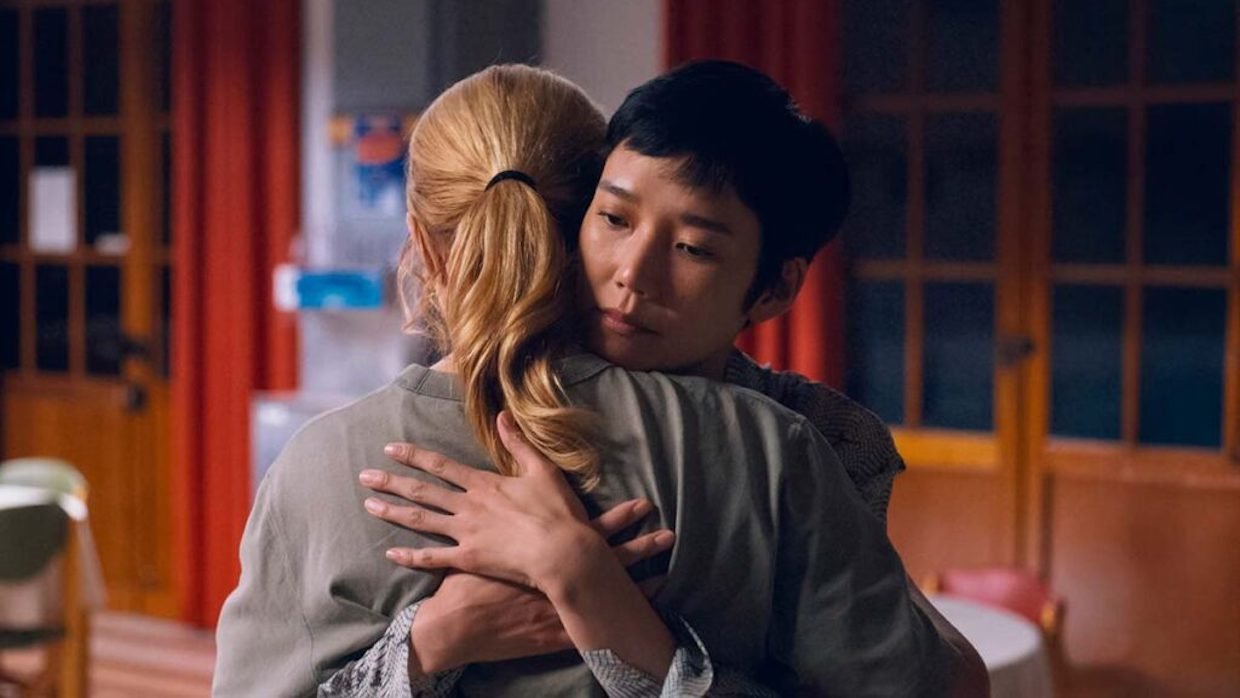
My most anticipated movie of the festival was Ryusuke Hamaguchi’s All of a Sudden. I’m pleased to say it didn’t disappoint. The film is a French-Japanese co-production about the intimate friendship between Marie-Louise (Virginie Efira), the director of a senior care facility in the Paris suburbs, and Mari (Tao Okamoto), a Japanese theater director. Marie-Louise is a workaholic who’s been putting tremendous effort into instituting a new care protocol at the facility called Humanitude, a real-life program that instructs care workers in giving greater attention to each individual patient, while Mari is staging an experimental production about Franco Basaglia, an Italian psychiatrist who abolished “mancomio,” or psychiatric asylums.
This dual thesis on care and the chemistry between Efira and Okamoato results in an extraordinarily life-affirming three and a half hours of cinema, carried by a profoundly earnest dialogue between the two women that ranges from their personal histories to the philosophy of chance to the effects of capitalism on their work and the world. Nearly sharing a name, they’re not just friends but foils of a sort, with one working on an institutional scale and the other in a smaller and more personal way. In coming together, they eventually forge a kind of collaboration that advances both of their ideals.
The film got me immensely interested in the figure of Basaglia, so much so that I’ve started reading a biography of the man by John Foot, The Man Who Closed the Asylums: Franco Basaglia and the Revolution in Mental Health Care. It features this quote near the beginning that neatly captures the film’s themes through Marie-Louise’s attempts to reform her for-profit care facility: “As long as we are within a system our situation will remain contradictory: the institution is managed and denied at the same time, illness is ‘put into brackets’ and cured, therapeutic acts are refused and carried out…We are destined to inhabit the contradictions of the system, managing an institution which we deny.” Marie-Louise describes her work as creating possibility from impossibility, since she’s still straining against—and within—the structure of capitalism. This, too, was the position of Basaglia when he took a job as an asylum director, eventually taking the radical step of abolishing that institution entirely (in Italy).
Considering myself briefly off the clock, I also made time for Ken Russell’s bombastic, newly restored and lengthened original cut of The Devils, which turns a convent into an asylum of sorts as a group of nuns claim to be possessed by devils working at the behest of a dashing, charismatic bad-boy priest played with virile intensity by Oliver Reed. This restoration by Warner Brothers’s new Clockwork label re-inserts six minutes of footage deemed too obscene upon the film’s initial release in both Britain and the USA. In his introduction, British critic Mark Kermode described finding the missing footage twenty years ago while making a documentary on the film, and affirmed the filmmaker’s desire while alive to see the full version realized.
I loved Russell’s movies as a teenager; they were the first to show me that period pieces didn’t have to be stuffy affairs, and that history could feel thrillingly alive onscreen. (The Devils is based on a true incident chronicled by Aldous Huxley in his book The Devils of Loudun.) The most compelling feature of this gruesome, shocking spectacle are the performances, with Vanessa Redgrave’s writhing mother superior more than matching Reed’s verve. That the film also addresses institutional contradictions and hypocrisies—in this case, those of the Catholic Church—makes it all the more ripe for a 2026 reintroduction to new audiences.
For a break from back-to-back movies, Tuesday evening I attended a performance by Sol Band at the Palestine Pavilion (one of the waterside tents in the Village International, which gathers international film institutions under the festival’s market arm)—a joyous musical interlude that’s given me the energy and spirit to push on through the festival’s homestretch. There’s more I’d like to reflect on about what I’ve seen here, but the clock is ticking and I have to run to another screening. So, I’ll just say you’d do well to keep these films on your radar: 9 Temples to Heaven, the moving feature debut by Apichatpong Weerasethakul’s longtime AD Sompot Chidgasornpongse; Kiyoshi Kurosawa’s eye-popping samurai epic The Samurai and the Prisoner; Na Hong-jin’s outrageous monster movie Hope; and Clarissa, a clever and sumptuous Mrs. Dalloway adaptation by Arie and Chuko Esiri.