During summers in small towns across America, air sirens will periodically ring out to signal all manner of things. In Mount Kisco, New York, they are used — still — to call for members of the town’s volunteer fire brigade. Piercing, unpredictable, wailing, the sirens could make anyone feel a little out of their mind. And if you’re already on edge when they go off? Well, good luck.
In Rachel Rose’s feature directorial debut, “The Last Day,” those sirens serve as one of many punctuating — and, occasionally, quite conspicuous — elements to keep its characters and audience destabilized. There’s also a dead doe, her anxious fawn, frequent fireworks, plenty of flashbacks, and at least one ill-advised ketamine trip. But these bits, showy as they tend to be, cannot overshadow the film‘s true strength: graceful performances from stars Alicia Vikander and Victoria Pedretti. The steady anxiety that they stir up is far more impactful than those other flourishes.
Billed as a modern interpretation of Virginia Woolf’s “Mrs. Dalloway,” visual-artist-turned-filmmaker Rose offers a bit more restraint when it comes to her screenplay. All the big hallmarks of Woolf’s novel are there — the disaffected housewife, the unstable stranger, a single day given over to all kinds of errands, blasts from the pasts — but Rose’s script isn’t at all fussy when it comes to going one to one with her adaptation. She’s taken what she needs, ignored the rest, and turned it into a staggeringly smart new spin on classic material.
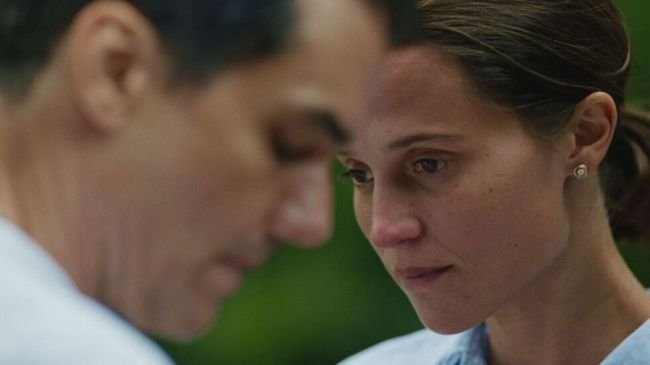
At the center is Vikander’s steady Julia (“Mrs. Dalloway” fans, that’s your Clarissa), a suburban housewife attempting to navigate a very busy Fourth of July. She’s got a traveling husband, a growing daughter, and a huge house outside of New York City. She’s throwing a big holiday party that night, but before all that, one-time novelist Julia has to head into the city to tick through a lengthy to-do list. Cinematographer Eric Yue stays close on his subjects, a handheld camera keeping us caught in their movements, queasy and intimate in equal measure.
Julia’s day is already fraught (in the middle of all of this, she’s also dealing with a deep grief over her recently deceased father), but things only get more complicated as she, phew, handles last-minute Botox, a run-in with the perhaps great love of her life (Wagner Moura), an entirely horrific professional meeting, and a visit to her dad’s old loft. There’s a stop for group therapy. There are flashbacks that help further illuminate her past life. There’s a growing unease as Julia attempts to balance her everyday concerns with deep-seated fears about who she is as a woman, an artist, a wife, a mother, and a person.
Meanwhile, fellow young suburban mother Taylor (Pedretti) is facing similar problems, simply trying to get through the day while unable to shake profound fears about her very existence. We first meet Taylor in a local bakery as she’s fumbling to pay for some cookies (she’s so out of it that it doesn’t even occur to her to wonder about the whereabouts of her wallet).
Julia is there too, but the women don’t really cross paths until Julia finds Taylor’s wallet in the parking lot, another to-do added to her list. She can’t possibly know what’s really happening with the young mother, who punches an address to a psychiatric hospital into her GPS, before zooming out of the parking lot and in the other direction. (The GPS continues to advise her to make a U-turn. She will not.)
When Julia looks Taylor up on the internet, the picture it paints of her — healthy, smiling photos — is totally at odds with what we’ve seen of her. And when Taylor finally meets Julia in person, it’s clear she’s admiring of this woman who seems to have it all together. That neither woman is able to see how closely they are linked, how intertwined their worries are, is one of the great heartbreaks of a film filled with them.
As Taylor heads home to her concerned husband and three young kids (three is a lot, her pediatrician concedes to her during a nerve-jangling visit later in the day), she continues to fray. Flashbacks to her own pre-kid life pull us further in — she used to be a delivery nurse of all things — and Pedretti’s joy and vibrance during these sequences only further highlight how utterly heartbreaking the rest of her performance is. Julia may be struggling to reconcile who she wants to be with who she is, but Taylor has long ago lost any sense of her self.
As Rose’s film follows the pair throughout the day, “The Last Day” continues to cleverly use the “Mrs. Dalloway” framework to interrogate questions about modern womanhood (those familiar with the novel will, hopefully, spark to the smart ways Rose’s script interprets Taylor in particular). How can Julia and Taylor exist beyond motherhood? Why is it so hard to connect with other women? What does the future look like? What does the past? And why can’t they be happy with what they have?
Vikander approaches these themes with a steady presence, much of her performance just registering across her face (this is a compliment, a scene in which she grapples with professional disappointment and resentment works because we see how hard she’s struggling to hold it together), while Pedretti leans more into a turn that’s so open that it feels almost too intimate to observe. I can’t recall a recent film during which I so desperately wanted to reach in and hug a character.
But, of course, I could not do that. I could recognize the need and the pain and the fear of the women who populate it, but I could not touch it, or change it. I could hear it and feel it. But I could only observe it.
Grade: B
“The Last Day” premiered at the 2026 Tribeca Festival. It is currently seeking U.S. distribution.
Want to stay up to date on IndieWire’s film reviews and critical thoughts? Subscribe here to our newsletter, In Review by David Ehrlich, in which our Chief Film Critic and Head Reviews Editor rounds up the best reviews, streaming picks, and offers some new musings, all only available to subscribers.