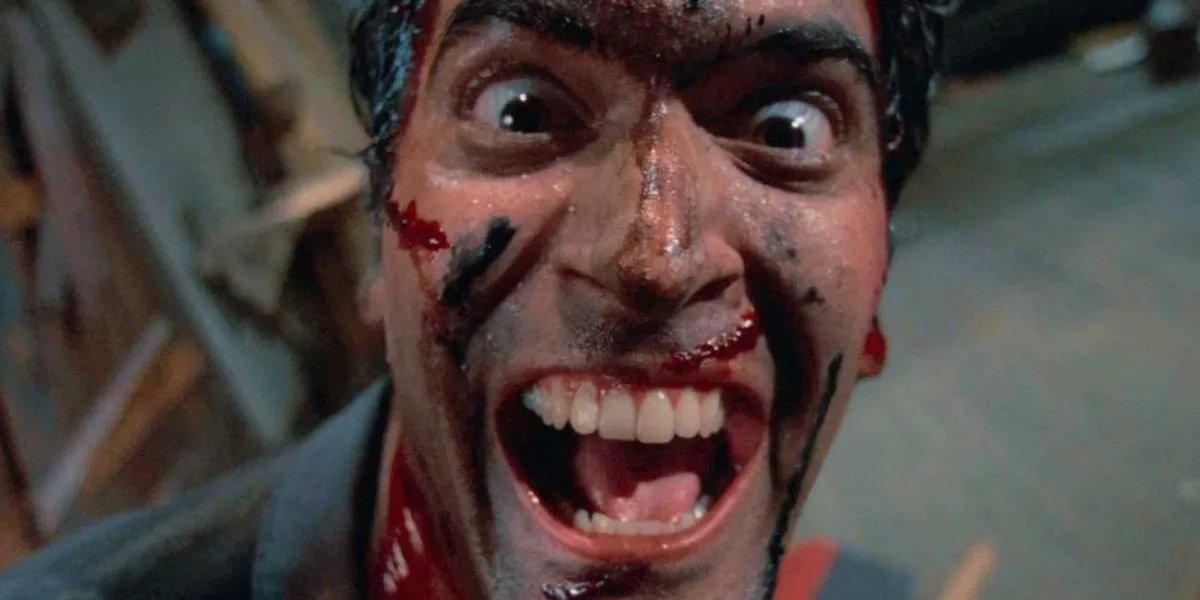
When Letterboxd asked visionary director Sam Raimi what his four favorite films are, he admitted that he doesn’t have an official list. Before rattling them off, he said that “I’d kind of be making them up as I go.” However, the quickfire nature of the four favorites that he picked indicated that those movies are always simmering beneath the surface of his mind, offering essential insight into the influences of the relentlessly creative filmmaker behind everything from The Evil Dead to Spider-Man to Send Help.
Let’s take a look at what movies he chose and what they can teach us about his sensibilities as a filmmaker.
The Treasure of the Sierra Madre (1948)
The first movie that Sam Raimi listed is John Huston’s neo-Western The Treasure of the Sierra Madre, which is perhaps best known for the oft-misquoted line “We don’t need no stinking badges!” (the real, longer, line is “Badges? We ain’t got no badges. We don’t need no badges! I don’t have to show you any stinkin’ badges!”). The 1948 film stars Humphrey Bogart as a drifter who travels to the Sierra Madre mountains with some companions to find gold, a mission that is complicated by outside forces as well as internal distrust and greed.
At first blush, The Treasure of the Sierra Madre would not seem to be a major influence on Raimi, whose work generally tends toward either horror comedies or populist blockbusters. However, his appreciation for the movie may have been what led him to eventually helm the adaptation of the Scott Smith novel A Simple Plan, which explores similar themes as it follows a group of friends who are torn apart when they discover a downed plane with four million dollars on board.
Nosferatu (1922)
The second movie that Sam Raimi listed was F. W. Murnau’s classic German expressionist silent film Nosferatu, which was an unauthorized adaptation of Bram Stoker’s Dracula. It follows young German real estate agent Thomas Hutter (Gustav von Wangenheim) being sent to help the mysterious Count Orlok (Max Schreck) buy a property that neighbors his own, only to eventually discover that the count is a vampire with designs on his wife, Ellen Hutter (Greta Schröder).
Sam Raimi said that the movie “really freaked me out as a young film student.” While he never attended an official film school, instead briefly studying English at both Michigan State University and Italy’s Bocconi University, it seems likely that he is stating that he was in college when he first encountered Nosferatu. This was likely a formative moment for the burgeoning filmmaker, as the tenets of German expressionism can be found in the majority of his work.
One of the foundational elements of German expressionism is that the design of sets, costumes, and lighting is not meant to literally reflect reality but instead represents the subjective experience of the characters. The over-the-top, often surreal nature of Raimi’s early horror movies very much takes this approach to heart.
This makes perfect sense, as he likely watched Nosferatu for the first time sometime around the time when he was producing his 1979 short film Within the Woods, which was later remade as his feature directorial debut, The Evil Dead.
‘Nosferatu’ (1922)Credit: Film Arts Guild
Psycho (1960)
The second horror classic that Sam Raimi brought to the table was Alfred Hitchcock’s Psycho. The movie is an adaptation of the Robert Bloch novel of the same name and follows [spoiler alert, as if you haven’t already seen it] unassuming motel owner Norman Bates (Anthony Perkins) murdering patron Marion Crane (Janet Leigh) after taking on the personality of his deceased mother.
Psycho is one of the key progenitors of the slasher subgenre, which Raimi has barely ever dabbled in (except, unusually, as an actor in 1989’s Intruder, which was directed and co-written by his frequent collaborator Scott Spiegel). However, its influence on his horror movies is nevertheless undeniable.
In addition to Hitchcock tropes being mixed up into his 1985 genre pastiche Crimewave, Psycho may have partially influenced Raimi’s habit of being unusually cruel to his main characters. While he takes a more slapstick approach when it comes to how he handles Ash (Bruce Campbell) in the Evil Dead movies and Christine (Alison Lohman) in Drag Me to Hell, the DNA of his willingness to torment or outright kill major horror characters in unexpected ways may have come from Psycho.
The Hitchcock movie pulls off the shocking death of the woman who seems to be the lead, about a third of the way through its run time, which could have laid the groundwork for Raimi’s no-holds-barred, anything-goes approach to characters in his horror movies.
Saving Private Ryan (1998)
It is intriguing that, while Sam Raimi is perhaps known for his work in the horror genre, he only picked two horror movies for his list. The other favorite that he chose to round out his Top 4 was Steven Spielberg’s Saving Private Ryan, a World War II movie that followed Captain John Miller (Tom Hanks) being tasked with the retrieval of the missing Private Ryan (Matt Damon), whose three brothers have all been killed in action.
The movie, which Raimi described as “a really beautiful tale” that was “so elegantly told,” was a smash success by every possible measure, becoming the second highest-grossing movie of 1998 (behind Armageddon) and going on to win five Oscars, including Best Director.
It is perhaps telling that Saving Private Ryan is the only movie that Raimi picked that debuted after he became a filmmaker. It is a movie that represented the type of auteurist blockbuster filmmaking that Raimi knew he was capable of and was trying to transition into making around that time. After all, it came out the same year as his thriller adaptation A Simple Plan, which he followed with the Kevin Costner baseball drama For Love of the Game.
Raimi’s experimentation with genres outside of horror eventually led to him taking the helm of 2002’s Spider-Man, which takes a very Spielbergian approach to popcorn movie grandeur. However, it didn’t sacrifice the kinetic filmmaking style that made him such a cult favorite in the first place, showcasing the fact that he learned the right lessons from Spielberg’s own rise from scrappy thrillers like Duel to mega-blockbusters including Jaws, E.T., Raiders of the Lost Ark, and Saving Private Ryan.
You can read plenty more about Sam Raimi on No Film School, including how he and the Coens defined the shaky cam, where he stands among Rotten Tomatoes’ greatest horror directors, and filmmaking lessons from the Evil Dead franchise.