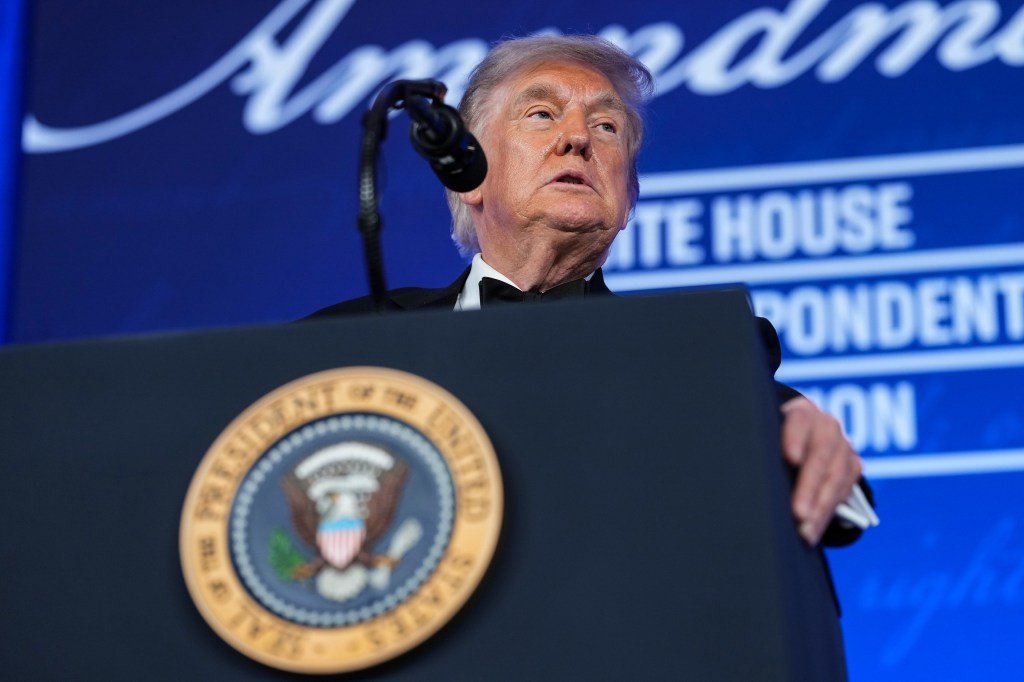
Speaking at the rescheduled White House Correspondents’ Association Dinner on Friday, Donald Trump delivered an hour-long speech blending shopworn rally material with a string of leaden one-liners.
He was making his first appearance as president at the dinner, which had to be rescheduled last Aprtil after a shooter attempted to rush the ballroom and was subdued by the Secret Service. While presidents for decades have long used the event’s keynote slot to zing reporters to varying degrees, Trump lapsed into rally mode, only deviating for some personal broadsides at members of the press, marbled with references to their appearance.
After one quip about an elderly U.S. senator’s sex life drew crickets, Trump asked, “Does anybody get that? I thought that was actually great. That was actually the only thing I thought was good in this whole frickin’ stupid speech. It was the only good one, and that went down with not exactly great laughter.”
Over the rest of the meandering speech (watch the whole thing below), Trump seemed to recognize that many of his would-be jokes were not landing. There were few laughs or reactions at all beyond squirming or fidgeting as he veered in stream-of-consciousness fashion from topic to topic.
“Tonight’s event is even crazier than the last time,” Trump said. “It’s so successful that I’ve been informed by CBS News’ David Ellison” (Ellison is CEO of CBS parent Paramount) that “next year, they’re going to call it the Trump White House Correspondents’ Dinner.” Changing the name, he added, “is the only way you’re going to get me back here.”
The hour-long speech tested the patience of all but the fiercest Trump loyalists in attendance. The audience only sporadically showed a notable reaction, with long periods of near-silence prevailing. Once Trump’s remarks concluded and mentalist Oz Pearlman took the stage, a number of guests streamed toward the exits.
Compared with April’s event at the Hilton, the ballroom at the Waldorf-Astoria is much smaller. Trump cabinet members mingled with reporters in an aisle near one of Paramount’s tables. Chief Legal Officer Makan Delrahim was at the dinner just a couple of hours after the decision to push back the company’s planned merger with Warner Bros. Discovery amid an antitrust challenge. At a Paramount table with Delrahim were cabinet members Pete Hegseth and presidential advisor Stephen Miller and his wife Katie Miller. Also at the event: Secretary of Health and Human Services Robert Kennedy Jr. and his wife Cheryl Himes, as well as Commerce Secretary Howard Lutnick, Department of Homeland Security Secretary Markwayne Mullin and Acting Attorney General Todd Blanche, who was at the center of one of Pearlman’s mental feats.
Prior to Trump’s remarks, there were some awkward moments onstage as annual awards were given out, including to some journalists behind investigations of the president. As Wall Street Journal reporters accepted an honor for their Jeffrey Epstein story, Trump shook their hands and then threw his hands up in the air and smiled a bit. Wolf Blitzer, who was presenting the award, noted that he sued the WSJ over the story for $20 billion.
Once at the lectern, Trump went after Josh Dawsey, one of the WSJ winners, and CNN host Kaitlan Collins with highly personal digs, but the room fell nearly silent as the would-be laugh lines were delivered. Weijia Jiang, outgoing president of the White House Correspondents’ Association, was stone-faced as Trump went into the would-be-roast-like digressions.
CNN even released a statement during the speech, defending its journalists.
The president appeared to have a set of prepared jokes, but he frequently veered off script, or their subjects seemed to remind him of an aside. The result was a speech that weaved through familiar political attacks, like on Adam Schiff’s appearance, to an extended riff on his plans for a White House ballroom. At one point, he pointed to details on the chandeliers at the Waldorf Astoria venue, which he built and previously operated as a Trump hotel. Some of his biting insults at the press were perhaps more muted than they otherwise would have been, given the sheer length of the speech and the topics covered.
When Pearlman took the stage, he noted that Trump had made “an announcement that he will attending next year’s event. I thought he was going to speaking until next year, actually.”
Trump had been scheduled to speak at the April dinner, but it was interrupted and then ended after a gunman breached a security barricade. The incident took place just outside the Washington Hilton ballroom, but shots could be heard among dinner guests. That sent the Secret Service scrambling to remove Trump and Vice President JD Vance from the dais, as well as other guests seated in the ballroom.
RELATED: Behind The Scenes As C-SPAN’s Team Captured The Chaotic, Harrowing Night Of The White House Correspondents’ Dinner
Trump urged the White House Correspondents’ Association to reschedule, but the new arrangements were for a new venue at the Waldorf, formerly a Trump hotel, and with a new set of security measures in place.
But just as in April, there has been attention on the WHCA and what would be said during the evening, not just by Trump but by other journalists. In addition to a flurry of lawsuits against media outlets and routine rants about the news media, Trump has threatened to pull network broadcast licenses and his Justice Department has subpoenaed reporters to try to obtain their sources. In the latter case, the DOJ this week withdrew subpoenas issued to New York Times reporters who wrote pieces on the lack of security features on the new Air Force One. That followed a court hearing in which a federal judge criticized government attorneys for the way that the subpoenas were issued.
The president skipped the WHCA dinners last year and during his first term, at times holding counter events. But he agreed to attend this year, putting him front and center at an event celebrating some of the journalists he has attacked. Among those receiving awards were reporters for The Wall Street Journal who reported on a bawdy letter with Trump’s signature sent to Jeffrey Epstein. Trump denied he sent the letter, and sued the publication, along with its publisher and Rupert Murdoch.