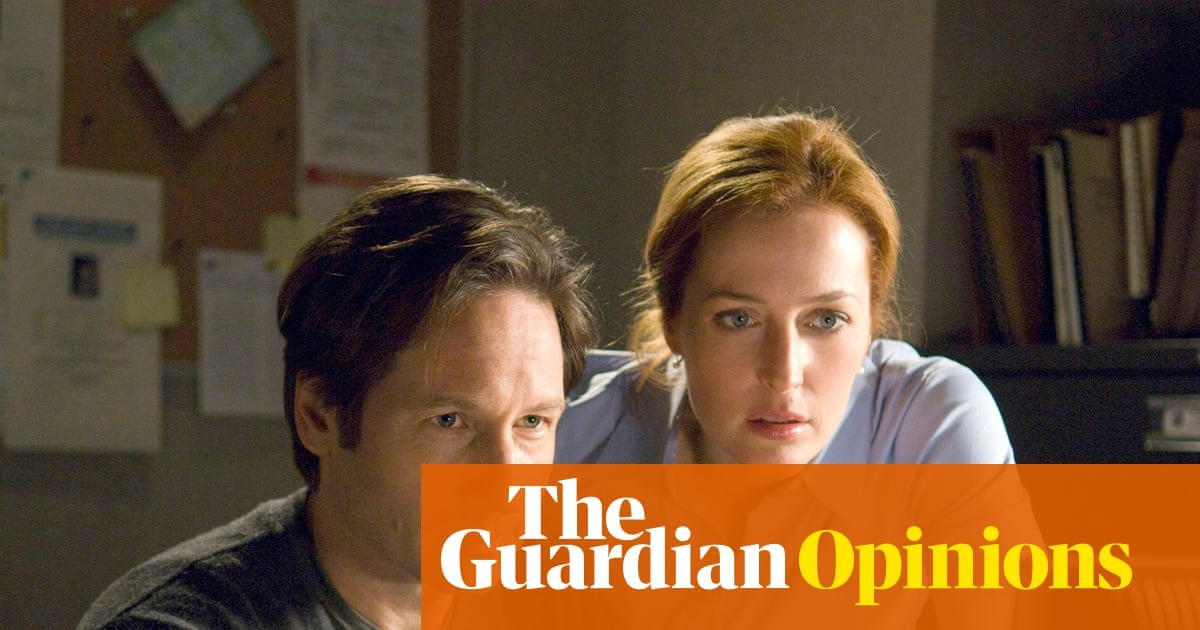
Everyone loves a director’s cut. But unlike some, The X-Files: I Want to Believe – Vrach Frankenshteyn, which debuted on Friday on Disney+, is not the kind of director’s cut that will radically alter critical perspectives on the original 2008 film. Much has been made, mainly by director and X-Files creator Chris Carter, of the new version’s grisly additions. But there is still so much about this movie that is underwritten, preposterous and lacking in basic dramatic intrigue that upping its body horror quotient merely makes the same old problems slightly more unpleasant to look at. Perhaps unsurprisingly, this new version is hidden away behind the “Extras” tab for the original film.
For those who have sensibly forgotten, I Want to Believe reunites Mulder (David Duchovny) and Scully (Gillian Anderson) several years after their departure from the FBI, when a female agent disappears and the bureau’s only lead comes from a disgraced former Catholic priest (Billy Connolly) who claims to be receiving psychic visions. So far, so X-Files. The priest, Father Joe, is a convicted paedophile who abused dozens of altar boys, which gives Scully some fairly understandable reservations about accepting his apparent supernatural gifts at face value.
What follows initially resembles a particularly wintry serial killer thriller. Women are being abducted, severed body parts are turning up in the snow and a collection of sinister eastern European types appear to be involved in some sort of illegal medical enterprise. Eventually we discover that the truth is considerably stranger: one of Father Joe’s former victims, Franz Tomczeszyn, is dying of cancer, and his husband, Janke Dacyshyn, has been kidnapping women so that a team of surgeons (it is never explained why they are Russian and Czech) can remove Franz’s head and attach it to their bodies.
Written down, this sounds magnificent, like David Cronenberg on weird steroids. A psychic paedophile priest is supernaturally connected to one of the children he abused, who is now having his head repeatedly sewn on to the bodies of murdered women by a gang of underground Slavic medics. Yet Carter contrives to turn it into a rather dreary procedural in which Mulder spends an awful lot of time following vehicles around in the snow while Scully, now a doctor, spends the whole film battling the Catholic hospital where she works for permission to perform an experimental stem-cell treatment on a terminally ill boy. We don’t get to the seriously gory stuff until the last 20 minutes.
The problem isn’t simply that the plot is preposterous: this is, after all, the X-Files. It’s that the film appears almost completely uninterested in who its villains actually are. Dacyshyn is murdering innocent women in order to save the man he loves, while Tomczeszyn is being kept alive by having his head attached to the body of kidnapped strangers. These are not minor character details – they are the sort of circumstances around which entire gothic novels could reasonably be constructed. Does Tomczeszyn know the women are being murdered? Does he care? How has Dacyshyn persuaded himself that keeping his husband alive justifies butchering innocent people, and why do the replacement bodies all belong to women? Is it a highly objectionable kink – because Tomczeszyn and Dacyshyn are gay? Or is it just easier to kidnap women than men?
There’s no way to know because we are told almost nothing about either of them. Mary Shelley’s Frankenstein transfixes the reader in a trance of hideous fascination because the author gives the creature an inner life: we hear his story, understand his loneliness and rage, and watch him reason his way towards monstrosity. I Want to Believe is momentarily intrigued by the grisly business of attaching a man’s head to a woman’s body, but has no interest at all in putting us inside that tortured noggin.
If this were a Jason-style slasher movie, it might not matter, but Carter’s film balances on the somewhat uncomfortable tightrope between gothic thriller and crime procedural, which means we instinctively want to know what’s going on behind the horror. Dacyshyn and Tomczeszyn aren’t unknowable forces of nature who turn up periodically to wave a machete at teenagers. Tragedy, obsession and moral depravity are all right there, ready to be explored, yet Carter barely gives either man enough dialogue to establish a personality. The new cut can’t fix this. Carter can restore more explicit shots of severed limbs, bloody operating tables and the distinctly unpleasant sight of Tomczeszyn’s head attached to a body that used to belong to somebody else. But the lights are off and nobody’s home.
At least one thing about the director’s cut makes sense: the new title Vrach Frankenshteyn – Russian for “Dr Frankenstein” – is almost perversely appropriate. Eighteen years on, Carter has gone back to his creation, stitched some old pieces back on, hacked some others away and attempted to bring the whole thing back to life. Unfortunately, the problem was never that the movie needed more body parts.