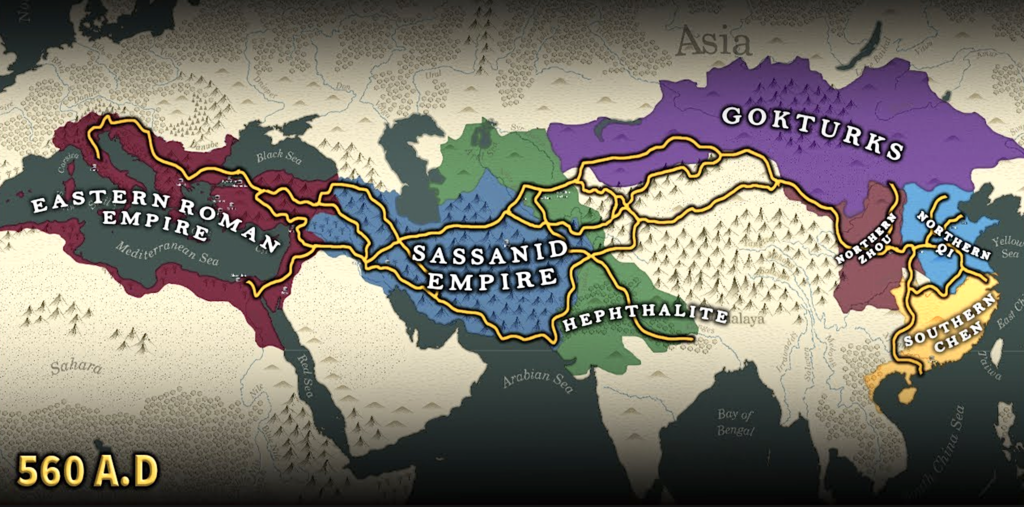
You don’t have to spend a long time reading up on the Silk Road before you see the term itself (“Silk Road”) called a misnomer. In fact, what we refer to by that name comprises a whole network of trade routes connecting Asia, Africa, and Europe, whose traffic constantly shifted over a millennium and a half according to climatic, geopolitical, and civilizational conditions. Nor was silk the only, or even the primary type of good carried along those routes. From East to West went tea, dyes, perfumes, porcelain, and paper; from West to East, glassware, horses, camels, honey, wine, and gold, to name just a few items in perennial demand. It was along the Silk Road, or Silk-and-Many-Other-Things-Roads, that gunpowder spread out of China — and the Black Death spread out of Europe.
According to the Knowledgia video above, the roughly 4,000-mile-long Silk Road was officially opened in 130 BC. But it wasn’t without its predecessors: in 500 BC, for example, the “Royal Road” established by Darius I’s Achaemenid Empire “stretched from Susa, which lies in modern-day Iran, all the way, nearly 2,000 miles to the west, to Sardis, which is today a part of Turkey,” with spurs reaching India and Northern Africa.
Whatever its economic impact, the Royal Road had nothing like the cultural effects of the Silk Road, any history of which emphasizes the “new thinking and new ways of life being passed along the network of trade routes,” to say nothing of “the spread of religions or ideologies that would occur thanks to the merchants and travelers themselves.”
This despite the fact that few of those merchants or travelers crossed the Silk Road’s entire length. But we can all name at least one man who made the full journey: the thirteenth-century Venetian explorer Marco Polo, who as a teenager first made the trek to Kublai Khan’s pleasure dome with his father. (At that point, the Mongol Empire had already unified its routes, but not before laying waste to a fair few settlements along the way.) It is to Polo’s writings that we owe our enduringly romantic image of the Silk Road, but he understood the dangers of that lawless gauntlet across empires as well as anyone. The Urban Atlas video above lists a few of them, including desert heat, diseases, hallucinations, banditry, and slavery. Today, we encounter no such perils on the way from Rome to Xi’an, a journey we can make on a flight with a stopover in Beijing. Perhaps Marco Polo would say we’ve all gone soft, but then, he’d probably be more interested in learning about our roads in the sky.
Related content:
The Ingenious Engineering of Silk: How the 2,000-Year-Old Pattern Loom Powered the Silk Road and the Wealth of Ancient China
Behold an Incredibly Detailed, Handmade Map Of Medieval Trade Routes
Invisible Cities Illustrated: Artist Illustrates Each and Every City in Italo Calvino’s Classic Novel
The Most Distant Places Visited by the Romans: Africa, Scandinavia, China, India, Arabia & Other Far-Flung Lands
How a Volcanic Eruption Helped Unleash the Black Death in Europe in 1347
Based in Seoul, Colin Marshall writes and broadcasts on cities, language, and culture. He’s the author of the newsletter Books on Cities as well as the books 한국 요약 금지 (No Summarizing Korea) and Korean Newtro. Follow him on the social network formerly known as Twitter at @colinmarshall.