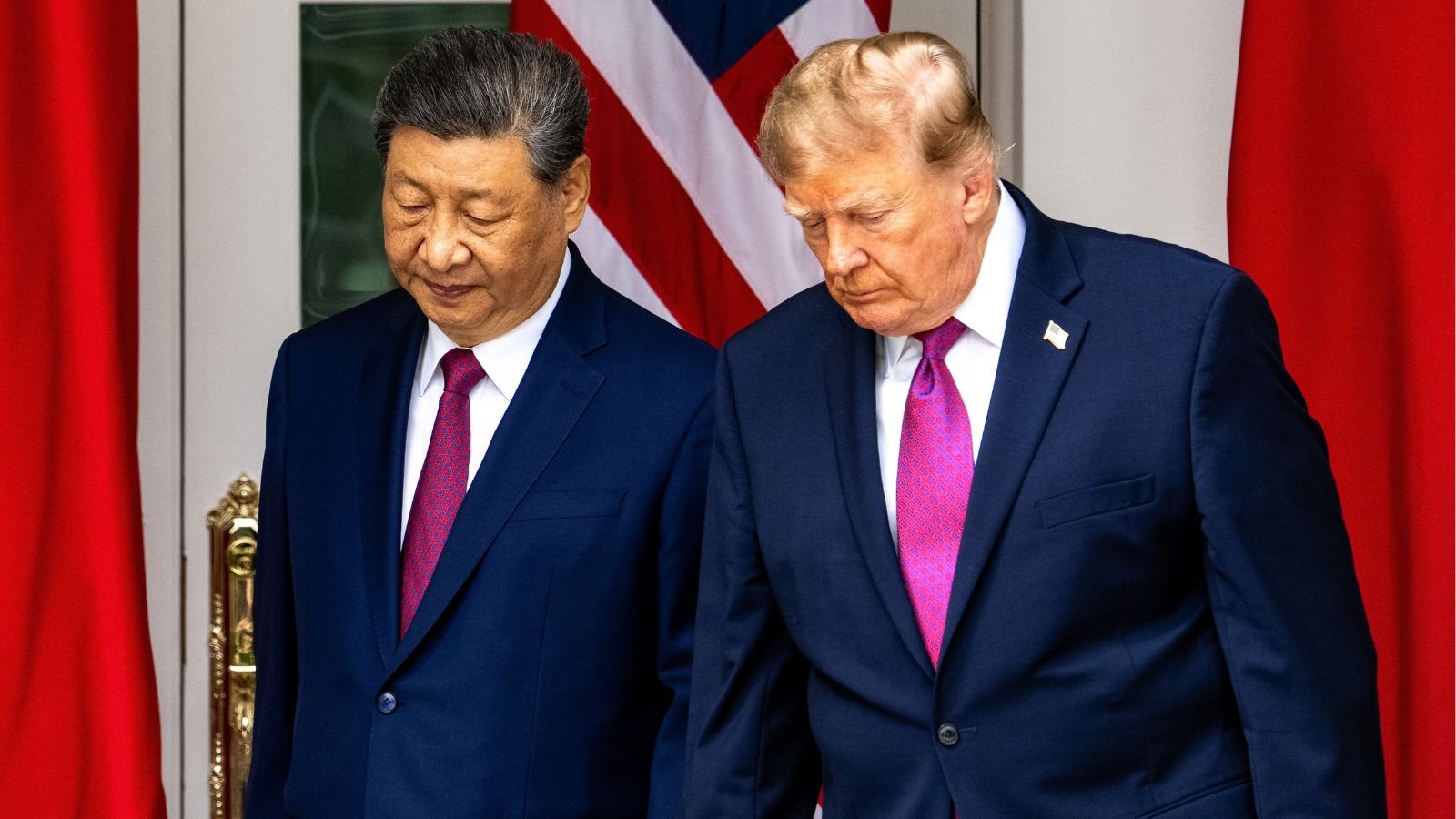
Xi Jinping US visit: President Donald Trump, right, and China’s President Xi Jinping arrive to watch a military review in the Rose Garden of the White House. (Photo: AP)
United States President Donald Trump and Chinese President Xi Jinping held high-stakes talks at the White House on Thursday, seeking to ease tensions between the world’s two largest economies. The talks came amid disagreements over Iran, Taiwan, artificial intelligence and trade.
Xi opened the summit by warning against what he called the “Thucydides Trap”, a term used in international-relations scholarship to describe the risk of conflict between a rising power and an established one. He called for dialogue and cooperation to prevent competition between Washington and Beijing from escalating into confrontation.
The meeting, marked by lavish ceremony, including a state dinner attended by top tech executives, produced warm rhetoric from both leaders but few concrete breakthroughs on the substantive issues dividing Washington and Beijing.
President Donald Trump shakes hands with China’s President Xi Jinping in the East Room of the White House during a State Dinner. (Photo: AP)
Did the two leaders agree to avoid military conflict?
According to China’s state news agency Xinhua, Xi said Beijing supported the US and Iran returning to the interim agreement reached in June, which was intended to halt the war and reopen the Strait of Hormuz. No breakthrough on the issue was reported from the Trump-Xi talks.
He said the two countries’ militaries should maintain regular contact and improve crisis-communication mechanisms to prevent conflict from breaking out.
Story continues below this ad
Trump, for his part, spoke warmly of the relationship, describing a friendship with Xi built on mutual respect, though he offered few specifics on what had actually been agreed.
Iran and the Hormuz sore point
- Trump pressed Xi to back the US efforts to isolate Iran economically and help reopen the Strait of Hormuz, which has remained shut since fighting escalated in February.
- China, Iran’s largest trading partner, was reportedly reluctant to commit to any firm action.
- Xi said he backed a return to the interim US-Iran agreement that collapsed shortly after being announced in June, though no breakthrough was reported.
Taiwan flashpoint
Taiwan remained a central flashpoint. Chinese state media reported that Xi urged Trump to oppose Taiwanese independence and handle the issue with caution, though the White House had not issued its own account of the discussion.
Taiwan’s presidential office spokesperson Karen Kuo said it was standard practice for Lai to take interviews and explain the government’s stance to the world. (File Photo)
Trump previously described arms sales to Taiwan as a useful bargaining chip with Beijing, a stance that has drawn criticism from US lawmakers who view military support for Taipei as a firm commitment rather than a point of leverage.
How did US lawmakers react to the visit?
Reaction on Capitol Hill was mixed:
Story continues below this ad
- Republican Senator Roger Wicker criticised the scale of the welcome given to Xi, citing unresolved tensions with Beijing.
- Democratic Senator Chris Van Hollen argued Trump was mistaken in believing warmth toward authoritarian leaders would work in his favour.
- Republican Senator Rand Paul welcomed the dialogue, saying engagement was preferable to conflict.
The two sides extended a tariff truce originally agreed last year, pushing its expiry from November to February. Analysts believe Washington is holding out for better concessions from Beijing ahead of a possible follow-up meeting at the G20 summit in Miami in December. Despite the ongoing trade war, Chinese imports into the US have continued to rise, putting China on course for a second consecutive year of a $1tn trade surplus with America.