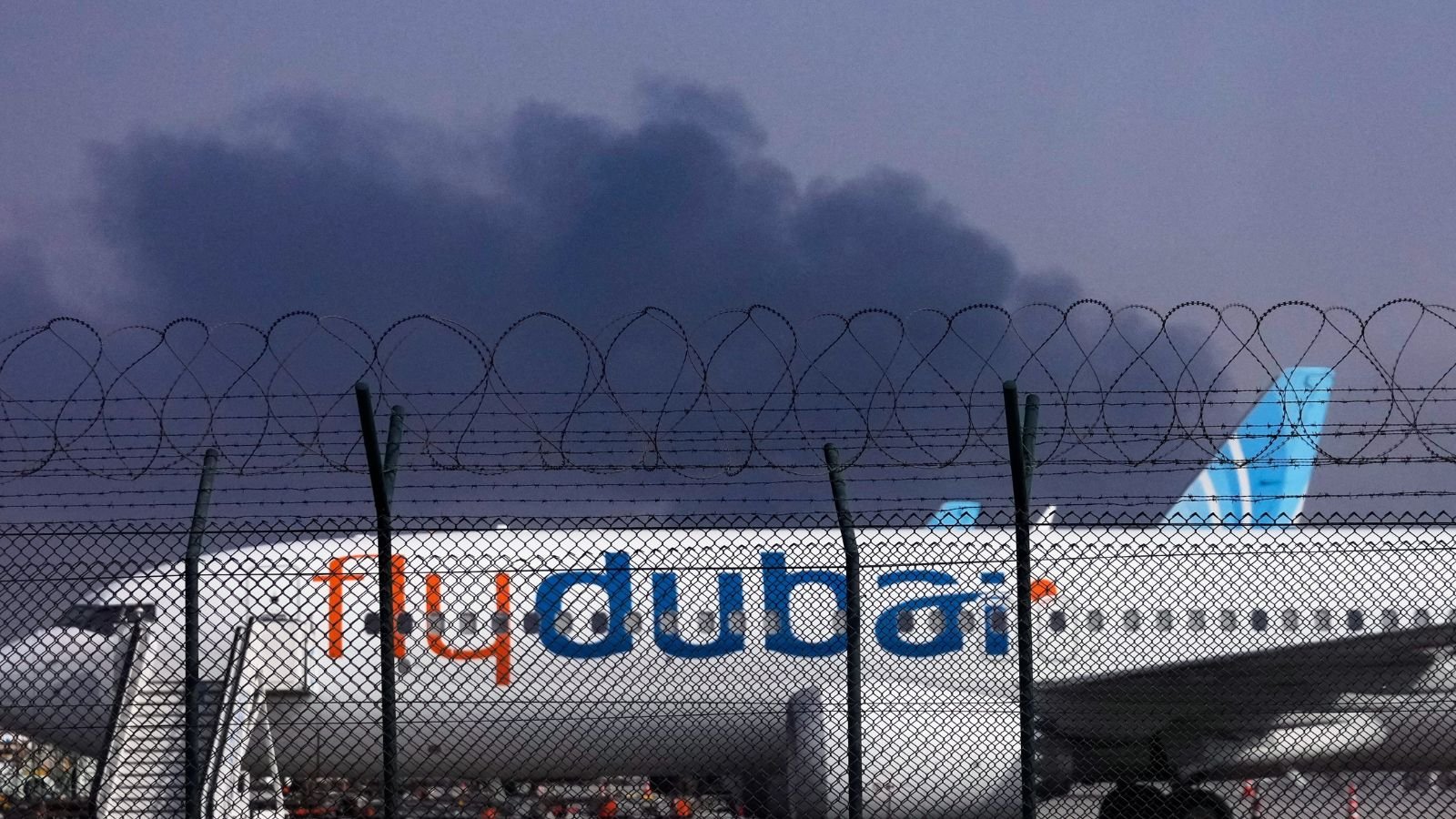
It started as a routine morning flight.
At 3.05 am UTC (8.35 am IST) Smit Machchhar, the pilot in command of a Boeing 737 MAX 8 registered to flydubai, departed DXB, Dubai International Airport. The destination was Tel Aviv.
The next three-four hours, though, were anything but routine.
The pilot and co-pilot would have a violent (and bloody) fight, the plane would go through a terrifying loss of altitude, and speculation of a hijack would trigger an Israeli military response.
Eventually flydubai FZ1073 landed safely in Saudi Arabia’s Tabuk, and the 170-odd passengers were flown home in another plane.
Machchhar and his Omani co-pilot – the man who reports claim was trying to seize control of the plane to crash it – have been hospitalized in Tabuk. And Machchhar has been hailed as a hero. And Israeli leaders have denounced an apparent terror attack, though the airline has (understandably) been more restrained.
What is confirmed
At 5.21 UTC the plane lost altitude; Al Jazeera says flydubai FZ1073 fell over 14,000 feet in under 30 seconds, while CNN’s window puts the loss at over 17,400 feet in under two minutes.
Al Jazeera says the plane squawked 7700 – ‘general emergency’ – at 5.31 UTC. Seven minutes later it was squawking 7500 – ‘hijack’.
Squawk 7500 is a red flag.
Story continues below this ad
What happens when a plane squawks 7500
First, ATCs establish contact with the squawking plane. They let the pilot know their distress call has been heard and that help is on the way. Communication is switched to a secure frequency.
Second, airspace around the hijacked aircraft is isolated, i.e., it gets complete and absolute priority over all other aircraft. This involves multiple ATCs working together to keep other planes out of the flight path and the plane away from populated areas.
And third, military interception. In this case, for example, Israeli fighter jets were reportedly scrambled to fly alongside. Crucially, in a post 9/11-world, most militaries are authorised to use deadly force if a hijacked aircraft ignores comms and/or commands and moves towards a city or populated area.
That said, there is no recorded instance in which lethal force has been employed.
Story continues below this ad
Once phases 1, 2, and 3 are active, ground control tries to negotiate a peaceful end to the situation, which could involve the plane landing at a designated airport, where the plane will isolated.
But an unspecified number of minutes later the squawk changed back to 7700.
What happened in those minutes?
flydubai says there was an altercation in the cockpit.
That lines up with passengers’ accounts and available mobile phone footage – alarm and chaos, and passengers rushing to the cockpit, followed by images of Machchhar lying, bloodied, on the floor and visuals of another passenger with a wound on his head.
Story continues below this ad
Three labels, three different claims
A stabbing. This is the best-supported description.
Israeli officials, passengers, and the footage point to this and reporting, including Al Jazeera’s, describes the attack on the captain, Smit Machchhar.
A hijack bid.
The 7500 squawk shows that someone signalled ‘unlawful interference’. Was it Machchhar? That has not been established yet. But a transponder code is a signal, not a finding.
A terror attack.
Israel’s defence minister, Israel Katz, called it an ‘attempted jihadist terrorist attack’, and Prime Minister Benjamin Netanyahu said the pilot tried to crash the plane with everyone aboard. The Israeli leader also said it is too early to comment on Iran links.
Story continues below this ad
flydubai has not confirmed this. The airline says motives remain unknown at this time.
The cockpit?
One confusing element of the reportage focuses on the cockpit doors – that a passenger kicked the door in and saved the plane. That is unlikely.
Modern cockpit doors are built to keep threats in the cabin away from the pilots, and cannot be easily broken down. So any theory that suggests that is suspect, at best.
An Israeli government spokesperson told Reuters the injured pilot Machchhar – lying bloodied on the floor, hit the cockpit door release – and that this was how pax and a crew member entered.
Story continues below this ad
One of the passengers – Yaniv Hayoun, whom Netanyahu later met and called a “lion” – told the Israeli leader he put the co-pilot in a chokehold and dragged him out of the cockpit, and then grabbed the plane’s controls to help bring it back under control.
Another passenger, a Dr Shota Musaev, a dentist, told CNN he tied the attacker up using headphone cords and plastic zip ties. He then started tending to the wounded pilot.
Multiple media outlets have picked up on this event.
Relief pilots?
Israeli officials say a second set of pilots were on the flight; that they were scheduled to replace the original crew. After the co-pilot was subdued, they reportedly took control and landed the plane in Tabuk. Now this is consistent with flydubai’s wording about on-duty crew travelling on the flight.
Story continues below this ad
But David Soucie, a CNN aviation safety analyst, told the US news website it is ‘fairly uncommon for additional on-duty pilots to be on flights, unless they are being repositioned for other flights’.
What happens next
On Thursday afternoon it was confirmed that the UAE, where the airline is based, will lead the investigation, ending uncertainty over whether Saudi Arabia (where the aircraft landed) or Israel (its destination) would take charge.
Israel is meanwhile weighing its own response.
The transport minister has asked security services to review whether flydubai should be allowed to keep flying to Israel. And a Netanyahu spokesman also told Reuters that Israel will tighten identity and security checks on every pilot flying into the country, including those working for foreign airlines.
For now, the confirmed picture is a violent fight in the cockpit, a steep dive, and a safe landing, with an Indian captain at the centre of the rescue. Why it happened is still an open question, and one the UAE-led probe will now have to answer.