In 2021, Georgian filmmaker Alexandre Koberidze brought us “What Do We See When We Look at the Sky?,” a formally playful, enchanting ode to love and chance encounters that found considerable magic in the mundane. That film opens with a case of love at first sight for a man and woman in the Georgian city of Kutaisi, but a wicked spell is cast on the two young people ahead of their scheduled first date: their physical appearance and voices change to be completely unrecognizable. Lacking contact details and unaware that the other person has undergone the same mysterious transformation overnight, both parties show up to the location of their arranged date but do not recognize one another. While that predicament gets the very loosely-plotted movie in motion, Koberidze goes on various compelling tangents in his two-and-half hour build-up to his shape-shifting leads getting another shot at a love story.
More than a magical realist romance, “What Do We See When We Look at the Sky?” was a quite touching and certainly beautiful-looking tribute to the magic of people coming together in public spaces. Koberidze’s follow-up feature, “Dry Leaf,” is ostensibly more of the same on that front (also repeating the heavy use of a storyteller-narrator), though with a greater focus on rural living and the natural world, rather than the modest incidents and encounters mostly taking place in a city. The major differences between the two are a thirty-minute upping of the runtime to a full three hours and a considerably muddier visual aesthetic.
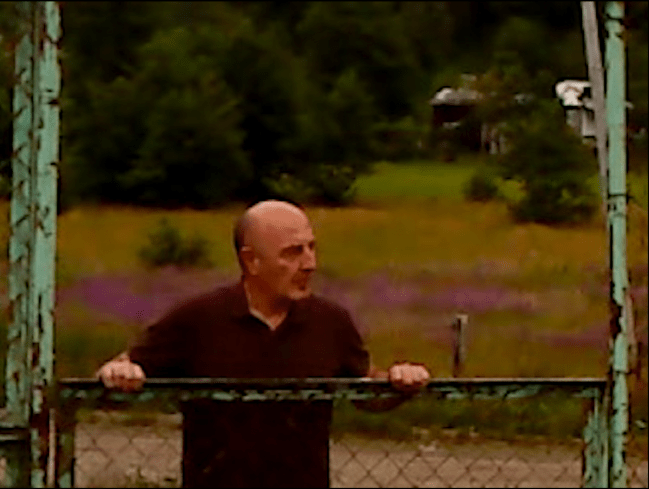
Although it was his international breakthrough, “What Do We See When We Look at the Sky?,” shot on 16mm, was not Koberidze’s first feature, and “Dry Leaf” is much closer in look to his actual debut feature, 2017’s “Let the Summer Never Come Again.” Running a breezy 202 minutes, the feature was filmed via the camera of a Sony Ericsson W595, a model of phone that debuted back in 2008. Made even further away from that product’s heyday, “Dry Leaf” was also filmed entirely on a Sony Ericsson phone.
While a wildly different movie tonally and scale-wise, it’s interesting that “Dry Leaf” is debuting to the world just a few months after the release of Danny Boyle’s horror blockbuster “28 Years Later,” a movie largely shot on more modern models of iPhones, where much of its acclaim concerned the purposefully strange sheen to its cinematography, including specific quirks you don’t get with modern digital cameras used for movies, nor when shooting on film. Given the age of the equipment used, “Dry Leaf”‘s aesthetic more resembles the early digital video of Boyle’s “28 Days Later” from 2002, though somehow manages to look even more like it was shot on a potato (complimentary) thanks to the phone’s video files involving very lossy compression and thus even chunkier artifacts of digital compression in the footage. In the daytime scenes, you can barely make out the natural lines separating bushes from grass; with anything filmed at night, especially if it’s capturing movement, you might feel like you need your eyes tested.
For a time, it’s quite a riveting experience to watch such smartly framed compositions with increasingly obliterated colors for anything that’s shot from far away. When people or animals move, the clumps of compression make them look like painted figures come to life. It really is rather beautiful in its own murky, pixelated way. But the sensory appeal of the technical limitations only lasts for so long. And as a feature, “Dry Leaf” does feel oh so long once there soon proves to be little variety to the bag of visual tricks over three hours.
Like its direct predecessor, “Dry Leaf” is light on plot but driven by a magical realist conceit in its setup. When a sports photographer named Lisa goes missing, the last known detail of her whereabouts is that she’d been photographing rural football stadiums across Georgia. Her father, Irakli (David Koberidze), sets out across the country to search for her with the aid of Lisa’s best friend, Levani (Otar Nijaradze), who has some memories of the spots Lisa had visited. The catch: Levani is invisible. As are a few other people that Irakli encounters on his road trip through quiet villages and countryside.
With a few exceptions (such as Levani’s introduction and the pair’s initial departure on their trip), many sequences involving Irakli are staged as though they could plausibly have been shot before Alexandre Koberidze fully decided on the invisible people angle at all, like he might have added in ADR after the fact to footage of David Koberidze where he’s rarely up close to the camera and usually wandering wide-open spaces where the only other (barely) tangible beings in the shot are other species. One of the film’s successful magic tricks is that you do buy into the presence of Levani — and the other invisible speakers — pretty quickly. As in “What Do We See When We Look at the Sky?,” part of that swift convincing is down to the relaxing and reassuring voice of the narrator, but a fair bit is also attributable to the body language of David Koberidze as Irakli, who manages to get across subtleties in his movements while mostly shot at a far distance and through so much digital noise in every frame that he’s in.
It’s not entirely clear if it’s a Great Gazoo situation where only Irakli and Lisa’s family can see the invisible people. Either way, clues to Lisa’s whereabouts prove just as obscure. But the mystery itself is not of pressing concern, even when the lead is the father of the missing person. How it’s eventually resolved is as an abrupt afterthought. You might view the resolution – narrative, not visual – as being a reflection on that idea of how it’s the journey, not the destination, that matters; something bolstered by one of the last few lines of the film being a character musing on how wonderful it is that roads exist because they can take us places. But like a road trip where you get held up in the same stretch of land for a long time (via a breakdown, traffic, whatever reason), even the most mesmerizing, strange sights lose their intrigue if little to no variation in the scenery is reaching your eyes.
Grade: C+
“Dry Leaf” premiered at the 2025 Locarno International Film Festival. It is currently seeking U.S. distribution.
Want to stay up to date on IndieWire’s film reviews and critical thoughts? Subscribe here to our newly launched newsletter, In Review by David Ehrlich, in which our Chief Film Critic and Head Reviews Editor rounds up the best new reviews and streaming picks along with some exclusive musings — all only available to subscribers.