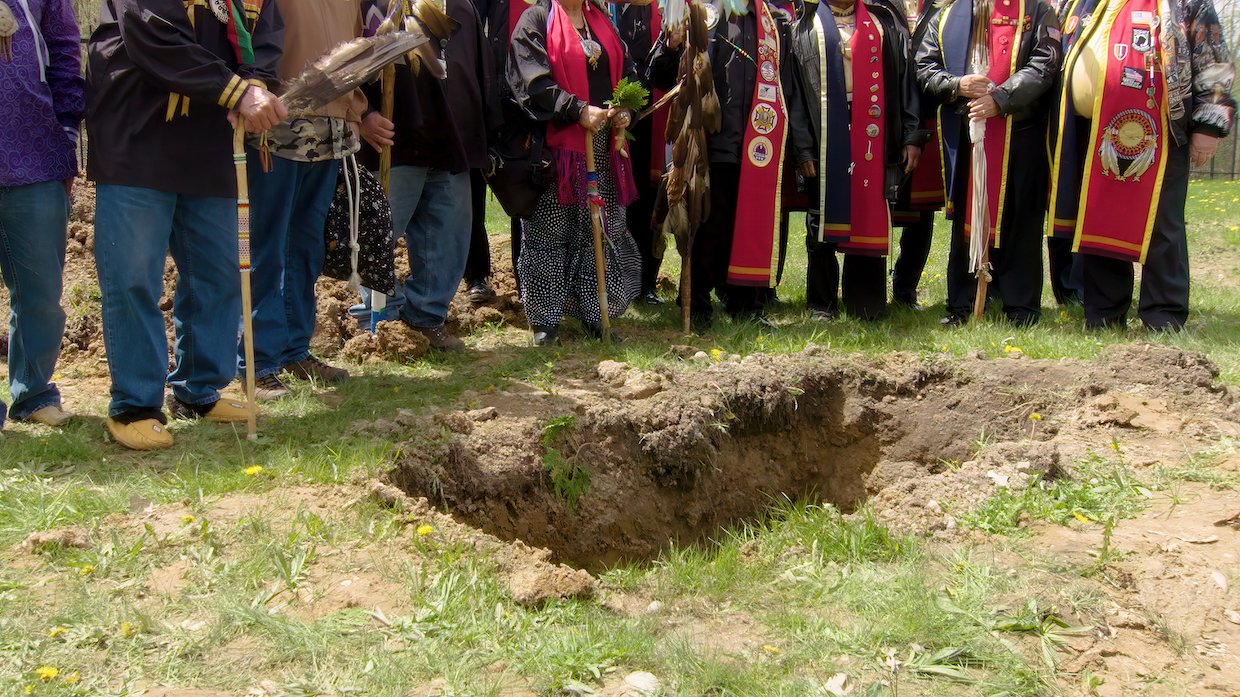
Aanikoobijigan [ancestor/great-grandparent/great-grandchild], courtesy of Sundance Institute
In 1990, a federal law was passed requiring the return of Indigenous human remains and sacred items to their rightful communities. More than three decades later, most of those ancestors are still waiting—boxed, catalogued, and stored in museum basements and university archives. In Aanikoobijigan, filmmakers Adam and Zack Khalil turn their attention to that unfinished work, following the long, often painful effort to bring ancestors home for proper burial. The film centers on a group of tribal specialists in Michigan who carry out this work day to day, navigating institutions built to hold on to what was never theirs.
For the Khalil brothers—Ojibwe filmmakers from Sault Ste. Marie—this project marks a shift. Best known for their work with the collective New Red Order, whose installations and short films often lean toward the conceptual, they recognized that Aanikoobijigan needed to serve a different purpose. They set out to make a film that could live in classrooms and museums as well as festivals: one that shows, in clear terms, what repatriation actually looks like, without flattening its emotional weight or historical violence. In the process, the film also asks hard questions about the documentary form itself, and about the institutions that claim to preserve history while continuing to cause harm.
That approach has resonated. Aanikoobijigan won the Audience Award at the Sundance Film Festival, where it premiered in the NEXT section. I spoke with Adam and Zack just before the announcement.
Filmmaker: Tell me about the origins of the doc, which you’ve been working on for eight years.
Adam Khalil: Our mom was deeply involved with repatriation work and also ran youth education activities for the Sioux Tribe. There was an elder in our community, Cecil Pavlat, one of the founders of MACPRA [the Michigan Anishinaabek Cultural Preservation and Repatriation Alliance], who was also a mentor and cultural knowledge-keeper. Colleen Rose Medicine, who’s in the movie as our tribe’s repatriation specialist, was a childhood friend. Cecil took Colleen under her wing and passed her the baton when he retired.
In 2013, I had been in New York for a few years when Colleen called me out of the blue, saying she was with another tribal elder, driving from Michigan to the American Museum of Natural History. They were 10 hours away and asked for our help. I was like, “Help doing what?” I realized this was it—we were actually going to be repatriating. Zack and I had always understood what repatriation work entailed, but this was the first time we were in it ourselves: the stilted, awkward encounters with the institutions and the people representing them. “Here’s your swag bag, an AMNH t-shirt, and oh, by the way, here’s the contract to sign over the property.” Then came the surreal, almost absurd part—pushing a plastic cart beneath towering dinosaur skeletons, fifty Ancestors packed in multiple boxes, and loading them into the back of a yellow cab.
Filmmaker: It sounds like that was a very fateful day.
Zack Khalil: The decision to focus on this film grew out of the experience of getting INAATE/SE, our first film, out into the world and realizing that a large part of our audience was in museums and universities. We were able to share the film with tribal communities in a meaningful way, which was incredibly rewarding. But reaching this broader, institutional audience was more bittersweet. At times, it felt like we were giving something up about our culture without getting much back. This work is still such an uphill battle for tribal repatriation specialists because the broader public doesn’t know our Ancestors are still in these institutions.
Filmmaker: Did that sense of the museum-as-an-audience also inform the film’s structure or visual language? It’s more straightforward than some of your shorter, more experimental work.
Adam Khalil: Definitely. Especially when considering our work with New Red Order, which is much more irreverent and ironic. There was a kind of burden attached to this film. Burden is too strong a word—but a sense of duty, maybe. Our work has also, in some ways, drifted pretty far from our community, even though it’s still grounded there. We saw this film as an opportunity to give something back—to the people who helped raise us and shaped us into the critical thinkers we are—and to do it in a way that might have some real utility.
With INAATE/SE, there was a lot of raw, punk rage and grief we were moving through at the time—a strong desire to claim an Indigenous presence that was more complex than simply saying, “We’re still here.” But there’s also a real necessity to share aspects of our culture’s epistemology and philosophy if people are going to understand why repatriation matters. That became our North Star—figuring out what’s ethically important to share so a wider audience can understand that this isn’t just about grave robbing. According to our own epistemologies, one of the most fundamental acts is returning oneself to the earth; to interrupt that process is beyond sacrilege.
Zack Khalil: We decided to own that pedagogical role and find utility in assisting the work of the Travel Repatriation specialists. One of the early supporters was Vision Maker Media, and from the beginning, there was an intention to air nationally on PBS—to reach museums, universities, and the next generation of archaeologists, anthropologists, museum professionals, and patrons. We were thinking about what it means to make a film relationally, from an Anishinaabe perspective. There’s value in sharing information about our culture, worldview, and epistemology—but the question was how to do that formally. How do you convey the trauma of Ancestors who’ve been held in archives for 200 years? What does it mean to imagine the film from the Ancestors’ perspective—unearthed and placed inside these sterile, almost science-fiction environments?
Filmmaker: At the screening I attended, someone mentioned during the Q&A that they wanted to run out of the theater because of the music—how overwhelming it felt at times. I recognized some Tim Hecker and William Basinski, but you also have music from Leila Bordreuil and Lucky Dragons, who are credited on the score.
Adam Khalil: We like music [laughs]. When we were working with Bayley Sweitzer on Empty Metal and Nosferasta, we talked a lot about what we call “Trojan horse filmmaking.” That idea applies here, too—the film can enter the room as a social-issue documentary, and that’s how it gets through the door. But underneath, there are gnarlier, more knotted ideas in terms of how we’re thinking about time, and about cinema as a medium that’s fundamentally built on time. That connects back to INAATE/SE and this ongoing question of how to make an inherently Anishinaabe form of cinema, if we’re thinking about film through a nationalist lens. Music becomes a huge part of that—another way to rewire how time is felt.
Zack Khalil: We’ve been huge fans of Lucky Dragons for decades. We’d incorporated some of their work into New Red Order projects before, but this was the first time we collaborated with them in a truly meaningful way. There’s something distinctive about how they approach electronic music: it’s allowed to sound alien and unnatural, while also leaning into the warm, organic qualities of synthesizers and processed sound. That gets to the heart of the film and this false dichotomy between science and Native people, or technology and nature. I really don’t want people to think of Native people as being anti-science. We have our own sciences and forms of traditional, ecological knowledge. We’re also down with working with your American scientific methods if they involve consent and collaboration.
The film also sets up this visual and auditory opposition between natural landscapes—forests, lakes—and the hermetically sealed, HVAC-controlled, bright-white archival environments. We were trying to imagine what it might feel like from an Ancestor’s perspective to exist in either space, and, from the point of view of a tribal repatriation specialist, what it’s like to move between those worlds over the course of a day. Many of our sound choices focus on the sense of presentness and futurity. Native people are so often just considered through a historical lens, sealed in the past. That’s, of course, what this film is trying to address. The work of Tribal Repatriation Specialists is all about bending space and time, thinking about the past, present, and future collapsing into one.
Filmmaker: How did you first approach MACPRA about making this doc, and how did they respond?
Adam Khalil: Colleen was a junior member of MACPRA, but also had a lot of credibility because of working with Cecil for so many years, and she vouched for us. I think the rest of MACPRA was a little skeptical, to be honest. One of the first things we did was organize a screening of INAATE/SE. There were a lot of blind spots in that film that we hadn’t even considered regarding respect for Ancestors, which they quickly pointed out and even gave us a mild tongue-lashing. That’s when we realized the stakes of this film are a little different.
Zack Khalil: It was a tongue-lashing, but a dialogue too, right?
Adam Khalil: It was a back-and-forth. To Zack’s point, it was about showing up before even taking out a camera to better understand the work they’re doing—and to make clear that we’re not trying to extract or sensationalize. Ground rules were set not to film any ceremonies or reburials. But then, a few years into the process, during one of the meetings, the members asked whether we were sticking around to film the reburial the next week.
Zack Khalil: To be clear, when we approached MACPRA, we weren’t saying, “We’re going to make this movie. Do you wanna be in it?” We’re asking, “Should we make this movie?” If they said no, we wouldn’t have done it.
Filmmaker: You’re both directors, editors, and cinematographers. I’m curious how you guys work together?
Adam Khalil: Especially with this project, there was a real sense of responsibility attached to the film, which made it difficult to know how to dial things in. We were drawn to different poles on different issues, or different modes of being, and there was a fear that the film would become saccharine, overly Hallmark, or overly social-issue-y. The inverse fear was something too expressionistic at the expense of the story. Other tensions kept surfacing, too: the desire to make something fully accessible or to embrace verité—something we’ve always resisted —and the challenge of riding the line between all those impulses. Working through that together helped us balance and calibrate the film. If either of us had tried to make this alone, we would’ve drifted too far in one direction or another.
Filmmaker: Was there a certain moment you guys butted heads creatively, or that you felt strongly towards one thing versus another?
Adam Khalil: We were at a stalemate, working on things remotely, on so many things, until Zack came out to Copenhagen. We both got the flu and holed up in my studio. Something happened during those days when things finally fell into place. We needed to land the scene when we revealed that the Ancestors were held underneath the stadium at Michigan State University. We’d been having real knockdown, drag-out fights about the music there. Either it felt too corny, or it wasn’t carrying enough weight. After months of going back and forth, I can’t remember who finally said it, but we decided to turn the music off entirely. When we watched it back, it was perfect.
Filmmaker: Can you talk about working with your cinematographers? There was a long list there including familiar names like Sky Hopinka and Bayley, who you’ve mentioned and worked with before.
Adam Khalil: Because the process took so long, there were so many shoots. It was a lot of filling in gaps regarding people’s availability for different shoots. Oresti Tsonopoulos and Samuli Haavisto have been longtime collaborators and came in for a few pickup shoots. It was super meaningful to have Sky and Shaandin Tome, who’s an amazing Native filmmaker and cinematographer, work on the film. Both of them shot separate reburials, one with me and one with Zack. That experience was especially powerful because we all come from different tribal nations. Having them welcomed into our community and our community recognizing that they arrived with an inherent reverence and respect for what they were being invited into meant a lot. There wasn’t a need to explain the gravity of the situation, which is rare, because cinematographers can sometimes be a little obnoxious.
A lot of the time, we had to show up as people first and filmmakers second. There was a moment when a tribal elder, George—who appears in the film—asked me to go down into the burial pit to help place the Ancestors. He said, “Come here. You have to help us now—forget your stupid movie.” And Shaandii immediately set her camera on the tripod, took mine, and just kept filming. There’s a fluidity to the process—keeping things loose enough that everyone understands what we’re trying to do.
Zack Khalil: Visually, we had a shared language for the film—leaning into lens distortion, using very wide and very long lenses, letting the seams show. But we also trusted each cinematographer to be fully present in the moment and to document it in the way that felt right to them, following their own intuition. I also want to highlight Jacques Clark, our producer, cinematographer, and sound recordist, who was with us for almost the entire project.
Adam Khalil: There was a kind of band dynamic to the whole process—swapping lenses, cameras, sound gear. Jacques was also a touring musician and owned a minivan, so we were constantly moving from community to community and from museum to museum. There was this sense of interchangeability.
Filmmaker: There’s an image of a floating box with a red cloth, and I was wondering if you could talk about the significance of that.
Adam Khalil: Jacques actually went rogue and shot that on his own, then showed it to us later, so it would be a little disingenuous for me to say definitively what it means. But I do have some ideas. Red is traditionally used for the Ancestors—it carries power and offers protection. It also suggests a transitional moment, the Ancestors moving from these institutional spaces back toward home, existing in a liminal space between worlds. In reality, the box was sitting on a plastic folding table, and you could always see the legs. We worked with an incredible animator, Driftnote, in Toronto, and two days before we burned the DCP, we asked if they could remove the legs. A bit of a last-minute shuffle, but I hope it landed.
Zack Khalil: Because we never wanted to film the Ancestors themselves, she created a fake site and box—no remains inside, of course—and even labeled it with our name, “Khalil,” which was unsettling in a way that drove the reality of it home. She let us borrow the box, and during long stretches when we weren’t filming, Jacques kept it with him and eventually staged it by Lake Superior, a place that’s deeply important to our tribe. It’s interesting to think that sometimes we all want some fresh air. It’s not even that woo-woo to wonder what it’s like to bring the Ancestors out. All these other meetings sort of spiral from that.
Adam Khalil: We’re part Egyptian, so the repatriation angles were doubly meaningful for us in terms of mummies and things like that.
Filmmaker: The so-called woo-woo aspect is interesting, because I’d hope many viewers can recognize something deeply relatable there—of wanting your Ancestors to be in the right place and for them not to be thought of as property.
Adam Khalil: There were these strange parallels that started to emerge because, through New Red Order, we’ve been working on the Give It Back project, which focuses on settlers who voluntarily return land to tribes. Midway through both projects, we began to realize how deeply connected they were—how difficult it is to return stolen property, whether that property is land or, even more fundamentally, Ancestors as life. We kept coming back to K. Wayne Yang and Eve Tuck’s Decolonization Is Not a Metaphor, where decolonization is defined as the return of all Indigenous land and life.
Watching people try to return land they inherited—land that had been stolen—meant confronting how ill-equipped existing legal frameworks are to address such acts. The systems of property and capital are fundamentally opposed to the idea of return, so people end up having to invent new pathways and loopholes just to do the right thing. That process mirrors what happens with repatriation: the moment something is transformed from a relative, or a living being, into “property,” and the immense difficulty of reversing that transformation. What you see is a collision of epistemologies.