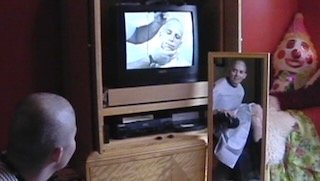
Shave and a Haircut (Angelo Madsen)
On November 12, 2025, The School of the Art Institute of Chicago (SAIC) “gutted” Video Data Bank (VDB), the essential moving-image art distributor, archive and streaming platform. The elimination of 60% of its staff, including director Tom Colley, and announcement that it would as a result of this reduction no longer acquire new work, sent shock waves through the video art community, including the hundreds of artists represented by the distributor, an illustrious roster including, to name a few, Bruce Nauman, Miranda July, Martha Rosler, Tiffany Shaw, Christopher Harris and Elisabeth Subrin. One artist included in VDB’s catalog is an SAIC alumni, Angelo Madsen, who has been featured in Filmmaker several times. He submitted the below open letter from himself to the school, and we are printing it below. Additionally, Colley has commented in a letter published on Instagram. — Editor
Dear Dr. Martin Berger and the School of the Art Institute of Chicago,
I reach out to you today as a concerned alumni. I did some of my most significant growth during my years as an SAIC undergrad, from 2001-2005, moving between all of the departments, but most significantly the Sound Department and Film/Video/New Media. During that time the Video Data Bank was a foundational resource for me.
I am reaching out to express my deep sorrow and dismay at the recent termination of three of the five key staff of the Video Data Bank, and to learn that the VDB will be restructured to no longer acquire new work. I understand these staff were escorted from their offices by security and immediately shut out from their email accounts, rendering them unable to contact external parties impacted (such as the 600+ artists they represent).
For so many students and youngsters exploring the fringes and legacies of art/culture-making, bearing witness to the scope of possibility, and importantly, encountering new work, the Video Data Bank is and has been unshakably seminal to an SAIC education. Alone, on a beanbag, in a small room, with a rollout VHS player, I learned what video art was, and had no idea how deeply it would change my life.
I am now a university professor, my films have screened widely around the world, I am a Guggenheim Fellow (2022), a Creative Capital Fellow (2025), a United States Artist Fellow (2023), and a MacDowell Fellow (2022), among many other honors. I cite these awards not because they legitimize my worth as an artist, but because they likely convey my worth as an artist, to you, the institution that is the School of the Art Institute. I know that you value these honors because you have shared them on social media, sent me messages via alumni relations, and have quantified my awards into the data you market to future funders. My statistics directly reflect your funding and consequently, tuition dollars. You capitalize off of my success. You capitalize off of the success of every artist who has come and gone from the School of the Art Institute.
As such, I am sure you are aware the impacts of an SAIC education stem directly from instruction and mentorship – the individuals and communities that arise around students, but also from staff, departments, and supplementary organizations and collections, for example, the special collections including the Joan Flasch Artists’ Book Collection at the Flaxman Library, the Gene Siskel Film Center, and of course, the Video Data Bank – one of the world’s foremost distributors of Video Art. Let me repeat, world and foremost.
Are you aware that the Video Data Bank is an international resource? Perhaps you are unaware that the VDB is the key steward of some of the most significant films and videos in the world. Perhaps you are unaware that Video Data Bank director Tom Colley, (and previously director Abina Manning and founding directors Kate Horsfield and Lyn Blumenthal) have spent over 30 years cultivating the relationships with artists, estates, and collections around the world to develop that unbridled robustness. The depth of their collection, their presence across the most significant venues in the world, not unlike my awards, has been a bearer of prestige to your institution for decades. You have sold the Video Data Bank as a key beneficial resource to your prospective students and funders alike.
From what I understand, you intend to limit operations at VDB and restrict any new acquisitions, and that this justifies reducing the organization to a two-person staff. Do you think it is reasonable to expect a two-person staff to manage a collection of over 6,000 films? Do you think it is logical to ask a two-person staff to manage a collection of over 6,000 films, and continue to distribute to some of the finest film festivals, museums, and venues in the world? (I could insert a truncated list here, but it would require this letter to be 16 extra pages.) Do you think it is possible for a two-person staff to manage a collection of over 6,000 films and continue to distribute to some of the most notable film festivals and venues in the world, and stay fully engaged with the shifting landscape of moving-image work as it directly reflects trends in archiving and distribution? Do you understand the depth of technical knowledge and the richness of long-built access points needed to fulfill any of these tasks?
Your decision to make such a drastic (and swift, which I will return to later) intervention with the VDB suggests to me that you have limited knowledge of the organization, its vibrant support system, and of the field of moving image, if any. Or, that you are aware, but simply do not care.
Allow me to offer a suggestion of how potential restructuring might have gone, if you had chosen to navigate the situation with baseline consideration. You might start by setting up an appointment with senior VBD staff to alert them to the school’s larger financial concerns. You might then have asked for their input in thinking through how the organization might consider shifting its operations. You might have invited neighboring organizations to discuss the possibility of shared governance or partnerships. You might have approached private donors individually with specific fundraising goals for the Video Data Bank exclusively. Your failure to explore any of these alternatives demonstrates no concern for others, culturally or individually.
At the beginning of this letter I cited that I was writing to express my sorrow and dismay. But to be clear, I am also writing to express my disgust. Some words I might use to describe this disgust are: Abhorrent, nefarious, despicable. But I might also say timely. It is timely that our country is in a crisis of higher education, just as you would make this decision. It is timely that our country is in a crisis of historical erasure as you make this decision. It is timely that our higher institutional structures are being piecemealed off to the slaughterhouse en masse, as you make this decision. It is not a coincidence that that path to authoritarianism is forged by eradicating access to higher education, severing opportunities for cross-cultural discourse and cultural criticism, and piecemealing museums, archives, and other cultural institutions through underfunding, limiting their reach, and leading to their closure.
From your 30 years of service to cultural institutions, you know that to be an artist is to be a culture maker. To be a culture maker is to be a cultural critic. An artist has to have something to say. It is no coincidence that the artworks held at the Video Data Bank are some of the most culturally critical in the world. It is timely that you seek to dismantle this, to render this criticism inaccessible.
Just as you have dedicated your entire career to the field of higher education, this staff has dedicated their entire careers to cinema. Can you possibly imagine being walked out of your office at the institution you’ve put your life’s work into by the same security that you see every day, with no notice or reason whatsoever? This is a simple question of humanity. Do you believe in it or not? Would you consider this humane treatment? Clearly, it is not. Why the inhumanity of this method, Dr. Berger? Your lack of respect for the life’s work of these staffers is unconscionable.
When you had Tom Colley escorted from his office, you also froze him from his email account. The email account that he has used since 1999 to correspond with the thousands of artists that he has built significant relationships with and those whose work the VDB holds. Holds. Is entrusted with. There is a delicateness there, which you have trespassed. Those hundreds of artists that the Video Data Bank represents (including myself) were unable to communicate about the future of our collections with our distributor. Your disrespect for our field, for the staff’s incomparable knowledge and their individual personhoods, ripples through them, and passes onto the more than 500 living artists represented by the Video Data Bank. And then through us, and onto the remaining dead that haunt the collections.
I am sure that you will largely attribute this reduction in staffing and freezing of acquisitions as being related to institutional financial strain. I do not doubt that SAIC is experiencing a shift in finances, as many institutions are. As a professor myself, I also understand the institutional frameworks of capital and cost. Yet, monetary value is not how we build culture because the value of culture is not measured in money. I know that you know this, but perhaps it has been clouded, or you forgot this somewhere along your way to a nearly half a million-dollar yearly salary? Your total reported compensation as of 2024 was $402,532. A simple 5% reduction in your salary would allow basic VDB operations to continue uninterrupted for three months – an appropriate amount of time to reassess operations. Perhaps a 3% reduction amongst the top 20 institutional earners would easily allow the VDB to operate fully intact (with a staff of five) in perpetuity?
It should be clear now, that my concern is not for the well-being of my films. Of course I have copies of those, and… they are just… films. My concern is with ethical priorities this decision reveals – unstable values, and a deeply misguided proclivity to prioritize financial gain over cultural well-being. I will not bring up SAIC’s history of no-notice terminations. I will not bring up the egregious manipulation and mistreatment of adjunct faculty over the last 30+ years, relying on their expertise to generate the competency of the artists whose successes you later use to market to prospective students and their parents. Yet, that is in my mind as I write this. I will not bring up the recent controversy around your language blunder of 2018, though that is on my mind as I write this. And I will not point to the fact that on the exact same day that VDB staffers were escorted out of their offices, the senior administrator of the Art Education program, Katheleen McGrath, was also walked out of her office. I will however repeat the word education. The very thing our authoritarian regime is attempting to silence.
In a crisis of education, you do not cut the meat. You cut the fat. Which is often at the top.
My request is that you reinstate the entire staff, publicly apologize for mismanagement, and enter a mediation process with the Video Data Bank. I believe former ED, Abina Manning, should be part of that conversation, along with the five-person staff. Tom Colley has been fostering the relationships with artists, curators, programmers, writers and critics that are irreplaceable, and he will best know how to guide the organization forward through a more humane, knowledgeable restructuring process.
I entrusted my 22 films, spanning 2004-now, to the Video Data Bank, not because I am an alum of SAIC, nor because I actually needed a distributor. I’ve been doing this long enough that I know how to get my work out into the world. I work with the VDB because I believe in the mission – its vision of access, stewardship, and dissemination, and the collection as an axis of creative possibility.
I sincerely hope you will consider my words.
Best,
Angelo Madsen (currently)
Projects as Angelo/Madsen Minax (2005-2022)
Associate Professor of Time-Based Media
University of Vermont