Faces of Death
When Faces of Death was released almost fifty years ago, the idea of being “extremely online” was a distant glimmer, probably somewhere in Tim Berners-Lee’s eye. If you had a predilection for the grotesque or a passing fascination with that which should not be seen, darkened theaters or pulpy true crime rags were the only source. The idea of seeing “real” human death, bodies dismembered, viscera strewn all over the street, was all taboo, but a softening one as we emerged from the Vietnam War. The horrific imagery from those senseless massacres awakened something in the general public. It certainly did for legendary makeup and visual effects artist Tom Savini, who famously cited his time as a war photographer as the inspiration for getting into his line of work post-war. You don’t want to look, but how could you not? Suddenly, sights and sounds once only shown in the seediest of grindhouses were mainstream thanks to very real atrocities. It makes sense that filmmakers would try to jump on a newfound urge for depravity.
Presented as a documentary, the 1978 Faces of Death follows a pathologist trying to understand what happens when we die. To do so, he subjects himself and the viewer to a series of “snuff” films, each depicting a violent and disgusting death. Watching it all these years later, it’s hard to believe anyone thought this was real, but in the pre-everything-at-your-fingertips days, the Faces of Death VHS felt like a cursed object. You’d see it on the shelf of your friend’s weird brother. Your eccentric uncle might throw it on in between showing you creepy magazines. That iconic skull-laden cover imprinted on the minds of many an impressionable youth. All these years later, death, destruction, and violence are on every feed of every social media app. You can’t scroll for five seconds without seeing something you’d previously never be able to shake from your mind. If images of death were once scarce, how do you recreate that in an environment that’s become desensitized to it?
“I would argue that this isn’t a form of desensitization. I think that’s a misnomer,” says writer Isa Mazzei, reflecting on what went through her mind while rebooting a classic. In 2026, the question of “how do you make Faces of Death effective?” is one answered by first finding that center of moral gravity within yourself. Mazzei says she and director Daniel Goldhaber subjected themselves to many snuff videos while trying to crack a way into a remake. What she found within herself scared her more than if she had become totally numb. “They were still affecting us. I still feel affected by them, but I think that my ability to even tell that I’m being affected is what’s being taken away,” she continues. “That to me is actually really terrifying because these things should affect us. It’s so easy to forget that the thing we’re looking at on the other side of the screen is a real thing, a real human being.”
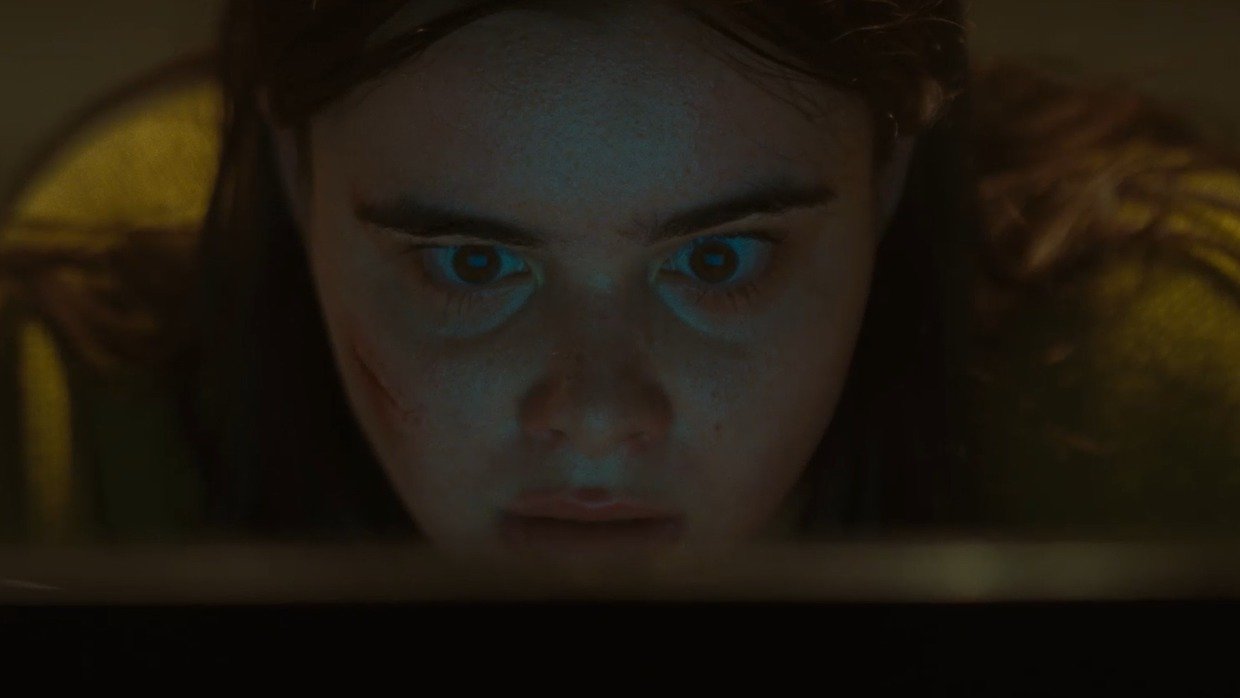
To bring Faces of Death into the 21st century, Goldhaber and Mazzei had to first look backwards. Not at the original film itself, but at the world they grew up in. Their approach follows a content moderator, Margot (Barbie Ferreira), who works for a TikTok-esque app, Kino. As she begins receiving submissions to review that seem to depict very real death, Margot falls into a rabbit hole trying to expose and stop the sadistic killer (Dacre Montgomery). What’s interesting about the killer’s videos is that he’s, quite literally, remaking the 1978 Faces of Death videos himself. This isn’t just a meta-textual comment on the original films, it’s also an eerie reflection of reality for Goldhaber.
“It always felt a little cursed,” says Goldhaber, describing his suburban upbringing in Colorado. Well known for the Columbine and Aurora Dark Knight shootings, the Centennial State’s mythic history of violence is well documented. It makes a bit of sense, then, that both Goldhaber and Mazzei grew up here. Well before he had his killer recreate Faces of Death, Goldhaber describes a chilling parallel of his own. Having frequented a local grocery store, King Soopers, Goldhaber made many memories in its parking lot, shooting the shit and smoking with friends. He’d even shot his senior thesis there: “I made a movie about this kid who kills his parents and throws a party afterwards, which was also something that had happened in our community when we were kids.” A scene in that film shows the kid shopping at King Soopers right after killing his parents. “Ten years later or so, somebody walked into that store with an automatic weapon and killed eleven people,” he says. The shooting, livestreamed to the masses, became another piece of carnage we’d see mindlessly scrolling. For Goldhaber, it hit harder:“We were basically watching this livestream of a citizen journalist who’d shown up while the shooter was still inside, watching this element of our childhood get destroyed.” This is the soup that a new Faces of Death, whether he knew it or not, would be born from.
Margot’s life reflects one not uncommon to most Americans of a certain age. Existing in the void of urban sprawl, her day-to-day consists of going to work, consuming hours upon hours of digital brain rot, and coming home to an apartment where her roommate does the same. “There’s something about these kinds of very alienating suburban spaces where that kind of explosive violence feels almost inevitable,” Goldhaber reflects on his youth in Colorado, but he could be talking about Anytown, USA. We’re a country that can’t help but celebrate violence. It’s in our DNA. We’ll pearl clutch about sex, but violence? Full steam ahead.
Early on, a humorous moment shows Margot giving the first Faces of Death recreation a pass while flagging a “How To” video showing how to correctly put on a condom. “We’ve had some people comment, ‘Why is Margot so fucked up? Why is she flagging the sex videos?’” says Mazzei. “Margot’s not doing that,” she continues, “She’s doing her job. That’s an important distinction there because ultimately that is what we see on these platforms. We see the over-censorship of things like sexual health education, sex work, harm reduction, and then we see the over-proliferation of violence.” Margot, being a product of an algorithmically generated ecosystem, is key because it’s what allows her to stand out from your typical “Scream Queen.”
That ecosystem, “The Attention Economy,” as Dacre Montgomery’s Arthur describes it at one point in the film, creates two leads that are different sides of the same coin. When everyone is “too” online, nobody is, and it just becomes the norm. Ferreira’s Margot is a hero for our times. Careless enough to put herself and others in harm’s way for the sake of “content,” her harrowing backstory involves a deadly accident while attempting the latest dance craze, but believably capable as someone who could survive a movie like this. “Part of the reason we were so excited to work with Barbie is that one of the earlier things she said to us was like, ‘I was a weird internet kid too,’” says Mazzei of Ferreira’s casting. As a content mod, Margot sees herself as a barrier to brain rot. If she can be a cog in the wheel of the algorithm, maybe she can spare others from suffering her fate of becoming the dreaded internet meme. “She believes that she’s there to do good in the world,” says Mazzei, “But then kind of has this rude awakening when she realizes that her entire job is really a smokescreen.” As her boss encourages her to continue pushing through the Faces of Death videos, Margot becomes an internet sleuth. Despite being understandably scared, her fear never immobilizes her. “Barbie really brought a fierce determination in her performance that makes her really, really engaging to watch,” Mazzei says. The gears are always moving behind her eyes, cycling through an endless Rolodex of Reddit threats and instructional videos in her mind.
The mirror to Margot as a child of the internet made good (relatively) is Dacre Montgomery’s Arthur. An astonishing performance of vacant glee, Arthur is the living manifestation of digital violence. “We wanted to avoid this idea that there’s any one reason,” says Goldhaber when describing the lack of motive for Arthur. When someone commits an atrocious act of violence, we immediately want to find a reason. There has to be a “why.” What makes Arthur terrifying is that there really isn’t one. “What fucked up Arthur?” Goldhaber asks, rhetorically. Affecting the voice of a pathologist, he continues, “‘He watched Faces of Death when he was six years old, and it traumatized him so much that he became a serial killer.’ That’s obvious, and the most reductive thing imaginable. People are not that simple, especially people who commit horrific acts. They’re incredibly complicated, and we know that.” It’s not that there’s a lack of care put into Arthur’s creation, “There are a lot of Easter eggs and clues kind of hidden around the house, hidden in his behavior,” explains Goldhaber, continuing, “Ultimately, we wanted to avoid this idea that there’s any one reason.” It’s not a far walk to imagine someone like Arthur being shaped by the endless churn of content.
Creating the digital world that Margot and Arthur swim in took plenty of research and patience. “When you’re scrolling, it’s such a diversity of content. It’s produced content, it’s very DIY content. Usually, it’s like a clip from a movie that you can’t license and then AI slop, and then it’s a fail video,” explains Goldhaber, describing what they pulled from to build their own “For You” page. “Sometimes, we just solicit people we know who make content to just make a little video. Sometimes, we ourselves are just going and shooting a little goofy thing on our iPhone, and then it ends up in the movie. It’s a mix of things.” No stone was left unturned. Even the Reddit threads that Margot uses for research were crafted by Mazzei, with Goldhaber saying, “Isa creates these unbelievable Reddit threads in the movie that she writes from scratch. Every username has its own personality.” That dedication lends Faces of Death authenticity, and as such, sinks you into their terrifying world. “Even if you’re not reading it, there’s a part of your brain that’s still processing that language subconsciously. It’s how we absorb the information on the internet,” says Goldhaber. “We very much wanted to reflect that way of information engagement in the form of the movie as well.” This is why the film sticks to the ribs more than your basic slasher. Its creators, channeling the original’s cursed vibes, insidiously pull you into their timeline and lull you into a haze of mindless security. Before you know it, you’re witnessing another gruesome death.
It’s this that makes Faces of Death far more than a salient commentary on “How We Live Now.” Goldhaber and Mazzei are making a horror movie here, after all. Their approach towards which deaths to recreate from the original directly mirrors Arthur’s rationale. They’re all entertainers feeding a machine. “He’s scrubbing the movie, and he’s thinking, ‘What from here can I reappropriate?’”, explains Goldhaber. “He’s also thinking, ‘I’m going to start small. I’m going to keep growing.’ That’s what people want. They want you to iterate on the idea.” As he escalates, his recreations become more elaborate. This allows him to sneak past the censors because he knows that they thrive on entertainment. “It speaks to the fact that these platforms know that violence will keep you engaged, and they know that they can profit off it,” says Mazzei. “So they’re going to keep it up.” The wilder the better. Only Margot finds this disturbing because she’s already experienced it as a former “content” creator herself.
It’s rare for a remake to exceed the original. Faces of Death 1978 is no great shakes as a piece of cinema, but its reputation and legend live on far beyond any parameters of “good” or “bad.” To live up to that, Goldhaber and Mazzei created something that could exist as both a product of its time and a genuinely great horror picture. As our world is constantly reshaped by algorithms built by billionaires, the furious power of their reinterpretation will only grow. Scroll long enough and you’ll find plenty of horror and minds broken by a daily intake of it. When describing the original and her experience with it, Mazzei says, “It’s not only extremely accessible, but it’s also just everywhere in these fragmented and decontextualized little clips of violence.” It’s that last bit that resonates as Faces of Death 2026’s core kernel. Decontextualized little clips of violence as far as the eye can see. The genie’s long been let out of the bottle, and all we can hope for is that we’re shaping far more Margots than we are Arthurs.