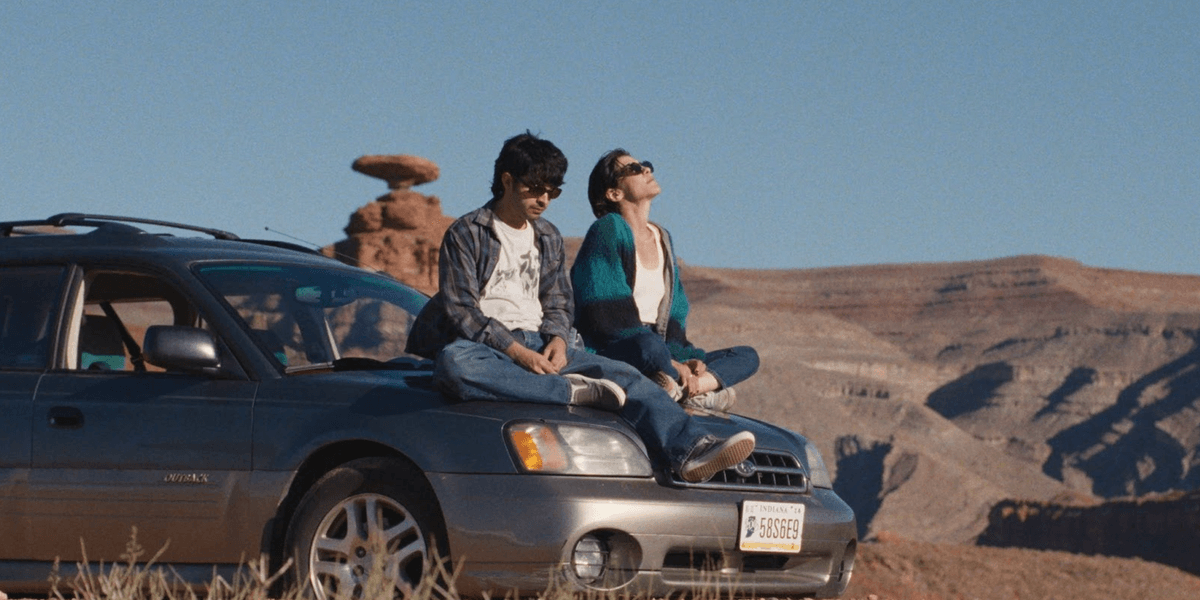
The rhythmic cadence of this film is no accident as Bashour – who also served as composer on the film – brought his musical background to the post workflow, and specifically his close collaboration with editor Mollie Goldstein. Edited on Premiere, Goldstein was tasked with sorting hours of footage captured in a car on a real cross-country road trip, which provided stunning visuals but also presented unique issues such as tumultuous audio and long, drawn-out takes with frequent lighting changes. As a result, Goldstein relied on the Essential Sound Panel to clean up noisy backgrounds, while preserving Bashour’s sound-driven, filmmaking style.
Check out our full interview with Goldstein on her workflow below.
What does it mean to you to show a film at Sundance?
Mollie Goldstein: It’s a true honor to have worked in such a storied and prestigious festival, and it was especially thrilling to go with two projects, Hot Water and In The Blink of An Eye, for the final year in Park City, UT.
Having a film at Sundance offers both the chance to have your work seen by a vibrant crowd of artists and an opportunity to be a part of American film history. It’s a festival that brings together a true community of film lovers, and I feel really lucky to be recognized and supported by the team here.
How do you begin a project/set up your workspace?
MG: Every project is different! On Hot Water, Ramzi (the director) started the edit, so I was inheriting a project that had already been set up. The first thing I did was copy it all into Dropbox so we could use Productions to easily share files and cuts between us. And then, creatively, the starting point for me is also to watch all the dailies. It wasn’t all at once on this one, but it was really important to me to see everything that was shot for a given scene before I dove into it.
Tell us about a favorite scene or moment from this project and why it stands out to you.
MG: My favorite thing in the movie is Daniel Zolghadri’s performance. He’s one of those actors who can’t strike a false note. What he’s doing looks deceptively simple – like he’s not acting at all. The truth is that the performance is just so alive that the acting disappears. And he’s so young – I’m really excited to see what work is ahead of him. There’s also a reveal at the end of the road trip in the film that was incredibly fun to cut, but I’m not going to spoil that here!
What Adobe tools did you use on this project, and why did you originally choose them?
MG: We cut in Premiere, using Productions to manage the large project and uploading cuts to Frame.io. This system allowed our producers (both based in Colorado) to collaborate with Ramzi and me on a really nitty-gritty level.
Max Walker-Silverman (producer), in particular, would leave us all kinds of stream-of-consciousness notes—reactions, suggestions, sometimes just laughter or applause—and Frame.io made it easy to know exactly where he was in the film. There was no confusion about what he was referencing, and we could easily track what we addressed and what we hadn’t.
What were some specific post-production challenges you faced that were unique to your project?
MG: Hot Water is about a mom and a son driving across the country, and the film was actually shot on the road. We had incredible footage and b-roll to work with, but we also had all the problems you get from shooting in a car: noisy audio, endless rolling takes, unpredictable weather, and lighting changes. I’ve never done anything quite like it.
The production sound mixer did an amazing job, but there was still a lot of noise on the dialogue track just from being shot in a car. This was my first time using the Essential Sound tool in Premiere, and I was really happily surprised by how well and how quickly it let me clean up the audio.
Hot Water was also a tiny movie, so I had to figure out how to assist myself, and quickly. By transcribing the dialogue automatically with Speech-to-Text and then having Premiere create subtitles on a sequence with all the footage laid out, I had an easy way to find the exact lines I was looking for without spending hours setting it up. Once the subtitles were in place, I could just scan the text track or step from subtitle to subtitle when I wanted to compare takes, and I didn’t lose momentum hunting through the footage.
Who is your creative inspiration?
MG: Rob Reiner is top of mind for me because we lost him so recently and so tragically. Who can top the back-to-back run of This is Spinal Tap, The Sure Thing, Stand By Me, The Princess Bride, When Harry Met Sally, Misery, and A Few Good Men? They’re all so good and so different. I hope to one day have such a sure understanding of how to make an audience feel so many things across genres and stories.
What advice do you have for aspiring filmmakers or content creators?
MG: Make things! Learn the software, work with other people, and get your hands dirty. If you’re not in this for the love of art and process, you’ll never make it through the inevitable struggles and disappointments.