Good filmmakers believe in their characters; great filmmakers believe in their characters and their setting. Now, before you fight me, I want you to watch Parasite–the Korean feature film directed by Bong Joon-ho that not only won the Oscar for Best Picture in 2020 but also brought Korean cinema under the global spotlight.
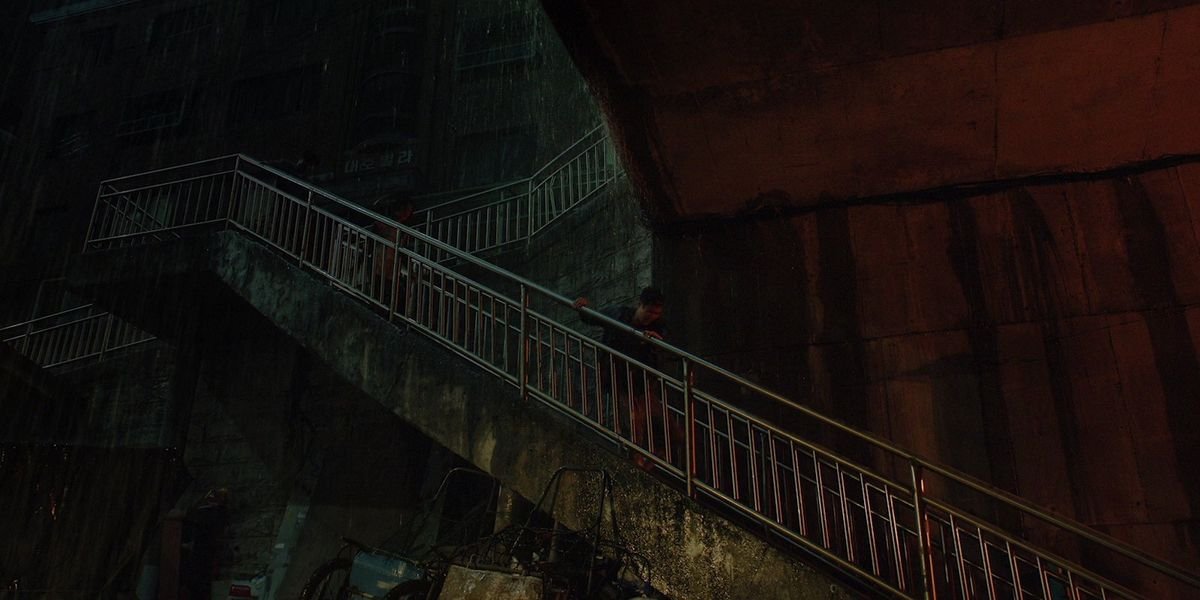
Edgar Allan Poe believed that tone and mood are the best guides to storytelling. Bong Joon-ho proves it with Parasite. In your first viewing, you might not notice how the filmmaker focuses all his directorial energy on materializing the singular mood of the narrative: ascent and descent. However, then you notice just how many times the film’s characters go up and down stairs.
Whether emotional, financial, or social, the staircase, a part of architecture that at its core signifies levels, becomes the primary visual motif of discrimination and class disparity in Bong’s Parasite— a film centered on inequality.
In this article, we explore how Parasite is basically a “staircase” movie.
(SPOILERS AHEAD!)
Bong Joon-ho’s Play With Elevation
Parasite (2019)Credit: Neon
Parasite centers on three Korean families whose fates are intertwined by the evils of the social structure. What we see in Parasite is the story of every country, all over the world. The society is divided into levels, discriminating between people based on their wealth, with capitalism feeding on the disparity between the rich and the poor. As a result, one strata becomes parasitic on another to survive.
The film opens with the destitute Kim family, a family of four, living in a cramped, basement apartment, in some underground part of the city, living on menial jobs.
When the son, Ki-woo (Choi Woo Shik), gets falsely recommended as a highly qualified English tutor for the wealthy Park family’s daughter (Jung Ji-so), he gets a chance to see how the other part of the world lives for the first time.
Parasite (2019)Credit: Neon
Fuelled by ambition, the Kim family hatches a plan, which is seemingly harmless at first, but in the end leads to a massacre.
With the help of his sister, Ki-jung, Ki-woo manipulates the naive Mrs. Park (Cho Yeo-jeong), making way for his family members to infiltrate the Park family by taking up menial jobs in their house, such as housekeeper, art therapist, and driver with fake credentials. Things work seamlessly until the Kims discover the previous housekeeper and her husband bunked up in the Park’s underground basement.
The Use of Set Design to Establish Social Hierarchy Through Elevation
The respective houses for both families are a vital visual element in this narrative centered on elevation.
The Kim house is located below street level. Although Bong doesn’t establish the exact geography of both houses until the climax, it is clear that to reach the Kim house, you’d need to go down multiple flights of stairs. Even the eatery where they hang out regularly shows a road with an ascent right behind it, implying that one needs to walk down to reach the eatery, and there’s always something above the people there.
Parasite (2019)Credit: Neon
On the other hand, when Ki-woo goes to the Park house for the first time, we see him making constant ascents. He begins by walking up a flight of stairs from his house to reach the street, and continues walking up the terrain. Ki-woo then walks up the street, after which the Park house is slowly revealed to him, and then finally, he treads up a long flight of stairs to reach Park’s front door. Here, Bong Joon-ho uses the sun as another visual metaphor. Up to this point in the film, the sun doesn’t appear anywhere in the film—it’s all dark and gloomy. We rarely see sunlight, but never the sun. But, as Ki-woo begins his ascent up the flight of stairs to the Park’s main door, for the first time, we see the sun glaring in the frame, shining brightly on him.
References From Parasite That Showcase the “Staircase” Treatment
Let’s take a look at a few examples from the movie to dig deeper into this visual psychology of elevation and the staircase.
1. The Stairs Inside the Respective Houses
Reportedly, both the Park and Kim houses were constructed, including the slum area around the Kim house. Layout-wise, the staircase inside the Park house leads to a set of luxurious bedrooms, whereas the brief flight of stairs in the Kim house leads to their bathroom, which floods anytime it rains.
Parasite (2019)Credit: Neon
Parasite (2019)Credit: Neon
2. The Scene Where The Kims Run Home
Only at the tail end of the film, Bong reveals the geographical layout of the two houses. When the Kims run to their house, somehow having safely managed to sneak out of the Park house, after the Parks return early from their camping trip, unannounced.
As we follow them down the streets, we get a complete view of the setting of their home. The Kims run down the slope, then down multiple flights of stairs, and finally down another slope to reach their home. The constant descent is a visual representation of their place in society.
Parasite (2019)Credit: Neon
3. The Discovery of the Old Maid and Her Husband
As the Kims take over the Park house in the absence of the Parks, they discover that the old housekeeper has secretly bunked in the basement with her husband, thriving on food and water that she occasionally steals from the kitchen. There is a long sequence following Mrs. Kim as she rushes down a seemingly endless flight of stairs to reach the depths of the basement.
Parasite (2019)Credit: Neon
Conclusion
Bong also uses the staircase to show visual separation between the two families, here and there. Anytime someone goes up the social ladder, up they go a flight of stairs. Anytime they’re pushed down, down they come a flight of stairs. And the most realistic part, as you begin to think that you’re close to understanding the social ladder, the funnel opens up wider, to show more people buried under the levels.
To me, the beauty of Parasite lies in its impartiality. Because the narrative doesn’t present either family as the antagonist, it successfully shifts the accountability of the unfortunate ending to the real culprit—society. In the end, Mr. Kim (Song Kang-ho) stabbing Mr. Park (Lee Sun-kyun) to death in wrath is a visual representation of how capitalism pits mankind against itself.
The fact that Ki-woo continues to fantasize about buying the Park house even after everything that has happened there is a strong hint at the irony of how he’s so eager to become someone he strongly detests.
Any other visual motif that caught your attention from the film? Comment down below!