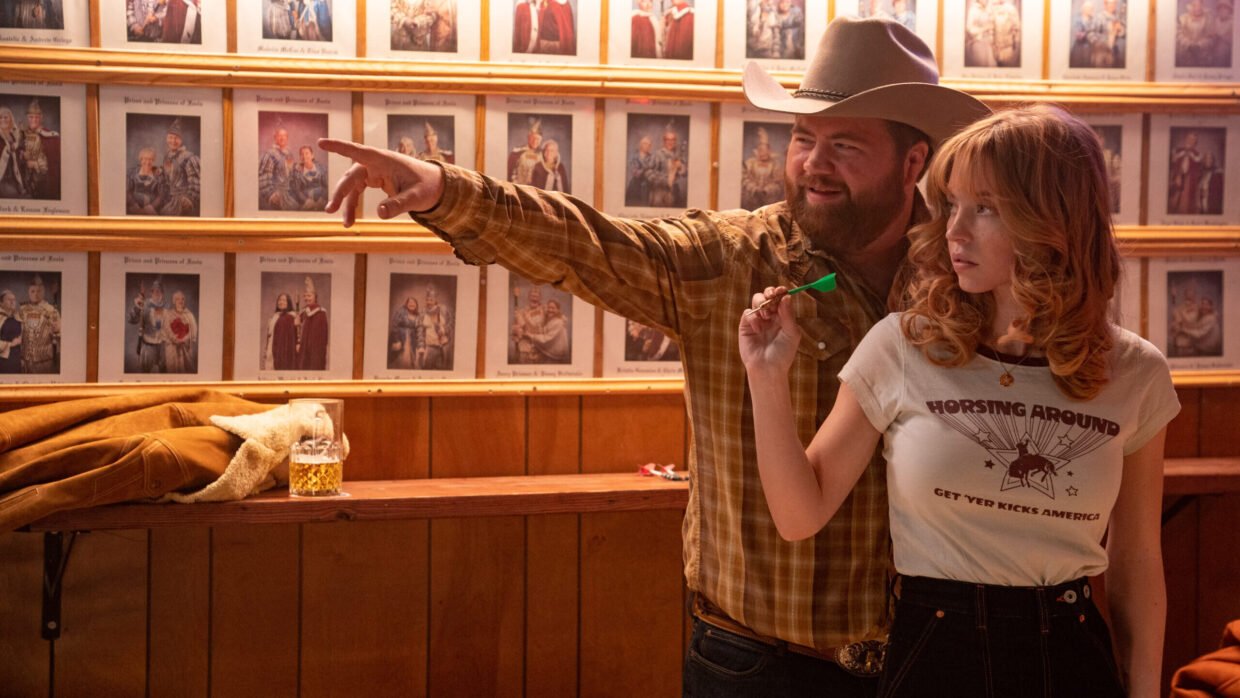
Americana
After 15 years working in series television, writing shows including Longmire, Damnation, The Terror, and most recently, Pokerface, Tony Tost moves into the world of feature filmmaking with his road-trip western caper flick Americana, whose cast boasts Zahn McClarnon, Paul Walter Hauser and Sydney Sweeney. Tost spoke with Filmmaker about his upbringing, his journey from academic and published poet to screenwriter, showrunner, and sage of the narrative craft — his Substack, Practical Screenwriting, is an endlessly rewarding font of experience, narrative nuts and bolts, and honest takes about the industry at large — all while musing over westerns, identity and the question of what a writer looks like.
Filmmaker: This is your first time in Filmmaker, so maybe we could take it back a bit, if you don’t mind. About your background, I wanted to ask you how you came into the world of poetry, which is where you first gained a foothold in writing. How did that avenue open up to you, and were there any formative experiences that might have catapulted you into that kind of creative life?
Tost: I grew up pretty blue collar, small town. Trailers and trailer parks in rural Washington state, right near the base of Mt Rainier, watching Westerns, Burt Reynolds movies, pro-wrestling, country-western music. That was kind of the bedrock of my world, and [I wasn’t] coming to it as a kind of culture but more just as part of the world. I was an okay student, nothing super-crazy or super-special, graduated high-school, wasn’t sure what to do, started working at a pickle factory, pretty quickly realized this wasn’t gonna be satisfying for me, so I took some community college classes. At this point now, I’m a teenager, and music changed. I was an hour outside of Seattle. Nirvana, Pearl Jam, Alice in Chains, they were all coming out at that time. And then Reservoir Dogs and Pulp Fiction came out.
So, I started to get a taste for things a little different and more alive than what I was used to, and then in community college I took a creative writing class and a film appreciation class and that was the first time I realized that I might be a good writer. I took a novels class and realized there were books that were exciting to me by Franz Kafka, Flannery O’Connor, and Kurt Vonnegut, and I started awakening. I wasn’t fully formed yet, but I started diving into movies, getting into Hitchcock, Kubrick, Orson Welles. Reading filmmaking books between classes at the community college. I did two years there, then moved with my family back to the Missouri Ozarks, where I was born, and saved up money to go back to college. Went to this Christian college in the Ozarks and my first semester there I took a Shakespeare class, a poetry class, read King Lear, Hamlet, Moby-Dick, Wallace Stevens, William Butler Yeats, and it was like a religious conversion. It was, “Oh, that’s the missing thing in life, this is my calling, this is what I wanna do.”
So, then the question became, how do I pursue this, how do I make a life out of this? I loved theater, loved poetry, and I had this group of friends, just art kids, and we played music together, hung out together. I finished my undergrad, wanted to go to film school, but very quickly realized I couldn’t even afford the drive to film school, let alone to go there. But to me, poetry was free. I went and got an MFA in poetry, then went right back to working minimum wage jobs. Then I did a Ph.D in literature because I thought I would make a little more money but also have time to read and write. I was going into this whole academic poet path, and a part of me still wanted to pursue filmmaking and screenwriting but I just resigned myself that it wasn’t in the cards for someone of my background. Then a friend of mine from the MFA program at University of Arkansas, Nic Pizzolato (True Detective, Galveston), he broke in as a staff writer on The Killing, after his novel got optioned. So, I thought, if Nic can do it, I can do it, he didn’t have any connections either. So, I wrote a few scripts, Nic gave me some feedback, he introduced me to his agents and they became my agents, and then I weirdly sort of parachuted in at the age of 35. I quit a creative writing professor job in order to freelance a couple episodes on season 1 of Longmire. At that point, I was like, “Now I’m a screenwriter, I’ve got to go learn how to do this.” It was a roundabout, little bit odd path. The passion was always there, I just didn’t think it was a realistic path. Once the door was open, I just sort of sprinted towards it.
Filmmaker: In your burgeoning years, when you were subsisting on these menial, sub-living wage jobs, were you already writing?
Tost: No, I didn’t start writing till I was in community college. I wrote a couple things in my high school English class that my teacher really liked. She even called me up at home and said, “Tony, you’re a really gifted writer, and you should really consider pursuing writing.” I was a teenager, and kind of this redneck, hick guy, and so I was just sorta like, “Okay, whatever…”
Filmmaker: It’s a daunting prospect.
Tost: And every single writer I had ever seen looked nothing like me. I mean, somewhat like me, but you know what I mean: Not a blue-collar, trailer-park kind of guy. But then when I took that creative writing class in community college and got positive reinforcement again, I started writing on my own. I caught the bug then. Growing up, I didn’t think about writing as like a cultural thing. I was more into sports. I liked movies, but I never contemplated [how they were made] and I didn’t read books.
Filmmaker: You weren’t a big reader.
Tost: Not at all. In our trailer we had like an old encyclopedia set and some children’s books and some sports books, like stat books that I got at a Salvation Army, but that was it. The books that were assigned in school, I thought were boring. [Back then] it wasn’t like I was illiterate, I could read, but it was more “Why would I do that when I could watch music videos instead?”
Filmmaker: Right. So then at some point there’s an awareness that sets in that poetry was speaking to you. Was there a specific experience that felt like you were accessing poetry in a way that was liberating or exciting for the first time?
Tost: It was creatively exciting to me, in that, even from the first time I got into it, I never wrote “confessional poetry,” quote unquote. What excited me were, first, ee cummings poems, and then Wallace Stevens, Yeats. Interesting, charged language, and weird images. I was getting these sensations — certain synapses were firing in my head, just from the juxtaposition of words and images — and I wanted to do my own version of that. That was kind of the spark, as opposed to feeling like I had these feelings I wanted to get out or something I had to get off my chest. It was more that I wanted to go after these images, these interesting word choices, these weird decisions, and then in the process of that inevitably personal emotions get expressed that way.
Filmmaker: It seems like some of the poets you’ve written about — Ezra Pound, Gertrude Stein, Frank Stanford — came from or carried on in the scenarist tradition and were working within a formally cinematic space in terms of their poems. Stanford’s Battlefield is definitely a stream-of-consciousness film, like a documentary of a series of dreams. As you were discovering these writers, was that a conscious experience, being drawn to these types of constructions, or were you just kind of swept up in the slipstream of it?
Tost: I think the kind of poets I’m drawn to have the same qualities [in their work] that I love about cinema itself. It’s that juxtaposition of images, whether in a poem or montage, put them together in a certain type of rhythm, and a third, new thing evolves from it. That’s something I never get tired of. So at first I scratched that itch through poetry, and was definitely drawn to people like Frank Stanford, whose recent biography [The Life and Poetry of Frank Stanford by James McWilliams] I just finished reading like two nights ago.
Filmmaker: You too? Man, there’s an incredible book.
Tost: Amazing. And had [Stanford] lived, I’m sure he would’ve become like a weird, redneck Jean Cocteau. But I didn’t know that when I was drawn to his poetry. It’s the same as with William Carlos Williams. There’s just something about capturing a strange but resonant image that just excites me.
Filmmaker: You mentioned Westerns and Burt Reynolds movies. Were you exposed to those types of films through television as a young boy?
Tost: Kind of. TV and VHS. We had a satellite dish. And sometimes, odd things would pop up on there. A weirdly foundational viewing experience for me as an adolescent was catching Altman’s Brewster McCloud. I remember feeling like, I’ve never seen anything like this, but it feels like somebody’s dream.’
Filmmaker: Were the westerns you got turned on by the more classic westerns or the pulpy oaters and TV series of the ‘50s and ‘60s?
Tost: Hawks, Ford mostly. Rio Bravo, or The Cowboys, True Grit, The Good, the Bad, and the Ugly. Trucker movies were also big. My parents were really into CB radio so there was a lot of that as well.
Filmmaker: You mean like Convoy, Citizens Band?
Tost: Yeah, those, and Every Which Way But Loose.
Filmmaker: When I was a kid I saw a lot of western TV as reruns. Was that something you were exposed to?
Tost: Yeah, I guess so. Lots of Bonanza, I knew what Gunsmoke was but didn’t spend much time watching it. I knew Maverick.
Filmmaker: Bonanza was definitely ubiquitous at that time. The reason I ask is not only because you later found yourself working in the western TV format, but also because there’s an economy and a concision to that storytelling, and for lack of a better way of describing it, so much of your sort of screenwriting advice that you put out on Practical Screenwriting tends to be devoted to an understanding of narrative that’s focused on simplicity. A lot of those movies you’ve mentioned are not so straightforward. Rio Bravo certainly is more complex and has more layers of nuance to it than a first viewing can reveal. Bonanza, you have a pretty clear idea of the stakes all the way through it.
Tost: (laughs) Yeah, I imagine there’s less subtext to an episode of Bonanza than Howard Hawks. I think my inner sense of how drama works is partly derived from the bedrock infrastructure being at least half made up of western archetypes, being drawn to those types of scenarios, but then the other half would have to be just how I was raised. We didn’t talk about our emotions at all. There was this weird laconic stoicism over everything. You could even call it repression. Directly talking about your feelings was just not something that was ever going to happen. But those things are obviously still there, so they come through in subtext, in gestures, in what you don’t say. And, so, I think it’s a combination of those two things. The western format is a good container for what by circumstance was the world I came from and there in me already. I wouldn’t know how to write a therapist scene. I just wouldn’t. I could do it, but it would be me doing a masquerade, to talk about feelings in a way.
Filmmaker: You’re a fan of crime fiction novelists. Were you getting turned on by crime stories, detective fiction, cop shows, or the caper format around this same time?
Tost: That kind of thing came later. I like Dashiell Hammett, Jim Thompson, but I think the foundational bedrock was just these movies and TV shows. Sometimes I’ll try to aspire to an odd dialogue thing like Elmore Leonard, but mostly, the characters and scenarios are mostly westerns and samurai films.
Filmmaker: So, coming out of academia, what’s that like when you finally get staffed on Longmire? Was it a rude awakening, or did you feel like in a way you were finally at home?
Tost: A little of both. I knew I wasn’t going to stay in academia. That’s nothing against the people who do it, but there’s this kind of elitist thing going on there that feels separate from my artistic instincts and my understanding of the world. I got this opportunity to be in a writers’ room and it was amazing. Great people. And I knew that I had gotten onto the wrong path somewhere between my first and second poetry books. I had stopped writing things that excited me and started trying to position myself within the field of poetry and had lost the tether. Then I wrote a book about Johnny Cash, and it was the process of writing that book and seeing Nic [Pizzollato] jump into screenwriting that drove me to make this jump, and when it looked like I had found a door, I decided to burn off my academic brain. I stopped reading poetry, stopped listening to Radiohead. Purposely just watched westerns, Sons of Anarchy, listened to AC/DC and country music. And just reconnected with that primal version of myself that I had been running away from in a way. The trailer-park version of myself. I had gotten away from who I was. I was playing this masquerade of a cultured professor type, because I had been in some version of college for like 15 years.
Filmmaker: That’s intense.
Tost: Yeah. I was playing catch-up, mainly because I knew that if I was going to be in these rooms with my background and be expected to be myself, that I would have to be the most well-read, authentic version of myself I could. So, I went through this period where I worked really hard at burning off the intellectual side of my brain, and just tried to get back to what’s compelling, moving, interesting, and just focus on these core narrative questions. The intellectual side of me seeps in anyway, since thematics arise, or grace notes arise, but I can’t lead with that. I can’t lead with an idea about America or the west. I have to be excited about situations and characters first. And inevitably, because I did spend so much time thinking about thematic elements or thinking critically about other artists’ work, then these things do tend to bubble up. But I have to lead with the primal and let the other elements sneak in the back door.
Filmmaker: Since that time, you’ve bounced around between so many different TV series. Were there film projects before Americana that you had set up? Were you always trying to direct?
Tost: No, Americana was the first thing I was going to direct. I had written other feature scripts and sold them or set them up elsewhere with other directors, but I didn’t feel entitled to direct yet. I wasn’t in that mindset, and I didn’t feel that ready. It wasn’t until I had showrun my own show [Damnation] and then worked on The Terror, where I was a senior writer and producer, that I finally felt like I fully understood the prep process, the production process, and had a grasp of what the director did. It took a long time. I came out of The Terror and felt like it had bought me a little bit of time, and I wrote Americana then.
Filmmaker: It does seem like there’s a throughline, these series, even if they’re pretty disparate in terms of the material. It makes sense you would find a home in all these different rooms and get hired on the merits of your previous work, but it’s hard not to notice how there’s recurrent themes. Native issues seem like a concern, and more generally, the American interior, and the inner lives of those experiencing it in a geographically isolated way. I’m wondering, again, whether or not that’s a conscious pursuit of yours. Are you noticing it as it’s happening?
Tost: Well, I didn’t start out with a conscious branding decision, but I grew up in a pretty small town. As the son of the school janitors, living in a trailer way out in the country, I felt pretty much invisible. And very much just on the margin of things, even though my demographic profile — white, straight dude — wouldn’t necessarily suggest that, economically, culturally, I kind of felt like I was always living in my own weird pocket. I also grew up on the border of the Muckleshoot Reservation — which is not in any way to suggest that I have ownership over that world, not at all — but that space, that border space, between what was a predominately white world and then the Muckleshoot Nation, that was where I grew up. So, I’m smart enough to see that there are so many problems we have as a country, but I’m also very patriotic. I love that America produces so many one-of-a-kind characters, and artists, and personas. So, there is that throughline, that I’ve noticed, and I hope will carry through, that’s based around that friction between the reality and the promise of America, the ideal of America. There’s something there that I do not get tired of exploring, the realities of the West, the mythic stories and archetypes and iconographies of the West. Those kinds of juxtapositions, those friction points, are just endlessly fascinating to me. In the beginning of my career, I was just trying to get hired. I got in by the skin of my teeth and was just trying to stay afloat. The kinds of shows that would hire me, would be those rural things, because of my background, and it’s not a normal background in Hollywood. But those’re also the kinds of stories I like. It wasn’t accidental, even if it wasn’t strategic.
Filmmaker: The characters in your film seem to have this same issue with their identities being conflicted, or feeling adrift in terms of who they are. At one point, you reinvented yourself, pursued a new vocation, felt like you had arrived, ensconced in a new life and successful in that respect, but then also felt like there was still something lacking, that you were still not fully square with your background, with being your truest self. Without giving anything away, there’s a dialectic being drawn between the notion of dream fulfillment as an American ideal and the reality that most of the time, people end up living small, frustrating lives, and falling short of their dreams. You can chase it, but you’ll likely fail for most of your life. Is that true to your own experience, or is this sort of mid-20th century tragic antihero type just someone you feel naturally aligned with?
Tost: It’s a good question. I’ll try to do it justice. I wasn’t consciously setting out to make Electra Glide in Blue or Aloha, Bobby and Rose necessarily. To address those references, when I was first talking to Nigel Bluck, our cinematographer, I told him some very specific visual references: William Eggleston’s photographs from the ‘70s, these kinds of overlooked moments you would walk by in your normal day but because of his eye now have a sort of odd grace or beauty to them. But I wanted it to feel like a hidden gem from the ‘70s that would just happen to be set in the 2020s. If you want to get on my wavelength, in terms of vibe, look, I told everyone on set — watch Sugarland Express. But there’s tons of movies like that. Thunderbolt and Lightfoot, Tender Mercies. My ideal career would be someone like Michael Ritchie, Hal Ashby, Paul Mazursky, Elaine May. They’re not trying to make monuments. They’re making these kind of companion pictures. In terms of characters, and the identity question, when I’m writing, I’m not thinking, I want to find people who all feel like outsiders in the modern American west. But that is somehow what I end up doing. What I’m trying to do is write characters and scenes that have a spark to them, so there needs to be some kind of displacement, some kind of missing thing that they’re not talking about overtly but that’s still informing their decisions and longing and somehow they’re all colliding together.