This is your first of three free stories this month. Become a free or sustaining member to read unlimited articles, webinars and ebooks.
Become A Member
Yazmin Auli’s neighbors in North Philly were the first to believe in El Coqui Panaderia y Reposteria. After almost two decades, 28 employees hired and millions of loaves of pan sobao, Auli is excited to be investing back into that same community. Literally.
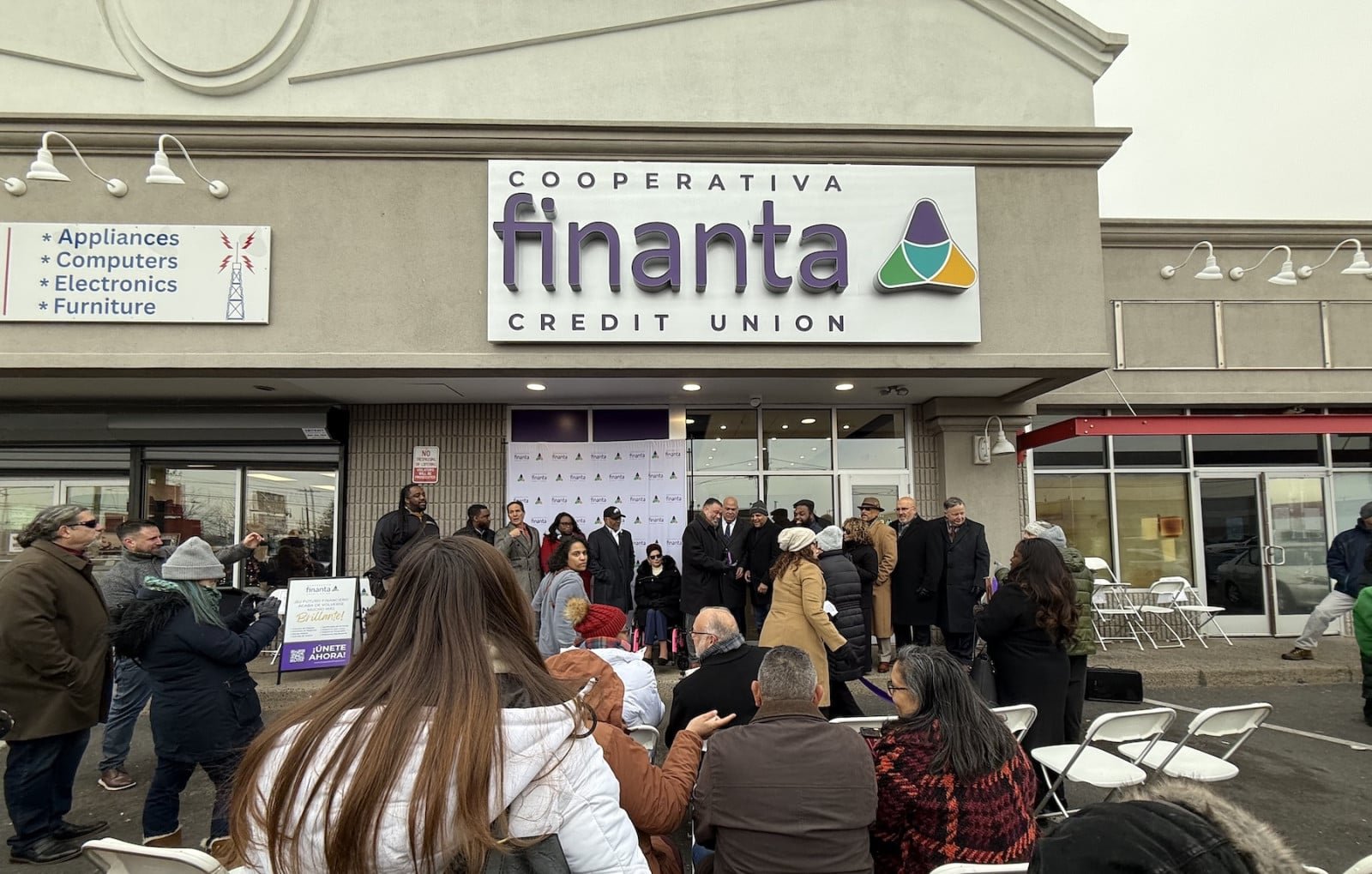
In December, Auli opened up new accounts for herself and for her bakery at Finanta Credit Union, which had just opened its first branch in Philly just a five minute drive from El Coqui’s location at the Harrowgate Plaza shopping center. She’s moving the bakery’s everyday banking out of the big bank that’s been charging her for daily operations like making change. Serving a largely immigrant community means a lot of daily cash transactions for El Coqui, Auli says, and those small charges add up.
It was Finanta that made the first loan to El Coqui more than a decade ago, helping Auli move the business out of her home kitchen and into its first brick-and-mortar commercial space. Back then, Finanta was just a revolving loan fund. It couldn’t offer to open bank accounts for its clients at that time, but it could provide small startup business loans using a version of lending circles — also known as tandas, sou-sous, hui, paluwagan or other names overseas and in diaspora communities. Finanta has been around in various forms since the early ‘90s, but it only obtained a credit union charter in 2022 — an astonishingly rare occurrence nowadays, as Next City reported at the time.
Among the credit union’s first account holders in Philly are the low-income households receiving $500 a month over a 14-month period as part of a guaranteed income pilot program run by Xiente, a local nonprofit. The payments get direct-deposited into accounts at the credit union, which households can access using debit cards, online and now via Finanta’s branch itself — located in the middle of a popular commercial corridor and right on a stop for two busy bus lines.
“It was a bank willing to work with our families where some of us have never been a client with a bank before.”
“It was a bank willing to work with our families where some of us have never been a client with a bank before,” says Michelle Carrera Morales, executive director at Xiente. “They needed a trusted organization and we needed the flexibility Finanta offered to the demographic that we serve.”
The organization recently closed on an $8 million New Markets Tax Credit deal with Finanta to renovate one of the buildings on the former St. Boniface Parish campus into a new “economic mobility center,” designed to bring Xiente’s financial counseling, economic and workforce development and other programs — currently scattered across the former parish facilities as well as several residential buildings that Xiente owns nearby — under one roof.
Finanta’s new credit union branch means North Philly residents now have an option to put their money to work for their own neighborhoods, helping finance investments in projects like Xiente’s new economic mobility center, beloved local businesses like Auli’s El Coqui, or homeownership for their longtime neighbors regardless of citizenship status.
They don’t have to finance these projects alone — Xiente’s project has funding from the state as well as philanthropy. But they can be part of the financing, instead of just passive recipients of outside funding.
Finanta CEO Daniel Betancourt speaks at the opening of the new North Philadelphia branch in December 2025. (Photo by Yami Cooks)
The $688 million question
It wasn’t always this way, but in the community development world right now, target communities themselves seem to be the last place anyone is looking for sources of investment in those communities.
Opportunity Zones, touted as the nation’s newest yet already largest economic development incentive, hinge on developers and project sponsors convincing corporations and high net-worth investors to invest some of their dollars today in the hopes of some tax-free capital gains income in ten years.
Private foundations are increasingly seen as sources of investment in affordable housing or small business, or even unorthodox approaches like worker-owned cooperatives or community-controlled real estate. That funding comes out of the income earned from the $1.6 trillion that foundations have invested in stocks, bonds and other assets including private equity and venture capital.
Federal Low-Income Housing Tax Credits and New Markets Tax Credits, at least, depend mostly on big banks purchasing the tax credits to support projects located in areas where each big bank has branch locations, giving those communities at least some ostensible connection to those investments — although the decisions about those investments are often made in distant underwriting departments with little if any real relationships to those communities.
In theory, at least some federal dollars as well as state or local government dollars also come from the communities where they’re sent back to fund community development. But there’s rarely a direct line.
Prior to obtaining its credit union charter, Finanta had decades of experience raising community development dollars from large banks, philanthropy, and federal as well as state and sometimes local government sources. As a federally-certified community development financial institution, or CDFI, Finanta has so far received $55 million in financial assistance from the U.S. Treasury’s CDFI Fund, as well as $160 million in New Markets Tax Credit allocations.
Finanta has combined all of those funding sources to make $580 million in loans and investments since inception in 1992. Of that, 86% has been loaned or invested in borrowers or businesses located in low-income communities, and 64% has gone to borrowers of color.
Finanta’s relative impact and reach has been typical of the 500-plus CDFIs that operate as revolving loan funds. Some specialize more in affordable housing or residential lending, others more small business or commercial. While a number of those loan funds had local investor roots, like raising funds from local religious order communities or churches to invest nearby, loan funds like Finanta have mostly specialized in bringing in all those other sources of funding from beyond the communities where they make their loans.
“All of my nos from over there are now yeses. I’m able to cater to my community in the way I really want to, in a way that has been missed, instead of just looking at everyone as just a number.”
And yet, in just the 19134 ZIP code that Finanta’s new Philly branch shares with El Coqui, there are $688 million in deposits held across nine different bank branches — some of which can be seen from the credit union’s front door.
Iris Santiago managed one of those branches before joining Finanta last year as its new branch manager.
“All of my nos from over there are now yeses,” says Santiago, who grew up in the area and whose family still lives nearby. “I’m able to cater to my community in the way I really want to, in a way that has been missed, instead of just looking at everyone as just a number.”
Many small businesses in her neighborhood are seen as too risky by bigger banks.
“Around North Philly, you bump into so many people posted up outside on the streets doing business, not having a brick and mortar, maybe doing it from a good truck that’s not necessarily registered,” Santiago says. “Not that long ago someone had their business taken away because they didn’t have all the proper licensing since they were stuck at different stages of documentation. They’re not a member yet but I cannot wait to see that person and say, ‘Hey, I can help you.’”
Typically, a new credit union is very limited in the kinds of lending and investments it can make. The National Credit Union Administration, the independent federal agency that charters credit unions and insures their deposits, tends to limit new credit unions to personal loans or car loans in their first few years of operation until they can prove themselves to be sound financial managers.
But since the credit union is attached to an established loan fund as its primary sponsor, Finanta’s new credit union members in Philly have immediate access to the organization’s full suite of borrowing options. These include home mortgages accessible to borrowers who lack a social security number but have an Individual Taxpayer Identification Number (ITIN), as well as Finanta’s Affinity Group Lending Program, the lending circle program that Auli used to obtain her first small business loan for El Coqui.
No such thing as a hopeless place
When it obtained its credit union charter in 2022, Finanta joined a select few CDFIs that combine a loan fund and a full-service depository institution under one organizational roof.
That list includes North Carolina-based Self-Help Credit Union and Self-Help Ventures Fund, D.C.-based City First Bank, Arkansas-based Southern Bancorp, and the Mississippi-based Hope Credit Union and Hope Enterprise Corporation.
“Sitting next to [Hope Credit Union co-founder] Bill Bynum talking about the impact that credit union had on Black families in the South, my mind opened up,” says Daniel Betancourt, Finanta’s CEO. “The mass retail approach means we’re targeting help for a lot of people versus entrepreneurs who are just a segment of disadvantaged communities. In a way it’s a much bigger vision.”
Hope Enterprise Corporation CEO Bill Bynum speaks during rural policy forum at Mississippi Valley State University in Itta Bena, Mississippi on Feb. 12, 2019. (Photo by Rogelio V. Solis / AP)
Depending on who you ask, Hope’s hybrid loan fund-credit union model was an accident, fate or divine intervention.
In the mid-1990s, a group of philanthropic and civic leaders came together to form Enterprise Corporation of the Delta as a loan fund to provide financing and other assistance for businesses and economic development projects in the Delta region of Arkansas, Louisiana, and Mississippi. To run the fund, the founders recruited Bill Bynum out of North Carolina.
Upon moving to Jackson, Mississippi in 1994, Bynum went out to find a church he and his family could join. At Anderson United Methodist Church, Bynum met Rev. Jeffery Stallworth, whom he told about his life back in North Carolina. Bynum had worked at Self-Help Credit Union, where he was a charter organizer and early employee. He was inspired to work there in part because he had seen how a credit union based in his vice-principal’s garage was the only banking option for Black residents in the town where he grew up. Later, financing from Self-Help enabled Bynum’s family to become homeowners.
The Sunday after that first meeting, Pastor Stallworth introduced Bynum and his wife to the congregation — and announced that Bynum would be helping the church achieve its longtime goal of chartering a credit union to serve its members. Chartered in August 1995, that credit union was named after Bynum’s wife: Hope Simmons Bynum, who passed away in 2019.
Fast forward to the early 2000s. At his day job, Bynum was working at Enterprise Corporation of the Delta, raising funds from philanthropy and other sources and working on a growing pipeline of loans and projects. It was among the very first crop of federally-certified CDFIs in 1996, receiving $2 million from the brand-new CDFI Fund in the agency’s first round of financial assistance.
A customer uses an outdoor ATM at a Hope Credit Union branch in Jackson, Mississippi in 2021. Hope Credit Union, a federally-certified CDFI, has nearly tripled in size between March 2020 and the end of 2025. (Photo by Rogelio V. Solis / AP)
But the loan fund’s pipeline was starting to grow faster than Bynum could fundraise; generations of disinvestment had left the Mississippi Delta region with a deep backlog of investment needs.
Meanwhile, Bynum spent many of his off-hours helping run Hope Credit Union, which was starting to take off. The credit union’s membership had expanded to include other nearby church congregations in the Mississippi Delta. Its deposits grew from $1.6 million in 2001 to $3.4 million by 2003. Hope was starting to hold more in deposits than it could make in loans through its limited staff and volunteers.
In hindsight, more than 20 years later, the solution seems almost too obvious. In 2003, Enterprise Corporation of the Delta became Hope Credit Union’s primary sponsor organization, formalizing what started out as an informal partnership between the organizations. Some of the first loans that the loan fund had made, where the projects or businesses had stabilized and were reliably making monthly payments, were refinanced by the credit union — freeing up the loan fund to finance the next few economic development projects or businesses in its pipeline while using members’ deposits to invest in projects that were already generating jobs and other benefits for their communities.
Hope Credit Union went from zero commercial real estate mortgages in 2003 to $27 million in 2007. Over the same time period, the credit union also went from zero home mortgages to $25 million — meeting a growing demand from many of its church-based members. In terms of deposits, by 2007 Hope Credit Union had grown to $45 million.
In 2011, Enterprise Corporation of the Delta rebranded as Hope Enterprise Corporation. Currently, the loan fund and credit union have more than $1 billion in assets combined, while Hope Credit Union holds $628 million in deposits from nearly 50,000 members stretching across the Delta, New Orleans, Memphis, Alabama and Georgia.
Finanta isn’t quite there yet, having just obtained its credit union charter in 2022 and only opening its first branch in Philly in December. It also has branches in Reading and Lancaster, PA, where the loan fund has also been working since the early 1990s. So far Finanta’s credit union has close to 2,000 members and more than $15 million in deposits across all of its branches.
“The loan fund is learning from the credit union,” Betancourt says. “It’s almost like a more grassroots workers movement, if you think about it. I came from traditional banking, but this is a more community organizer approach.”