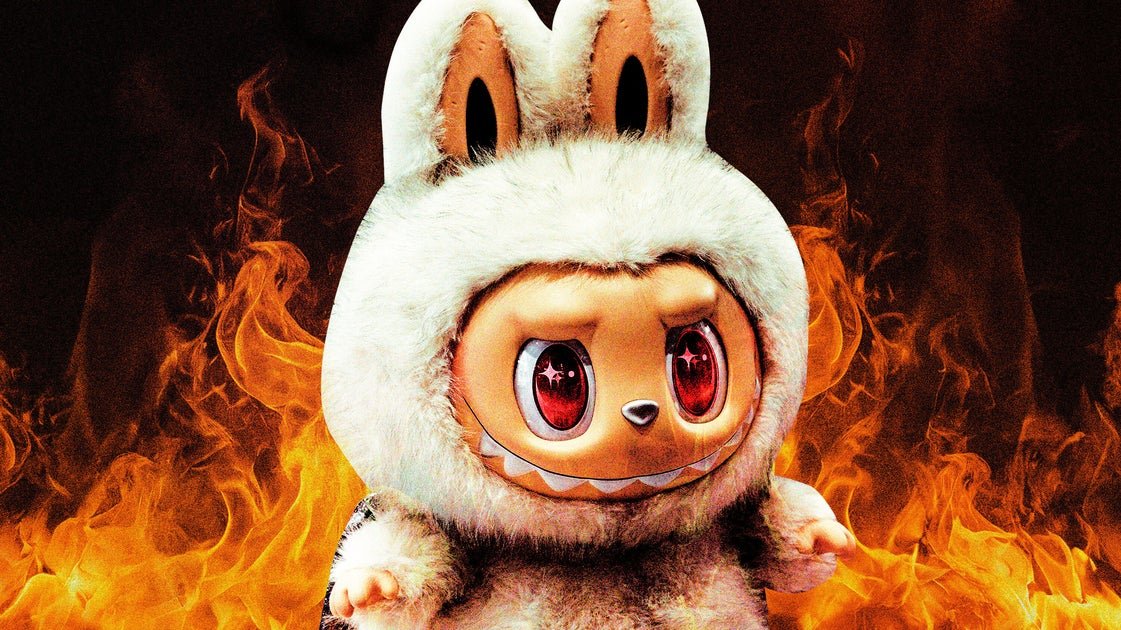
Labubu ― the doll created by Beijing-based toy manufacturer Pop Mart ― is many things: a viral sensation, a toy that’s fetched as much as five figures on the secondary market, an “ugly-cute” phenom (look at those little serrated teeth and maniac eyes!), a fashion darling.
But are these fuzzy guys also “agents of Satan”?
Some spooked parents and a handful of Christians on TikTok and X have said that the mini stuffed animals are demonic and inspired by Pazuzu, a Mesopotamian god who hasn’t gotten this kind of name recognition since it was featured in the “The Exorcist.”
In both William Peter Blatty’s novel and the 1973 movie adaptation, Pazuzu is the dastardly spirit that possesses young Regan. Later, Pazuzu starred as the demonic statue that Homer Simpson accidentally orders thinking it’s pizza in one “Treehouse of Horror” episode of “The Simpsons.”
Now, he’s apparently taken over Labubu.
Illustration: Kelly Caminero / HuffPost; Photo: Getty Images
Is this the face of evil? Some online are saying yes.
“You need to know what you’re inviting in your home,” TikToker The Spilled Tee said in one viral video. ”[Labubu dolls] could be a modern-day vessel for a demon god worshipped thousands of years ago, and I’m not just guessing about that.”
Egads! Should you be worried that your Labubu-obsessed kid or girlfriend is going to become possessed by their Labubu née Pazuzu, and start vomiting up pea soup at you, a la Regan? Probably not! But it is interesting how certain people have latched on to this internet myth and how fear of Labubu plays into old, familiar patterns of satanic panic.
What’s the actual backstory of Labubu?
The truth is, the lore of Labubu is pretty sparse. The dolls are characters from the “The Monsters” series, which was created in 2015 by Kasing Lung, a Hong Kong-born artist now based in Belgium. Lung has said the series is inspired by Nordic mythology that Lung gravitated to as a child.
“I spent a lot of time reading in the library to improve my Dutch,” Lung told China Global Television Network (CGTN). “After my studies, I was preparing to become an artist. I always thought about my childhood, what I’ve read and what I’ve always loved. So I’ve always come up with something related to the fairy tales and what I loved so much when I was a kid.”
Dramatically, Lung did say “Labubu is in my soul. It dares to do the things that I want but don’t dare” ― but nothing about Pazuzu.
Kevin Frayer via Getty Images
A performer wears a costume of a character from Pop Mart’s hugely popular Labubu dolls series while dancing for visitors at the Pop Land theme park on July 17 in Beijing, China.
Just who is this Pazuzu guy?
Long before “The Exorcist” or Labubu blew up his spot, Pazuzu was an ancient Mesopotamian demon associated with the winds, said Eckart Frahm, a professor of Assyriology at Yale University.
“His iconography is known from numerous amulets and small figurines, many just rendering his head, dating to the first millennium BCE and found at various archaeological sites in ancient Iraq and adjacent regions,” Frahm told HuffPost.
Pazuzu is usually shown with a prominent rectangular head that combines theriomorphic (especially dog-like) and anthropomorphic elements, and a partly canine body equipped with claws of a predator bird, two pairs of wings, a scorpion tail and a penis erectus ending in a snake’s head. (Can’t say Labubu comes with all that.)
Chicago Tribune via Getty Images
Pazuzu, a king of demons ruling over the demons of the wind, is seen at the University of Chicago’s Institute for the Study of Ancient Cultures.
All these features contribute to Pazuzu’s “stunningly terrifying” appearance, Frahm said, but the god was not perceived as an instrument of evil in ancient Mesopotamia as he’s now being painted out to be. Instead, he served as an agent of white magic.
“The people of Babylonia and Assyria put his frightfulness to good use — especially against a demoness called Lamashtu, a terrifying ‘anti-mother’ with a lion’s head and sagging breasts who was believed to kill pregnant women and young mothers and snatch away their children,” Frahm said.
By wearing Pazuzu heads on a necklace, or by displaying Pazuzu amulets in close proximity to their beds, Mesopotamian women hoped to keep the evil Lamashtu away, he explained. (Fashionistas do fasten Labubus on their purses, so there’s at least one parallel between these two.)
Do Pazuzu experts ― Pazu-perts, if you will ― see the resemblance between him and Labubu?
Frahm has looked at a lot of Pazuzu figures in his time and really doesn’t see any pronounced similarities between Pazuzu and contemporary Labubu dolls.
“Pazuzu completely lacks the somewhat ‘fluffy’ appearance of the dolls, which have no bird’s claws, wings, or tails, and certainly no penis,” he said.
The only more noticeable parallel Frahm can pick up on is the syllable structure of the two names: La – bu – bu and Pa – zu – zu.
“It follows the same pattern there, but this may well be fortuitous,” he said. “The whole thing is clearly a stretch.”
DEA / G. DAGLI ORTI / picture alliance // Getty Images
Is there a resemblance between these two guys? You be the judge.
The moral panic around Labubu is nothing new.
David Waldron, an associate professor of history at Federation University in Victoria, Australia, has long studied satanic panic and Christian fears over secular trends and fads.
Satanic panic over cultural trends tend to happen when there are changing values or perceived threats to tradition, established power structures or organizations, he explained. The collective worry that ensues is a way to cope with change.
Take, for instance, the 1980s Dungeons and Dragons panic. As a self-proclaimed nerdy youth, Waldron spent a considerable time playing the tabletop role-playing game and remembers people routinely claiming that the game was teaching kids “real”magic and the dark arts.
“Ironically, this was also the case with early ‘Harry Potter’ fanfare, though now its creator J.K. Rowling is a darling of conservative Christians because of her anti-trans statements,” he said.
Barry Batchelor – PA Images via Getty Images
Some little kids about to be indoctrinated into satanism because of “Harry Potter.” Just kidding.
Much like the fears over D&D, Cabbage Patch kids, the “Momo challenge” or even rock music ― the Beatles and Elvis were called satanic, too ― claims of supernatural danger spread rapidly when a strange or unsettling design meets existing religious anxieties, Waldron said.
“All these dramatic claims are designed to spike anxiety around youth culture,” Waldron told HuffPost. “Plus, for some Christians, Labubu’s popularity can trigger concerns about idolatry or demonic influence, especially when it’s perceived as a cultural craze drawing intense devotion.”
In this case, “it’s one of those situations where the fictional representation, ‘The Exorcist,’ has supplanted actual history and culture in people’s minds,” the professor said. “For some Christians, the possession in that film and movie has become a focal point of their fears and anxieties.”
Scholars think this Labubu panic is kind of silly, but also kind of sad.
The fact that in 2025, we’re still having conversations about inanimate objects being possessed is kind of crazy to Frahm.
While this whole story could be considered a “harmless silly season phenomenon,” Frahm also sees here a “pronounced inability, grounded in intellectual laziness, to look at ancient artifacts in their own right.”
“Those claiming the Labubu dolls have some sort of demonic power originating from Pazuzu seem to operate within a mindset that combines Christian fundamentalist beliefs a little bit too easily with modern pop culture in an attempt to prop up at all costs a gnostic view of a world that sees demons and evil forces all over the place that threaten the putative purity of their own lives,” he said.
Vincenzo Izzo via Getty Images
“The issue isn’t so much the dolls themselves, but the people who possess a set of lenses that make them prone to seeing demonic influence,” said Joseph Uscinski, a professor of political science at the University of Miami and an expert on conspiracy theories.
Demonic rumors or not, Labubu isn’t going anywhere.
20 Years OfFreeJournalism
Your Support Fuels Our Mission
Your Support Fuels Our Mission
For two decades, HuffPost has been fearless, unflinching, and relentless in pursuit of the truth. Support our mission to keep us around for the next 20 — we can’t do this without you.
We remain committed to providing you with the unflinching, fact-based journalism everyone deserves.
Thank you again for your support along the way. We’re truly grateful for readers like you! Your initial support helped get us here and bolstered our newsroom, which kept us strong during uncertain times. Now as we continue, we need your help more than ever. We hope you will join us once again.
We remain committed to providing you with the unflinching, fact-based journalism everyone deserves.
Thank you again for your support along the way. We’re truly grateful for readers like you! Your initial support helped get us here and bolstered our newsroom, which kept us strong during uncertain times. Now as we continue, we need your help more than ever. We hope you will join us once again.
Support HuffPost
Already contributed? Log in to hide these messages.
This is likely a small number of people who actually buy into this, relatively speaking, said Joseph Uscinski, a professor of political science at the University of Miami and an expert on conspiracy theories.
“Everything that becomes big attracts the attention of lots of people, some of whom seem Satan and demons everywhere,” he said. “So, the issue isn’t so much the dolls themselves, but the people who possess a set of lenses that make them prone to seeing demonic influence.”