Dispatches
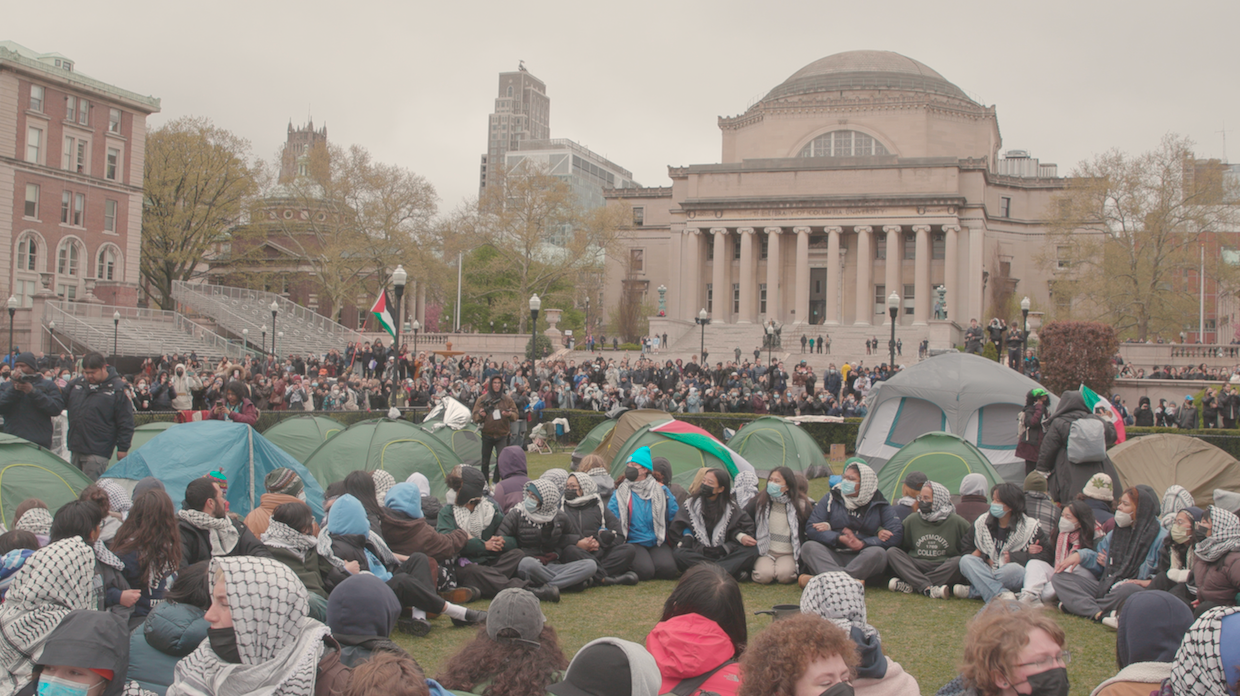
Dispatches, a feature-length vérité documentary I’m currently co-directing alongside Kira Boden-Gologorsky, follows protesters and student journalists covering the fight for free speech on Columbia University’s campus at protests which made international headlines and faced mammoth political backlash. But more than just chronicling those events, Dispatches explores what it means to report from within an institution while it’s in crisis and to film the story when you are already inside it. By the time tents appeared on our campus’ South Lawn in April 2024, I had already filmed dozens of hours of footage and spoken with countless students who had all declined to go on the record. Some had already been doxxed, harassed and threatened, while others feared being fired from their job, or banned from future opportunities for which they had invested in Columbia. We were students and journalists, our community was at the center of one of the biggest news stories of the year…and it felt like no one was listening to us.
One of the first things I learned in my filmmaking career is that “access is everything.” I understood this in a superficial way—having worked in TV and radio journalism, I thought it was obvious you have to get someone to agree to be on camera. What I didn’t realize is I wasn’t asking someone for a quick comment or a 45-minute interview—I was asking young adults, who had just barely left the cocoons of their parents’ homes, to open up about months of trauma they had endured, and to be placed under a microscope while they put their safety on the line and risked all they had to risk.
What I saw when legacy media interacted with the protesters was that “access” is treated as currency to be acquired, negotiated or controlled. At Columbia’s iron-cast gates, mainstream reporters often waited behind barricades, relying on institutional access. In contrast, student reporters built relationships over time. This became especially clear one afternoon when I entered the camp with my camera and a national broadcast reporter shouted at me, “Hey! Why do you get to go inside?” Around him, journalists with expensive rigs and shiny press credentials stood waiting. But the students inside the camp had set their own terms: no cameras without consent, no press without trust. Outside press was being carefully monitored due to safety concerns, fears of being doxxed and concerns about privacy for the students living in the camp 24/7. What a classroom could never teach me is that access is built from hours spent not filming, not asking—just listening. It doesn’t come from a press badge; it comes from showing up consistently, honoring boundaries and demonstrating that your work is being done in good faith.
Dispatches was shot in the heat of breaking news, but it is not a news broadcast. It’s vérité, observational and character-driven. We wanted to provide an alternative to the reactive news content created during that time by capturing the small, revealing moments between the chaos—shivering students waking up under the rain when the university banned tents for a couple of days, the countless food options available thanks to donations from the local restaurants, meticulously organized democratic assemblies where all members of the camp gathered to shape their newly formed society, art build stations where you could get t-shirts, stickers and posters to forever remember this moment. These were the moments of community that existed in the encampment—and defined it—when the mainstream media wasn’t around.
This ethos shaped every aspect of our production, like filming with gear that was lightweight, flexible and unobtrusive. The School of Journalism provided C200s for us to use, and we gave up on carrying tripods as they were just slowing us down. Although the camera only weighs about four pounds, I slung it over my shoulder for four to six hours a day and held it upright for hour-long interviews at a time. I have yet to get rid of the pain in my left shoulder one year on. We carried minimal audio equipment and kept everything mobile—no boom pole, only small zoom recorders with a microphone attached and our trusty lav mics for longer in-situ interviews. We were able to move quickly in case of an emergency.
At any moment, the situation could escalate, and eventually it did. In those moments, the question wasn’t just how to document. It was how to do so responsibly. We agreed to have a “buddy system” where we split off in pairs when we were out “in the field” reporting to make sure we were never left alone during moments of crisis. Our professors, who have years of conflict reporting experience, gave us advice on how to deal with possible arrests and teargas deployment, and we scribbled the phone numbers of our lawyer frantically on our arms. We also built emotional support systems, which entailed regular debriefs with collaborators, space for rest and a culture of care within our small team. This support and camaraderie was the only way we could keep doing our work in this volatile environment. It was the only reason I seldom stopped filming as the student protesters were arrested by a mammoth wave of abundantly equipped NYPD officers.
One of the most complex dimensions of this project was the question of consent, particularly in an environment where students faced real consequences for speaking out. Working in close consultation with legal advisors and documentary mentors, we created a system of protocols to ensure that participants knew exactly what they were agreeing to. These included evolving consent, such as the right to withdraw or modify participation at any time. We agreed to not film or blur out faces, or applied voice distortion for participants who requested anonymity. We also offered to allow for collaborative review for high-risk interviews. These protocols were not about editorial compromise. They were about protecting the safety of our participants.
While still in production, we’ve begun to shape Dispatches not just as a film but as a tool that can support dialogue and education around student press freedom, civic engagement and media literacy. We’re working with educators, librarians and First Amendment lawyers to develop impact programming. These will include curriculum materials gathering research from student journalists across the country on how to report on their own universities during times of political upheaval. We would also like to organise screenings with student newspapers, and provide space for facilitated conversations led by their student body coming together in a safe space for dialogue and understanding. We are in contact with students across the country who are keen for this cross-collaboration to take place. Our goal is to use the film as an entry point for difficult, necessary dialogue that is central to our generation’s future. This is a film about student journalism, protest, and the First Amendment, but it’s also about the ethics of storytelling, what it means to witness, and to be witnessed, and how we build trust in an era of distrust.