This is your first of three free stories this month. Become a free or sustaining member to read unlimited articles, webinars and ebooks.
Become A Member
This story was produced in partnership with Feet in 2 Worlds, an independent media outlet and journalism training program that empowers the voices of immigrant journalists.
Samantha Bernardine was growing tired of Zoom meetings. Being a high school teacher in October 2020 meant spending the day staring at gray boxes on her computer. Yet Bernardine was looking forward to her next meeting. Her principal at the Erasmus School in Flatbush, Brooklyn, had asked her to represent the school in a community task force meeting organized by the mayor and city council. They would be discussing the empty lot next to Erasmus — a patch of grass on the corner of Bedford Avenue and Church Avenue.
The mayor and the district’s council member — then Bill de Blasio and Matthieu Eugene, respectively — outlined their plan to build an affordable housing development on the lot. Bernardine wondered why they wouldn’t instead build a park for the children who attended the several schools around the lot and who lacked green space.
At some point, someone from the New York Historical Society chimed in with a question: Wasn’t the lot at Bedford and Church a known African Burial Ground?
Bernardine balked. “ We all kind of paused and was like, come again? What do you mean?”
Extensive historical records showed that the plot of land and some of the area around it was a burial ground for freed and enslaved Black people in Flatbush, the Historical Society representative explained. The Flatbush Dutch Reform Church Cemetery up the block, meanwhile, had been for whites only.
Bernardine and some other community members became enraged.
“ How could you build on top of a known burial ground?” Bernardine asked. “Especially a burial ground of Blacks – of us, of me, of my descendants?”
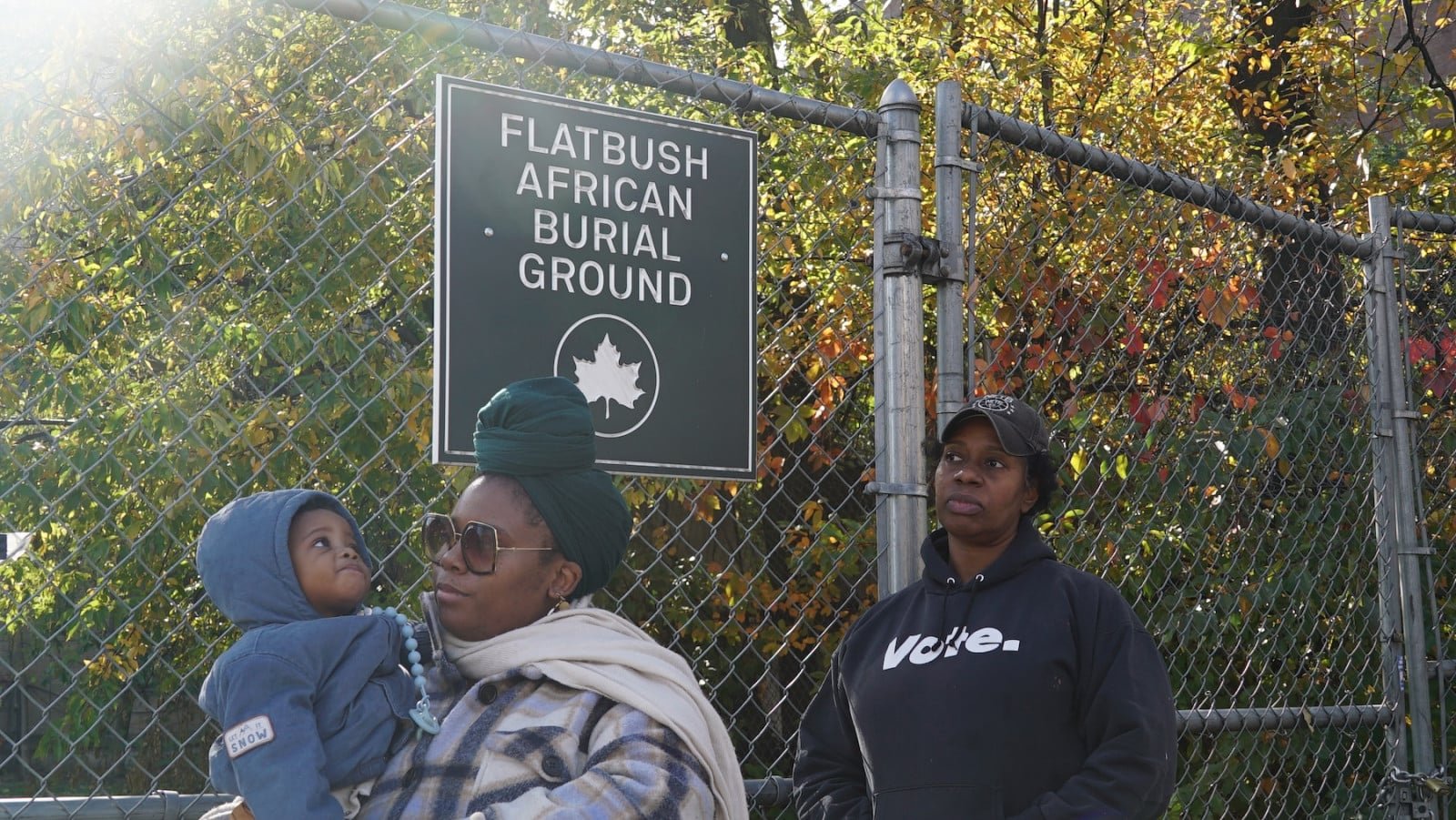
Bernardine is one of the founding members of the Flatbush African Burial Ground Coalition (FABG-C), along with Shanna Sabio, Allyson Martinez, and Shantell Jones. The FABG-C was created in 2021 to protect the former burial ground from “further desecration.” The FABG-C dedicated itself to spreading awareness about the burial ground and pushing back against the housing plan.
In under a year, the FABG-C’s activism and community engagement helped put an end to the Department of Housing Preservation and Development’s plan to develop a high-rise on the burial ground. But attempts to memorialize the site have been rocky.
In December 2022, the site’s jurisdiction and budget were reallocated to the Parks Department, which sought to create a memorial park on the land. Initially, the Parks Department seemed more willing to work with the FABG-C and the community to collaborate on a design plan for the lot that would memorialize its history while directly addressing the neighborhood’s needs.
Three years later, advocates say the Parks Department has literally and figuratively locked the community out of the burial ground: Bernardine leads regular clean-ups outside the fence, but must email the department for a permit to enter the lot. Most of those requests have gone unanswered, she says.
Although the FABG-C was proud to have stopped the development from being built on top of it, Bernardine says, it has felt frustratingly out of the loop after the Parks Department’s initial meetings with the community.
(Photo by Jesse Allain-Marcus / Fi2W)
A forgotten history
At the turn of the 19th century, Flatbush was made up of wide, rolling expanses of farmland, dotted with trees and the occasional house — mostly family homesteads organized around the Dutch Reform Church.
“Most of the land was owned by three major families, and they’re probably very familiar to New Yorkers today,” says Prathibha Kanakamedala, professor of History at Bronx Community College. “It is the Cortelyous, the Lefferts, and the Bergens.” Today, there are streets, parks, and even entire neighborhoods throughout central Brooklyn that carry these families’ namesakes, while the history of the people whom they enslaved has largely gone forgotten.
Sarah Hicks was born in one such homestead in the late 1700s. The homestead belonged to Jacob Lefferts — as did her mother and father. They were enslaved to the Lefferts family. One of Sarah’s earliest memories, as she recalled to Peter Lawrence Schenck in Historical Sketch of the Zabriskie Homestead (removed 1877), Flatbush, L.I., was playing at the Erasmus School near the Lefferts’ homestead.
Sarah also remembered having a twin sister, Phyllis. Phyllis had died young. She remembered taking a basket of cake and wildflowers to Phyllis’s grave, which was “in the burial-ground for colored people…near the public schoolhouse.”
Phyllis was one of the many people who were interred and then forgotten about in the Flatbush African Burial Ground, which a city-contracted researcher theorized was in use until 1835.
Over and over, the burial ground was built over. The “public school house” was built over the burial ground in 1842 and expanded throughout the next few decades; Bedford Avenue was built over it in 1865; another house was built over it in 1875; a sewer was built through it in 1890. All of this development happened despite maps showing the cemetery’s location as early as 1855.
Read more: The Disgraceful History of Erasing Black Cemeteries in the United States
Throughout all of these construction projects, human remains have been found in and around the burial ground on several occasions. The most recent was in 2001, when an archaeological assessment ordered by the NYC Board of Education unearthed four human teeth and a mandible. Analysis suggested that some of these teeth had come from a young woman who had passed away due to malnutrition.
All of this information was included in a report to the city, yet few residents seemed to know about any of it.
(Photo by Jesse Allain-Marcus / Fi2W)
Displacing Black communities – and Black history
“You see all the high-rises being built here?” Bernardine asks. Taking a look around Flatbush, it seems as though new high rises and condo developments are being built around every corner. One block away from the Flatbush African Burial Ground, at 2720 Church Avenue, a massive construction project is underway. Soon, that lot will be home to a 17-story concrete and glass brutalist structure with 56 rental units.
Yet, of the thousands of new residential units built in Flatbush between 2010 and 2024, just 8% were designated for low-income households; the citywide benchmark is 27%. And over the past three years, only 17 affordable units have been completed in Flatbush.
New York City’s housing crisis has defined local politics for decades now. But attempts to increase housing supply have often priced out low-income communities of color rather than increasing affordability.
One of the government’s many strategies to alleviate the housing shortage was through the 15/15 Supportive Housing Initiative. In 2015, Mayor Bill De Blasio announced the local government’s plan to build 15,000 units of supportive housing — affordable housing that includes social services, substance and mental health treatment services — by 2030. In 2024, POLITICO reported that only 3,853 of these units had been built since 2016.
Meanwhile, 4,359 new housing units were completed in Flatbush alone between 2010 and 2024, less than one in five of which are income-restricted. What this means for Flatbush is much the same as in many other Brooklyn neighborhoods; rents are rising rapidly to match the demand of new residents, while those who have lived there for generations are being squeezed out.
“We’re not anti-affordable housing, we just don’t want affordable housing on top of a burial ground,” FABG-C co-founder Sabio told the BKReader in September 2021. Less than a month later, then-Brooklyn Borough President Eric Adams published an open letter to the mayor agreeing with the coalition. “Our borough absolutely needs to build more affordable housing, especially in Flatbush,” Adams wrote, “but I cannot support building it on an area shown to have human remains of enslaved people below.”
(Photo by Jesse Allain-Marcus / Fi2W)
Since the mid-20th century, Flatbush has become home to a thriving Caribbean community, with some parts of the area dubbed Little Caribbean and Little Haiti. From the annual J’Ouvert parade to the aroma of jerk chicken and oxtail wafting out of family-owned restaurants, the neighborhood is characterized by its connection to Caribbean culture.
But gentrification has slowly begun to foretell a shift in Flatbush’s character. The neighborhood lost 9,031 Black residents between 2010 and 2020, according to 2020 census data, and added 4,327 white residents. In 2015, a 2-bedroom apartment in Flatbush cost about $2,200; today, it’s an average of $3,500.
Flatbush locals recognize the need for more affordable housing in their neighborhood. But advocates argue that it shouldn’t mean erasing the history of Flatbush’s Black community.
For some New Yorkers, the conflict brings to mind the case of the Jacob Dangler House. In the historically Black neighborhood of Bedford-Stuyvesant, the Jacob Dangler House was a stately, ornate mansion built by the architect Theobald Engelhardt in the late 19th century. In 1967, the house was bought by a Masonic organization mostly made up of Black women. For decades to follow, the Dangler house was a meeting and event space for the community. Michael Williams, a longtime resident of the neighborhood, told The New York Times that he remembers going to Cub Scout meetings in the Dangler House in 1962.
In July 2022, after a long fight between developers and the local community, the New York City Department of Buildings issued a permit for a full demolition of the Dangler House. One video shows a yellow bulldozer arm opening its jaws and pulling the house apart, quickly reducing the historic site to rubble. The developer who purchased the lot now plans to build condos on the site.
The threat of encroachment on the Flatbush African Burial Ground has taken on particular significance to community members since Donald Trump began his second term as president and set out on a campaign to erase Black history and quash discussions of racism. His administration has worked to discredit the National Museum of African American History and Culture and minimize Black history within the public education system.
“Preservation,” says Marcus Smith, the founder of the Black Grassroots Heritage Preservation Network, “is fundamentally about Black community in this context.” Smith emphasizes that Black Americans’ grassroots preservation efforts across the country are essential to shape national historical narratives and reclaim what he calls “Black self-authorship.”
“ It’s part of a larger legacy … to preserve, to share, to celebrate African American history in the face of erasure,” Smith says.
All across the United States, there are microcosms of this uphill battle. Camp Naco in Arizona, the Suffolk African-American Waterman Villages in Virginia and the A.G. Gaston motel in Alabama are just a few examples of physical histories that shed light on the underreported experiences of Black Americans. Sites that represent Black history make up less than 2% of entries in the National Register of Historic Places.
Smith believes that the places and people that are chosen to be memorialized, remembered, or preserved are a direct representation of which histories our society values most.
“What does it mean when a community says that they value the history of the people within a cemetery?” Smith asks. “They’re saying they’re acknowledging through policy, through funds, through preservation, that this history and this community … are essential to understanding the history of this town and this country.”
Black grassroots historical preservation campaigns are also often in resistance to some kind of displacement or gentrification, Smith says, making these efforts a form of political empowerment and advocacy.
But building more affordable housing does not need to be at odds with historical preservation efforts, he emphasizes. New developments in gentrified neighborhoods are often built without community knowledge or input, which is the key problem, he says.
“What it really comes down to is, to what extent does the community have control to self-determine its own future?”
(Photo by Jesse Allain-Marcus / Fi2W)
Community engagement
Flatbush residents don’t hold any one specific vision for the burial ground’s future. Even among the coalition and the neighborhood, there has been disagreement about what memorialization looks like. At some point, some had wanted it to be a garden. Others wanted it to be a park, and others still didn’t want it developed at all.
For the coalition, though, having these types of open discussions is the point.
Their ideal situation would be a collaborative process that allowed it, as well as the wider descendant community, to have a real voice in deciding what a memorial on this land would look like. “We want an inclusive process that brings in the youth and elders in the community,” says Shantell Jones, the FABG-C’s co-leader and board secretary.
Before the burial ground’s jurisdiction was officially given to the Parks Department, the FABG-C had suggested turning it into a community land trust, Jones says. But the Parks Department’s plan to take over stewardship went forward by the beginning of 2023.
What is a community land trust?
With an estimated 300 to 450 such trusts across America, community land trusts (CLTs) are an increasingly popular model for creating and preserving local ownership and long-term housing affordability.
CLTs are locally-based nonprofit corporations that acquire properties in their service area, then sell the buildings to low- or moderate-income homebuyers through a renwable ground lease. The nonprofit retains the deed to the underlying land, which is leased to homeowners through a renewable ground lease.
This lease is usually 99 years, in contrast to other shared equity or inclusionary housing models that have 20- or 30-year limits. Nonprofits also embed provisions in the lease to ensure these homes remain affordable to income-qualified households even if the homeowner decides to sell and move on, which restricts the profit a homeowner can make. Read more.
The lead landscape architect for the Park Department’s project at the burial ground is Emmanuel Thingue, a Caribbean-American immigrant who was raised in nearby Crown Heights and who came out of retirement as the department’s designer to lead this effort.
His plan for the Flatbush African Burial Ground was to expand the area, plant Palaver trees — which the presentation deck describes as a “neutral gathering spot for community discussions” in “African traditions” — and build a memorial to honor enslaved people’s West African heritage and symbolize “struggle and resilience.”
The Parks Department typically does not consult the public again after the initial design phase. However, representatives from the Parks Department noted in nearly every meeting that this project requires more sensitivity, care, and community input than its usual process in order to memorialize the space’s history respectfully and inclusively.
The design phase has lasted about three years, Thingue tells Next City. “The reason why it’s been so long is that we wanted at every step to get the community involved and to keep them updated. So it’s been a learning process for this particular project.”
On a Zoom meeting for the Flatbush African Burial Ground Task Force on April 27, 2023, Davey Ives, the then-Chief of Staff for the Brooklyn Parks Department, said that Parks wanted to “make this burial ground something that the community is really proud of.” That was the first meeting that kicked off the project under the Parks Department’s jurisdiction.
But in New York City, the process of establishing new public memorials and parks is long, rigid and bureaucratic. Despite what may have been its best intentions, advocates say, the department struggled to fulfill Ives’ commitment.
(Photo by Jesse Allain-Marcus / Fi2W)
In the meeting, Talisha Sainvil and Duane Joseph, co-chairs of the ad-hoc Flatbush African Burial Ground Committee on Community Board 14, repeatedly emphasized that the Parks Department needed to prioritize community outreach and engagement with the descendant community, given the deeply important and sensitive nature of the project. When Sainvil asked what the department’s plan was, Ives replied: “ We don’t have a concrete outreach plan at the moment.”
Duane Joseph, as well as community organizer Corazón Valiente, suggested in the meeting that the department could contract a third-party vendor to improve outreach and engagement. This suggestion was not taken up.
The Parks Department and Council Member Rita Joseph’s office also organized several town halls to collect design input from the public. But Jones argues that these engagement sessions were poorly advertised and poorly attended. “I don’t really remember seeing flyers in the neighborhood, and it was only posted on Rita Joseph’s Instagram,” Jones remembers. Thingue, however, says he remembers the community outreach being more extensive.
Throughout 2023, Community Board 14’s monthly meeting minutes include time for an ad-hoc committee dedicated to updates about the Flatbush African Burial Ground. The Parks Department also gave relatively frequent updates and organized community engagement efforts at the time. “I really felt like it was going somewhere,” Sainvil said.
However, mentions of the ad-hoc committee and the burial ground itself are almost non-existent in the board meeting notes for 2024. According to Sainvil, the committee was dissolved near the end of 2023 with no word from the department. “There was no longer a need for [the committee] at the time,” Sainvil said, “because the onus at that point was on the Parks Department to move forward.”
Meeting notes indicate that the Parks Department didn’t give any update on the design until December 2024 and only presented the design at a community board meeting on March 6, 2025.
During that March meeting, Brooklyn Level Up co-founder and FABG-C co-trustee Allyson Martinez told the Parks project manager, “I just wanted to have a commitment from Parks that…we’re clear that there would have to be a governing or a partnering body with the community.” Martinez stressed the importance of the community’s continued engagement throughout the design and construction process.
The City Council and Parks both floundered to respond. “We’ll have to figure that out,” the project manager said.
Thingue, though, says he took all the feedback that the community gave and responded accordingly during that period. “After my initial design presentation to [the community], I totally reversed and went completely the opposite way based on what they commented on,” Thingue says. His initial sketches had interpreted the term “burial ground” more literally.
“I basically designed it in a way where people would stand and look at the site, almost like a cemetery. But the community wanted it to be more interactive … a place where they can have picnics and events and participate [with the site],” Thingue tells Next City. His most recent designs, Thingue says, have been a response to that initial feedback.
Jones says that, over the years, the FABG-C has presented opportunities for it to meet with the Parks Department on a regular basis. “We were always told, ‘we need to bring this to city council,’ and that Rita Joseph’s office has the final say,” Jones says.
Council Member Joseph told Next City that there have been “multiple opportunities for community engagement and public discussion” including presentations and Community Board 14’s discussions.
“From the outset, my office has emphasized that this sacred site must be shaped with the voices, history, and lived experiences of the surrounding community at the center of every decision,” Council Member Joseph said in a public statement. “That said, I look forward to continuing our community feedback sessions, deepening outreach, and promoting broader involvement, particularly as it relates to the proposed design and the path forward for this space.”
(Photo by Jesse Allain-Marcus / Fi2W)
During a Nov. 5 meeting of the Brooklyn Community Board 14’s Community Environment, Cultural Affairs, and Economic Development Committee, the Parks Department made its most recent public communication about the burial ground project.
“The FABG-C was not made aware of that last design update and has had no communication from Parks or City Council,” Jones tells Next City. She and Bernardine say they received little communication from these institutions for the past year.
In the November meeting, the Parks Department Brooklyn Commissioner Martin Maher explained that the Flatbush African Burial Ground had recently undergone a preliminary review by the New York City Design Commission. The Commission has final say on the design of all public parks and has given a few conceptual and technical notes on the park’s design. During a phone interview in early January, Thingue confirmed that the park’s design has been approved by the Community Board and the Design Commission.
Valiente is still skeptical about the park’s design. Although he says he understands the project’s bureaucratic and budgetary constraints, the incorporation of community feedback felt like “the bare minimum” to him.
But he remains cautiously hopeful the Parks Department will follow through on their promise to collect community input for the park’s remembrance wall. Thingue tells Next City that the names inscribed into the remembrance wall will be determined through community feedback once the project reaches that stage of the process.
Commissioner Maher also mentioned in the November meeting that an archeologist would be on-site throughout the park’s construction, differing from Parks’ usual process of only conducting an archaeological assessment before breaking ground.
According to a source that requested anonymity , the Parks Department has already quietly awarded a contract to an archaeological firm to supervise the park’s preliminary archaeological assessment at the burial ground. A Parks Department representative confirmed this. But when asked to provide the name of the firm or whether this decision would be formally announced to the public, the Parks representative replied that this stage was “typically…not the focus of community engagement.”
In 2023, New York State introduced a formal process to protect burial grounds through the Unmarked Burial Site Protection Act. Kelly Britt, an anthropological archaeologist and longtime partner of the Flatbush African Burial Ground, thinks the law is a good start but needs to be expanded to better protect Black burial sites.
“[The Unmarked Burial Site Protection Act] is not geared for urban settings,” says Kelly, who helped the coalition conduct its own ground-penetrating radar survey of the burial ground. “And it’s geared more towards Indigenous burial grounds.” For Black communities in an urban area like New York City, Britt argues, a more effective policy would require engaging with and involving the community, taking into account diverse diasporic perspectives.
“ Most of the city’s engagement is having one or two meetings that the majority of the community doesn’t know about,” Britt says. “They talk a little bit, get some information from the community, but pretty much already have an idea of what they’re gonna do. That’s not community engagement — in my book, anyway.”
On the Flatbush African Burial Ground’s online project tracker, the department still estimates that the design phase will be completed by September 2026, after initially targeting October 2024. However, the project is not even halfway through the design phase, which has already spanned nearly three times as long as the average park design time of 9 to 14 months.
The FABG-C is still hoping for more transparency during the design process, and is especially hopeful that it will be able to meet with the architects and archaeologists before the Parks Department breaks ground. “We just want to make sure that this is not done in a disrespectful way,” says Bernardine.