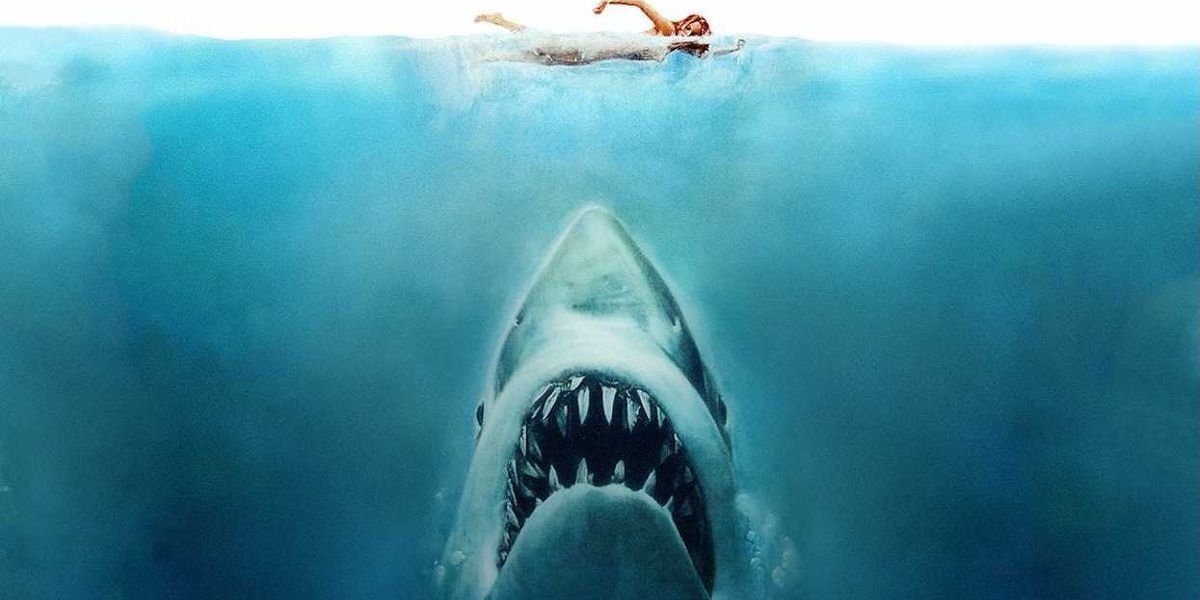
We open with a woman and a man running on the beach gleefully toward the ocean, taking off every article of clothing. She dives into the ocean and wades there as she waits for her lover to join her. All of a sudden, the lights go out. The screen turns dark. Two notes sound: “duh-dum, duh-dum.”
And at that instant, your pulse quickens. You can sense a bad thing is about to happen even before that bad thing appears on screen. That sound is more than just musical notes—it’s a warning that “the bad thing” is a shark, and it is circling nearby. As moments pass, the “duh-dum, duh-dum” notes intensify, and suddenly the woman feels a pull from inside the water. Before she can make sense of what’s happening, the shark has launched its full-scale attack. All that remains behind are the woman’s screams and the gut-wrenching two-note sound.
It’s been 50 years, but John Williams’ two-note theme for Jaws (1975)—used today in everything from cartoons to sports arenas—still serves as a shorthand for danger. It’s universal. It’s recognizable.
And yet, those notes barely made it through their initial run. When Williams first played the score, Steven Spielberg, then a young filmmaker working on his second theatrical film, assumed he was kidding.
Imagine this: the sound that we know now as the epitome of cinematic danger was almost rejected as being too simple, even ridiculous.
Why do you think a theme that was so appropriate for the movie was being overlooked? That’s the tale of how a piece of music that lives on in our collective memory was shaped by instinct, miscommunication, and one obstinate composer.
The Maestro and The Visionary
John Williams: A Composer at a Crossroads
John Williams wasn’t a rookie by the mid-’70s, but he also hadn’t become the Hollywood icon he would later become. He was a dependable name in disaster films, having composed the music for The Poseidon Adventure (1972) and The Towering Inferno (1974). He had previously collaborated with Spielberg on a smaller, road-movie, The Sugarland Express (1974). This collaboration sowed the seeds of trust, but trust in film is complicated, particularly when one side strives for grandeur while the other seeks simplicity.
Williams was aware that Jaws commanded something primordial. The film focused on the unseen and underlying fear rather than romantic swells or high drama. Though it would be difficult to persuade Spielberg of that, he had the instinct to remove ornamentation. The composer was at a crossroads where a single, audacious move could make or break his career.
‘Jaws’ CREDIT: Universal Pictures
Steven Spielberg: A Director with a Sonic Vision
Spielberg, just 27 but tremendously ambitious when the film went into production, wanted the sound design and the entire movie to seem fantastical. He envisioned something intricate for the shark, possibly a sweeping, orchestral cue or avant-garde textures, something that could operatically portray menace.
Instead, he heard a cello playing “two” alternating notes slowly and softly.
There could not have been a more acute disconnect—Williams was aiming for instinct; Spielberg had visions of grandeur. One of the most well-known musical misunderstandings in movie history was made possible by this creative tension.
The Birth of a Simple, Terrifying Idea
From Concept to Cello
Williams’ idea was deceptively straightforward. Sitting at the piano, he stripped down all excess until he was left with two alternating notes. It was nearly comical on paper: E and F, back and forth. For someone who was expecting a symphony, the simplicity was almost offensive, but Williams had faith in it. He was aware that the shark required a sound that reflected its nature: unrelenting, instinctive, and unstoppable.
When translated to the cello, these two notes pulsed with a deep, unsettling resonance—sounding almost savage and ancient. At first, the tempo was purposefully slow, at about 60 beats per minute, which is about the speed of a resting heartbeat. Then, it accelerated gradually to a panicked pulse.
It was more than simple minimalism. Williams selected the low register of the cello because of its guttural vibrating quality—something more akin to the body’s rhythm than the grace of a violin. He was writing a sound that could seep into the skin rather than a musical piece in the conventional sense.
More Than Just Notes
This is where genius comes into play. There was movement in that two-note ostinato. Williams intended for it to quicken, creating tension akin to a pounding heartbeat. It was music set to psychology. The audience’s nervous system sensed danger in addition to hearing it. Additionally, those notes served as the shark’s stand-in, since it was frequently hidden from view on screen. The shark was “there” whenever the theme began, even if the camera only captured swimmers and waves.
In a sense, Williams had given the shark a voice—simple, primal, unforgettable.
“You Can’t Be Serious!”: The Icy Reception
Spielberg’s First Reaction
Spielberg initially believed the concept was a joke when Williams presented it. “I thought he was kidding,” Spielberg later acknowledged. According to him, Williams entered, took a seat at the piano, and played just the notes E and F. Spielberg thought he would laugh out loud, but Williams just kept repeating them.
Spielberg thought it sounded too easy, even juvenile. This couldn’t possibly be a thriller about a terrifying shark, could it? Williams’ genius almost seemed ridiculous in that moment.
A Case of Miscommunication
The conflict stemmed from expectations. Spielberg expected to be handed over a grand musical motif, something like Wagner—what he received was a nursery rhyme.
Williams, on the other hand, was attempting to embody the shark rather than “score” it in a conventional sense. The shark’s breathing, pulse, and steady approach were the two notes.
Spielberg would soon see it, even though he hadn’t yet.
‘Jaws’ Credit: Universal Pictures
The Turning Point
The Test-Screening That Changed Everything
When Williams’ score was synchronized with the video of the shark pursuing its victim, it was the true test. The music went from being “too simple” to being “on the spot.” Frightfully effective all of a sudden. When combined with underwater POV shots, the low cello notes made the shark seem inconspicuous. At the test screening, the audience began to squirm—nobody thought it sounded like a nursery rhyme, nobody laughed. As it became apparent, clarity was what the theme needed, not complexity.
Spielberg came to see the strength of Williams’ idea lay in its very starkness, which he had questioned.
The audience listened to the shark approach rather than seeing it.
Spielberg’s Mea Culpa
Spielberg eventually called the theme “responsible for half the film’s success,” publicly acknowledging his initial unwarranted skepticism. That’s no small admission. It was a recognition that the movie’s terror depended more on music that spoke to a deeper emotion—the fear of the invisible—than on gore or special effects. From that moment on, the director trusted Williams completely, and the two would work together on almost all of Spielberg’s subsequent projects.
The Unseen Star: How the Score Saved the Film
Compensating for Bruce the Shark
The mechanical shark, known as “Bruce,” was a catastrophe behind the scenes. Spielberg had less usable footage of the creature than he had intended due to frequent malfunctions. The movie, again and again, had to “imply” the shark’s existence rather than fully reveal it. This could have seriously damaged the film, but Williams’ soundtrack filled the gap.
Even though the shark wasn’t visible, the theme made it present. The monster was created by those two notes. Ironically, Bruce’s failures increased the music’s impact.
A Lesson in Suspense
The result was a suspenseful masterwork. The anticipation of teeth, not their sight, was the true source of fear. Spielberg and Williams compelled viewers to visualize the peril by combining that throbbing motif with images of open water.
Furthermore, no rubber shark could ever be as terrifying as the audience’s imagination—any Hitchcock scholar would agree.
Legacy
Defining the Modern Blockbuster Sound
Not only did Williams’ score for Jaws work for a single movie, but it also revolutionized the cinematic sound. Its understated terror established a new standard for both blockbusters and thrillers. Its influence can be heard in everything from action movies to horror scores, where music foreshadows danger before viewers even notice it. It demonstrated that memorable movie music didn’t have to be ornate.
Academy Award Glory and Immortality
Williams’ reputation as the composer of his generation was cemented when the theme won him the 1976 Academy Award for Best Original Score. Its cultural impact goes beyond accolades. Almost anywhere in the world, you hum “duh-dum,” and people will immediately understand what it means: danger lurking just around the corner. Very few musical compositions have so fully transcended their films.
The Music That Almost Wasn’t
Ultimately, the Jaws theme is a tale of instinct overriding presumption. Williams believed in simplicity, Spielberg in grandeur. What started out as a misinterpreted joke evolved into the most iconic suspenseful soundtrack in movie history.
Not only is that “duh-dum” the shark cue, but it also serves as a reminder that true genius can be concealed in just two notes and that sometimes the most audacious ideas are the simplest. Even the most basic concept can permanently alter cinema, as evidenced by the fact that, after 50 years, the sound of Jaws continues to reverberate around us like a predator in deep water.
“Duh-dum. Duh-dum… I am still coming for you.”