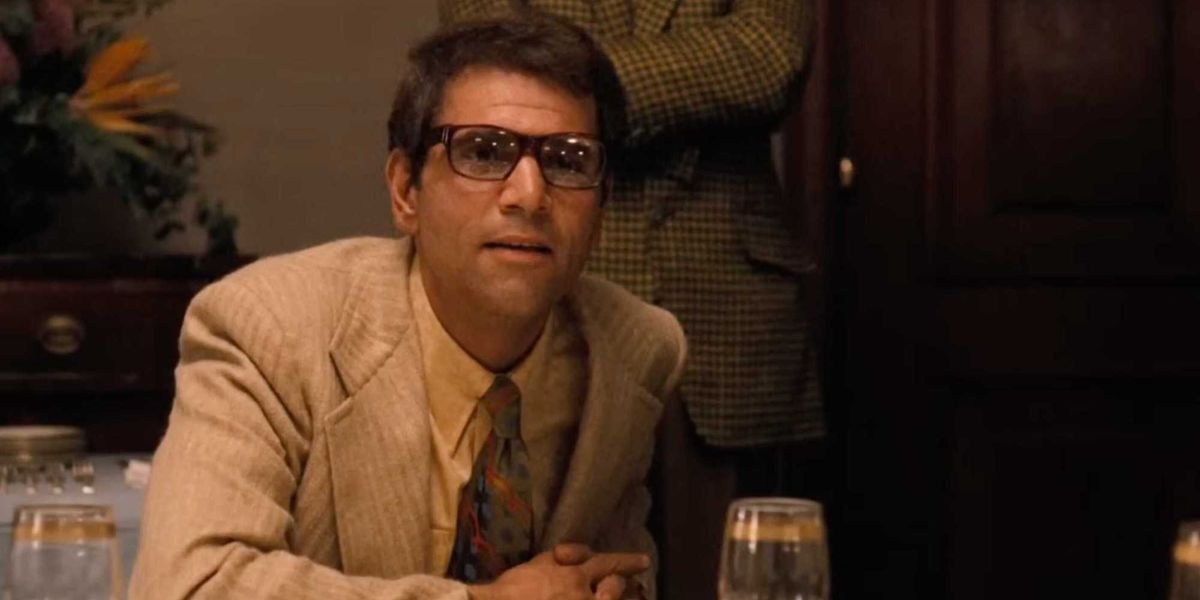
Michael Corleone (Al Pacino) is one of the most fascinating characters in cinema. Perhaps the most nourished character arc ever. His downfall from an idealistic war hero to a cold-hearted crime boss is as layered and nuanced as it is iconic.
The qualities that define him, especially in light of his taking the reins of his family’s mafia business, and give him an edge over others, are a topic worth studying, not only for filmmaking but perhaps human behavior. One of the most prominent of those qualities is his calm, cold, and undemonstrative approach.
His face-off with Moe Greene (Alex Rocco) is perhaps his first action after becoming the acting head of the family business. Despite dealing with a seasoned criminal, Michael doesn’t come off as a newbie. He shows promise through composure and reticence.
That’s why, in a world dominated by hot-headed, volatile, and egoistic people, not much different from Moe Greene, Michael stands out and wins.
The Vegas Meeting
Since Sonny (James Caan) is dead, and Fredo (John Cazale) is useless, Vito (Marlon Brando) ensures Michael’s safe return from Sicily and makes him the acting head of the family business. Michael, having lost his Sicilian wife, Apollonia (Simonetta Stefanelli), to an assassination attempt on him, marries his old girlfriend, Kay (Diane Keaton). He also promises Kay that he will legitimize all the family’s business operations in five years.
In order to start delivering on this promise, he chooses to start with the casinos in Las Vegas. They are run by an outside operator, a Jewish mobster, Moe Greene, who also carries out illegal racketeering from them. Michael’s solution is to buy Greene’s stakes from the family casinos and legitimize them.
However, in the meeting, Moe Greene erupts in anger and refuses to sell his stakes. He even brandishes his support from Emilio Barzini (Richard Conte).
Undeterred, Michael raises Moe’s “unlucky” streak and his humiliating treatment of Fredo as an excuse for driving him out, but Moe still refuses and hurls more insults.
The Psychology of a Quiet Takeover
Weaponising the Low Volume
Moe enters the room with a business owner’s swagger and further throws his weight around by telling Michael that the chef cooked specially for him, and he can enjoy the most intense and spectacular entertainment—kick your tongue out—in Las Vegas since his “credit” is good. This is Moe Greene trying to assert his dominance and independence from the Corleones. He is showing he is not just a subordinate but a powerful boss in his own right.
“Since your credit is good” is a key part here. Michael, as a Corleone, owns the casinos. He doesn’t need to have the credit. You don’t need to pay for your own house. So when Moe says that Michael’s credit is good, he is trying to establish himself as the top dog in these casinos. Ideally, that should offend the owner. But Michael keeps calm. He even goes a step ahead and recycles Moe’s own insult to slap him: “Is my credit good enough to buy you out?”
He is essentially poking the bear right now, but he says it as if he were ordering coffee. There is no intense stare, there is no pause, and there is no ominous “stillness.” In fact, Michael is casually fidgeting inside his pocket as he says that. Michael’s words and his nonchalant body language catch Moe Greene off guard. Fredo, since he knows the explosive nature of the conversation, lets out a nervous laugh. Even Moe giggles sillily.
This is the power of the mysterious coldness of Michael. He doesn’t put it out for discussion; he simply signals that buying Moe out is decided. The only question is “How much?”
The “Unlucky” Diagnosis as a Death Sentence
First off, when Michael tells Moe, point-blank, that he is “unlucky,” many don’t realize how chilling that word is. Moe is a seasoned criminal, while Michael (in Moe’s eyes) is a newbie, the baby son of a crime boss who’s on his deathbed. Michael has just poked him with this “buying out” offer, and now this. Things could get really ugly, really soon, in this world.
And now from Michael’s point of view. He has come with a definite goal and determination: buying Moe out. So, every reason, every success story Moe has to put up in his defense, is already discredited. So he simply gives the reason that Moe has no power over: luck. “Your bad luck makes you a rotting fruit in a basket; you gotta go.”
Just one word, and Michael dismisses the man’s whole career. This linguistic efficiency is how Michael shows what kind of boss he is going to be: the one who values results over history.
Absolutely ruthless and cold.
Hidden Strategy Behind the Calm
Turning Fredo’s Humiliation into Leverage
When Michael reminds Moe that he once slapped Fredo in public, Moe momentarily goes silent. By bringing up the incident, Michael reframes the discussion. Suddenly, it’s not just about the casino deal; it’s about the family’s honor.
It also has a veiled message for Moe: “You may have been cradling the spineless Corleone brother, but the one you’re dealing with now doesn’t forget insults.”
A Conversation That Quietly Seals Moe Greene’s Fate
The calm that Michael displays even after Moe refuses the deal and hurls insults shows that he (Michael) was expecting this. And the fact that he was expecting this shows that Michael had already judged him, and his judgment was right.
Michael ends the meeting with a demeanor of having completed some sort of bureaucratic formality. But that clinical attitude is also indicative of what’s written for Moe Greene: He is marked as an obstacle for the Corleones’ expansion into Las Vegas and is ultimately taken care of in the climactic finale.
Conclusion
At the heart of this confrontation between Michael and Moe is simplicity. One man shouts about achievements and leverages, while the other one speaks softly and yet never loses control.
When the argument is over, the balance of power has clearly shifted in Michael’s favor. When Moe talks to Michael, he sees nothing but an insolent outsider, but his heated, conceited temperament blocks his view of the next Godfather.