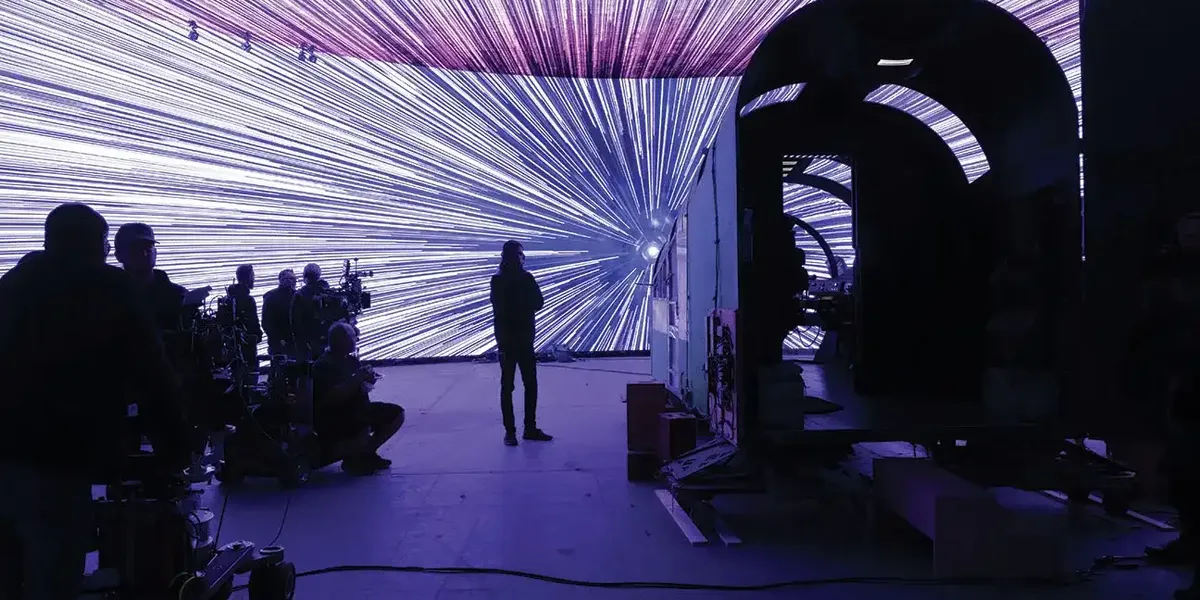
We’ve all seen the behind-the-scenes clips of The Mandalorian or The Batman. You know the ones: actors standing in a massive glowing circle of LED panels (the “Volume”), looking like they’re on a $200 million playground. For most of us, those images can feel a little alienating. If you’re scraping together a budget for a short or an indie feature, virtual production (VP) often feels like a tool reserved for the studios.
But at a powerhouse panel at SXSW today, a group of industry pioneers, including director Lesley Manning (Ghostwatch), producer Annalise Davis (No Way Up), and Neil Graham of Dimension Studio, came together to kill that myth.
The big takeaway? Virtual Production doesn’t have to be scary. In fact, it can actually save you money and support independent filmmakers!
1. VP is a Production Philosophy, Not a VFX Tool
One of the most persistent misconceptions is that virtual production is something you “add on” at the end. The panel was quick to correct this: it’s an end-to-end workflow that changes how departments talk to each other from day one.
“It’s a creative sandbox where the physical and virtual worlds finally speak the same language in real time… It’s not just a visual effects tool, but a production philosophy.” — Miles Perkins
By using real-time engines like Unreal Engine, the DP, production designer, and director can see the “final” world during prep. This removes the guesswork of green screen and brings the budget back where it belongs: on the screen.
2. The “Eye of the Needle”: Prep is Everything
For directors who like to “find it on the day,” virtual production requires a massive shift in mindset. Lesley Manning described the intense pressure of prep as “threading the eye of the needle.” You have to make your decisions up front so that once you’re on the stage, you have total freedom.
“If you don’t storyboard, they’re going to storyboard… so you really want to storyboard because they need to know what you’re looking at. They need to know how to prepare the wall.” — Lesley Manning
Once you pass through that initial gate of heavy prep and locked storyboards, the “needle” opens up. You aren’t just shooting a background; you’re in a living, 3D world where you can change the lighting or move the camera with the same intuition you’d use on a physical set.
3. Independent Film and the “No-Decision” Luxury
In big-budget Hollywood, there is a habit of “kicking the can down the road”… fixing mistakes in post because the budget allows for it. For indie filmmakers, that’s a luxury we don’t have. Interestingly, this makes VP a perfect fit for the independent world.
“We can’t afford [to kick the can]. Virtual production fits really nicely into independent filmmaking because it’s like: make decisions upfront… The FX has nothing to do with it.” — Annalise Davis
In an indie workflow, VP forces you to be decisive. You aren’t guessing what the monster looks like or what the lighting will be in six months; you’re seeing it in-camera. This saves money in the long run because you aren’t paying for “fixes”—you’re paying for the shoot.
Behind the scenes of ”The Mandalorian’ Credit: Disney+
4. Visualization: Communication is the Real Killer App
Neil Graham, who has worked on everything from Barbie to House of the Dragon, noted that the most powerful part of the tech isn’t even the LED wall—it’s the visualization.
“It’s a central point of communication that everyone can visually discuss rather than it having to be so linear. It enables a lot more collaboration.” — Neil Graham
Using tools like Twinmotion or Unreal for “TechVis” allows the art department to build a room virtually and show the DP exactly where the camera can fit. It stops the art department from building sets that will never be seen and allows the DP to test lenses before a single physical nail is driven into a board.
5. The Democratization of the Tech (The Costco Hack)
You don’t need a multi-million dollar studio to start learning this. The panel highlighted that the math behind a massive LED wall is the same as the math behind a 4K TV in your garage.
“There is such a wealth of information that you can find online about people who are doing this in their garage… It’s the same process. It’s all the same stuff.” — Miles Perkins
Whether you’re using a “guerrilla” setup with a big-screen TV or a professional stage, the skills are transferable. Learning how to light for a screen and how to “knit” physical props into a virtual background is a skill set every modern filmmaker should start building.
Be sure to check out the rest of our SXSW 2026 coverage!