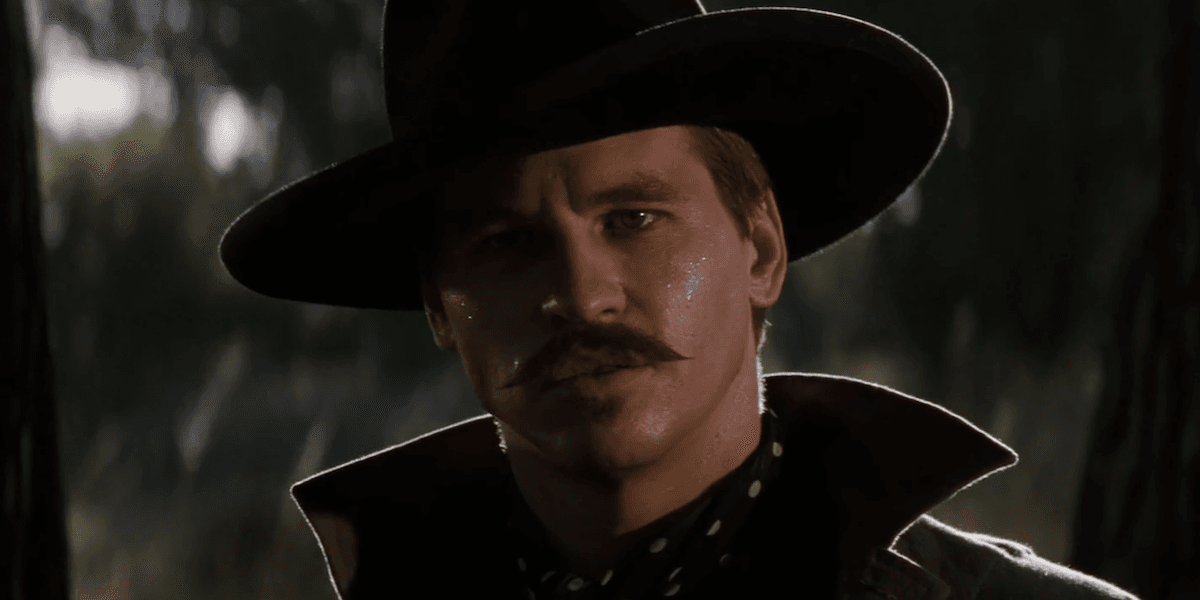
As the story gallops towards the climactic showdown, the scent of pine and impending doom fills the air. In a movie where we expect the atmosphere to be thick with gunpowder, all we feel is a rising heartbeat. This is the conclusive do-or-die moment where the dialogue cuts deeper than a Bowie knife.
The story’s deuteragonist (secondary protagonist) has arrived on the scene fully knowing this could be a suicide mission. But he doesn’t care. He is terminally ill, and yet, he greets his adversary with words that reflect his potent sense of dry humor, which is as sharp as ever.
His greeting, “Why, Johnny Ringo, you look like someone walked over your grave,” is not friendly banter. It is a nimble-witted psychological strike. This is the same as a mongoose playing with a snake before it bites down on its neck—and knowing that it will bite down on its neck.
This iconic line, delivered with a nice Southern drawl, is basically Ringo’s obituary in person.
The Scene
This Western is set in the late 1870s. A gang of outlaws, known as “Cowboys,” is active in the Pima and Cochise counties. They were running amok, committing crimes, killing people, and carrying out armed robberies. An ex-lawman, Wyatt Earp (Kurt Russell), agrees to take them on to protect the town.
After a few skirmishes, Earp kills the leader of the Cowboys, “Curly Bill” Brocius (Powers Boothe), making way for the gang’s second-in-command, Johnny Ringo (Michael Biehn), to become the new leader. Ringo lures a reformed Cowboy, Sherman McMasters (Michael Rooker), who has now joined the lawmen, to the Cowboys and kills him. He then sends a messenger (with McMaster’s corpse) to Earp and challenges him to a duel. Wyatt accepts.
However, on the day of the duel, unknown to Earp, his old friend, Doc Holliday (Val Kilmer), had already arrived at the spot in his place. When Doc shows up instead of Wyatt, Ringo is taken aback. Seeing him surprised, Doc says, “Why, Johnny Ringo, you look like somebody just walked over your grave.”
The Anatomy of a Cold Open
“I’m Your Huckleberry”
When Doc shows up for the duel, right before he emerges from the shadows, he says to Ringo, “I am your Huckleberry.” In the 19th century, this phrase was used to imply willingness to take on a task or a challenge.
But why is it significant? How is Doc dueling any different from Earp dueling?
The answer lies in the fact that Doc (in Ringo’s mind) is supposed to be on his deathbed. Doc is suffering from tuberculosis, which in the 19th century was always as good as terminal. There was no escape. Soon after this scene (in which he kills Ringo), Doc dies of the disease. So, when Doc shows up for the fight, Ringo’s surprise is understandable.
What it means here is that Doc is basically throwing himself on the sword. He knows he doesn’t have much time, and risking a leader (Earp) is not worth it when he himself is quite “dispensable.”
A Literal Ghost Story
In the story, it is established that Doc is a better shot than Ringo. Ringo, who prides himself on being a formidable gunman, knows that it’s perhaps only Doc who surpasses him in being a “quick gun.” So, it’s natural that color drains off his face when he sees Doc instead of Earp. Doc not only notices Ringo’s surprise, but he has been expecting it. So, when he sees Ringo surprised (or scared), he calls out his fear by saying that he looks like someone walked over his grave. Doc presents himself, not only as a dueling rival but also as the physical manifestation of the “death” that Ringo has spent his life dealing out to others.
Conclusion
The few seconds that come before the fight are where “words” belong, and Doc Holliday makes perfect use of those first few seconds. Before he uses his actual weapon to kill Ringo’s body, he turns a simple idiom into a weapon and uses it to kill Ringo’s spirit. Just his intellect and a bit of his dark humor are all he needs to exert his dominance and dismantle his opponent before it actually comes to a gunfight. Having the fastest gun made Doc a quick gun, but having the last word made him a legend.
Doc indeed killed Ringo in the duel, but that was just a formality. It’s this moment when Ringo actually died.