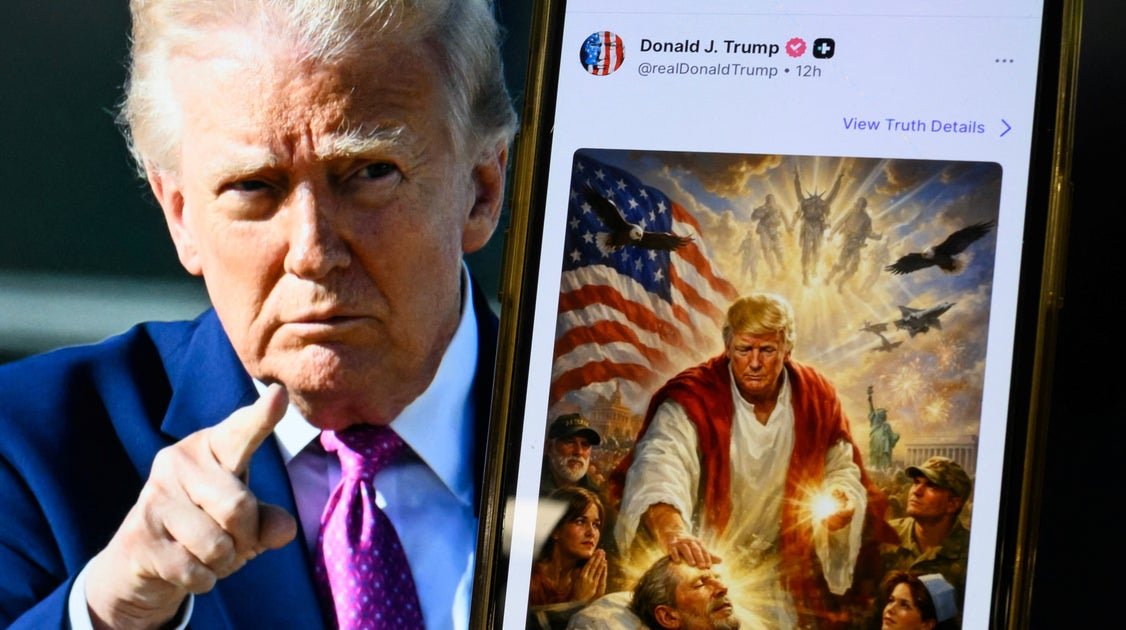
Between 6 p.m. Thursday and 8 a.m. Eastern on Friday, President Donald Trump posted and reposted 24 times on Truth Social. The president is known for his love of the platform, but experts say that posting at this frequency overnight could reveal more than he realizes.
“From a secure marketing perspective, he is getting the desired attention that he constantly craves,” Greg Kushnick, a psychologist specializing in cognitive behavioral therapy, told HuffPost.
Kushnick is not diagnosing Trump, but is basing his assessment of the president’s general behavior on psychological studies about social media usage and his experience with patients.
“Doing it at night and having people wake up in the morning to hear about his messages — he’s basically controlling the news cycle,” Kushnick said. “If it didn’t get the attention, he probably wouldn’t do it as much.”
This is not new for Trump. In 2017, he credited social media with helping him win the 2016 presidential election, saying it helped him consistently get his message out to voters.
“Initially, Trump used social media in an innovative way to achieve his goals, and he did so with great success,” Michael Genovese, a professor of political science and international relations at Loyola Marymount University, told HuffPost. “He was able to get around the media and go directly to the public. He compelled everyone else to report on his tweets and his posts, and it was a magnificent display of how to use new media and how to use it effectively.”
His messages have changed over the years, Genovese argued, which is why voters are becoming more concerned.
“In the beginning, he was colorful and creative,” Genovese said. “Now, it’s a little bit scary and threatening a civilization.”
Truth Social is an “echo chamber,” according to experts.
Truth Social, which is owned by Trump Media & Technology Group, is an “echo chamber” for the president — “an environment in which people seek out and consume information that reinforces their existing beliefs, values or opinions,” Manahil Riaz, a psychotherapist, told HuffPost in February.
On Truth Social, Trump’s worldview is essentially reiterated, Riaz said. Truth Social had 6 million monthly active users in 2024, according to Statista, compared to X’s 557 million and Facebook’s 3 billion.
For Trump, that echo chamber ensures he almost always gets the reaction he wants, Kushnick said.
Photo by Mandel NGAN / Getty Images / AFP via generated AI
President Donald Trump frequently shares posts on Truth Social overnight.
Trump’s late-night posting could be a way to “assert authority,” one expert says.
Trump does generally post more often during the day, especially between 5 p.m. and 6 p.m. Eastern, according to one data journalist. But between January 2025 and January 2026, Trump posted over 300 times at midnight and over 100 times at 1 a.m. In December, the president posted 158 times between midnight and 3 a.m., Axios reported.
There are multiple reasons he might post late at night. For one thing, Trump rarely sleeps, White House press secretary Karoline Leavitt said at a Turning Point USA event earlier this week.
Asked what aspect of her job keeps her “up at night,” Leavitt said it was Trump’s “crazy” nocturnal nature.
“The fact that my boss is up all night and probably going to call at any hour,” Leavitt said. According to Leavitt, Trump sleeps “very little. Like maybe four hours a night. It’s crazy. I’m a third his age, and I can’t keep up.”
In 2018, while answering press questions about Trump’s health, White House physician Dr. Ronny Jackson said the president only sleeps four to five hours a night.
Kushnick theorizes that these late hours, when Trump is alone and his team is ostensibly off the clock, are when he can post “without any adviser’s influence.”
“It’s a way to assert authority,” Kushnick said. “He is going to do it on his own without the influence of others.”
Kushnick calls this type of behavior “pathological certainty,” a compulsive psychological state in which a person does not doubt their beliefs or ideas because there is no one there to challenge them.
Psychological studies have also found that, late at night, thoughts tend to be amplified. The “Mind After Midnight” hypothesis links “nocturnal wakefulness” to impaired decision-making, increased desire for attention and rewards, and limited emotional regulation.
Experts say posting frequently on social media also gives “pseudo-validation.”
As of this reporting, Trump has posted almost 7,000 times on Truth Social in the past year and 590 times in April, according to the Roll Call databases.
When people post so frequently on social media, it adds to their sense of validation, Kushnick said, but he cautioned that it’s “pseudo-validation.”
Research has found that frequent social media engagement creates “The Slot Machine Effect,” in which users don’t know when they will get “likes” or comments, so it produces consistent dopamine spikes as they keep seeking that engagement.
“I’m sure there is that reinforcement where he gets to see the reactions it gets, and he keeps doing it because it feels good,” Kushnick said.
But with poll numbers turning against Trump, Genovese thinks he may be experiencing more anger and frustration than in his first term, which is why he’s lashing out more in his posts.
“We see him with seemingly no filters, no control, can’t stay focused,” Genovese said. It’s not the first time a political leader has been like this, either. During the Watergate scandal, then-President Richard Nixon’s aides reportedly let him air his frustrations out loud but contained them from the public.
Reactions on social media “are moving him, rather than him moving [them],” Genovese said. “The world is not responding to him the way he wants.”
But as long as the posts keep getting attention, experts said they feel the behavior is unlikely to change.