When a once-successful director finds himself stranded in a wilderness of misguided projects and indifferent audience response, he may try to reignite inspiration by going back to the ingredients of an iconic hit. If he can replicate the perfect storm of elements that made the earlier film work, maybe the new movie will put him back on top.
This kind of thing happens often enough — examples range from William Friedkin shooting for a West Coast “French Connection” with “To Live and Die in L.A.” to John McTiernan making “Die Hard with a Vengeance.” But we’re in a far more degraded realm of return-to-glory-days syndrome when it’s Renny Harlin out to recapture the low-trash spark of “Deep Blue Sea,” his well-liked exploitation action thriller. Talk about a 1999 movie that wasn’t about the brave new movie future!
It was about killer sharks (with enhanced intelligence!) eating people, and about a scientific experiment — something to do with curing Alzheimer’s — that was there to fill up the space between chompings. But “Deep Blue Sea,” whose big star was Thomas Jane, went down as a summer sleeper (it bit its way to $73 million domestic), and the nostalgic fondness that a lot of people have for it surely fed into why we’re now getting “Deep Water” (opening May 1), Harlin’s most lavishly scaled production in quite some time.
In the 1970s, disaster films had titles that described exactly what they were. “The Towering Inferno” was about a towering inferno, “Earthquake” was about an earthquake, and then there were films like “Meteor” and “Avalanche” and “The Swarm” and “The Hindenburg” and “City on Fire.” In that spirit, “Deep Water,” which is very much a neo-’70s disaster film. should have been called “Airplane Crash into a Sea of Jaws.” As it stands, the word in the film’s generic title that echoes that earlier Harlin movie is more than a bit ironic, since “deep” is just the word to describe what Renny Harlin’s movies are not. They are shallow. They are dramatically flat. They do not have interesting characters even on a schlock B-movie level. As a director, he has a sixth sense for how to reduce actors to walking slabs of pulp.
Yet there’s no denying that Renny Harlin, in his utilitarian action-hack way, has some chops. “Deep Water” starts out by introducing the main players on an intercontinental flight from Los Angeles to Shanghai. Aaron Eckhart, with his likable downcast valor, is the First Officer, a stalwart fellow who’s a bit of a ne’er-do-well (that’s why he’s never become a captain); he’s suffering from an oblique family trauma we can kind of suss out. Ben Kingsley is the captain, a jaded overseer on the verge of retirement who is introduced singing “Fly Me to the Moon” in a karaoke bar, where he somehow imagines that his crooning is going to have a seductive effect on the flight attendants seated at a table. (The truth is that he looks rather frighting in his sand-brown goatee.)
We’re also introduced to the passengers, who are real Jane and Johnny one-notes, though we do take special notice of Dan (Angus Sampson), a long-haired slovenly bellicose chain smoker whose bulky red plastic suitcase the camera tracks onto the plane. For a while, we think it must have a bomb in it. It doesn’t, but it does contain something that randomly ignites, setting a fire in the cargo pod, which becomes an explosion, which ricochets into the cabin, at which point a hole gets blown in the side, one of the engines catches fire, and this thing is going down.
It doesn’t take excessive skill to make a plane crash scary, but Harlin executes this one with stylish flamboyance, as bodies get sucked out of the plane and flying wine bottles turn into shrapnel. Our heroes want to try landing at an airport in Guam, but that plan goes out the window, as they barely manage to ground the plane in the middle of the ocean.
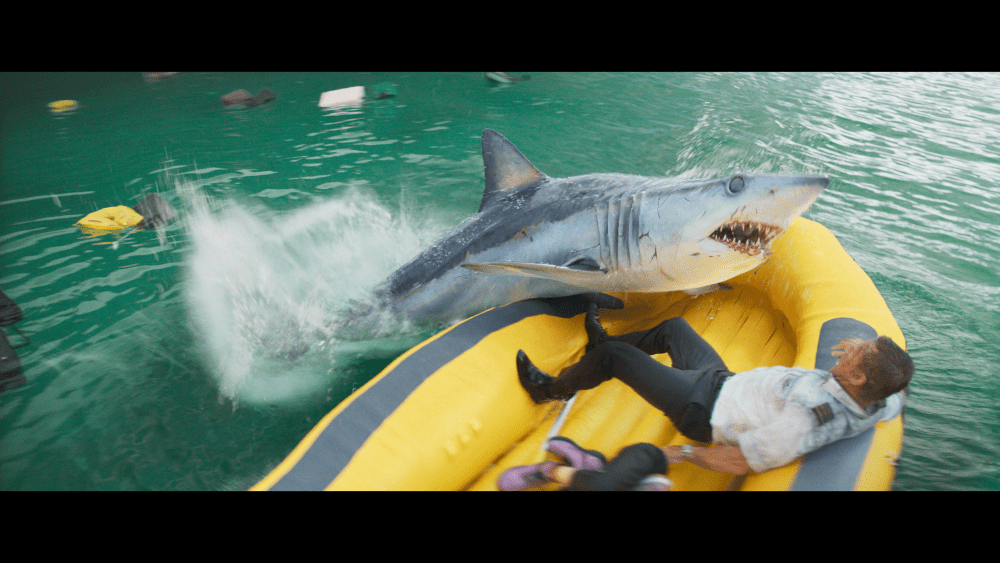
There were 257 passengers aboard, all but about 30 of whom are now dead. The plane is in pieces, the main two chunks being the cockpit and the fuselage, both of which have been reduced to floating canisters with wires popping out of the sides. The plane’s pieces are now, in effect, life rafts (though there are some actual oversize yellow inflatable rafts aboard that will come into play). If the proper distress signal was set off (there’s some question about whether that happened), they should be rescued in a matter of hours. But until then…sharks!
They are mako sharks, which to my movie-trained eyes don’t look all that different from the great white shark in “Jaws,” as they flop their giant razor-toothed mouths aboard the rafts. “Jaws” was scary because it was about anticipation and sudden fear and the power of suggestion. “Deep Water,” on the other hand, has little in the way of suggestion, which is why it’s more gory than scary. Harlin stages the shark attacks in an overt here-ya-go way, with the one consistent suspense issue being whether the shark will consume a victim whole or bite off his or her limb or simply leave them with a nasty gash (which happens quite often).
Meanwhile, two bros (one American, one Chinese) start off as enemies but get over that, the scurrilous Dan continues to assert what a dick he is by smoking and snapping at everyone, and Eckhart’s character bonds with Cora (Molly Belle Wright), the now-orphaned young girl aboard, which triggers a reappraisal of his own domestic situation. Human drama! Not. (Or, at least, not very much.) Yet there’s a way in which it matters not, since even back in the ’70s the “human drama” of disaster films was just the frame on which to hang the sensationalist fantasy of death porn and survival. “Deep Water” isn’t terrible for what it is, but what it is is disaster product.