You made it time. If you want to look a little longer, just scroll back up and press “Continue.”
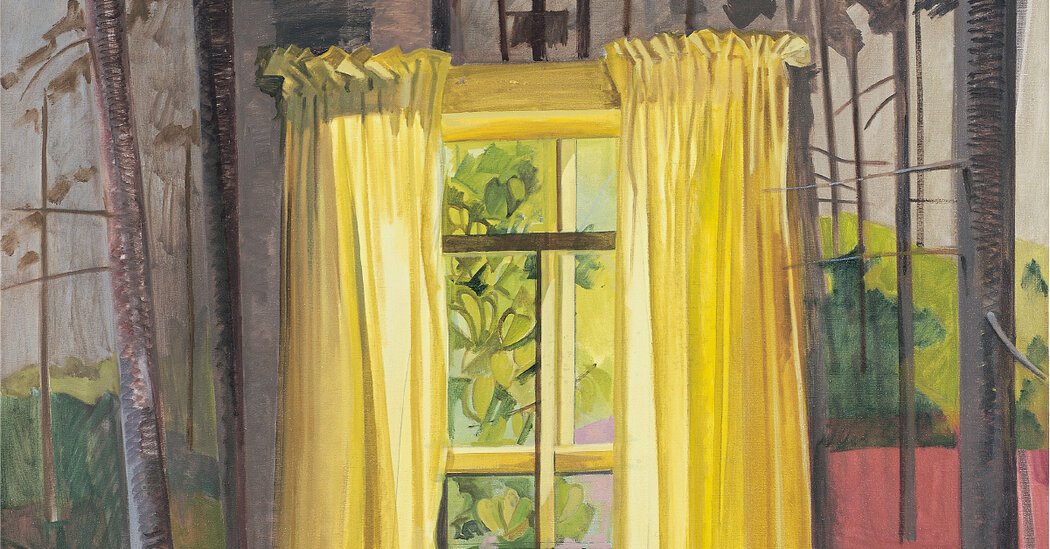
You and I are in a room in Lois Dodd’s house in Maine, looking through yellow curtains, out a window. The scene is a real one — like all of Ms. Dodd’s paintings — but it comes off as slightly strange. Are we really inside?
The curtains, a sliver of ceiling with the lightbulb peeking into the frame,
the shadow of the bed in the room, faintly rendered here,
put us clearly inside the room.
But then there are these woods painted on the walls.
“So, first I painted the walls,” Ms. Dodd told me. The walls are based on her paintings of the woods across the street, which she then painted on the walls of this room, which she then turned again into a painting.
Ms. Dodd has been painting for more than eight decades. Now 99, she is gaining a wider audience, with her first European retrospective, a new documentary and fairs in Paris, Berlin and Miami.
She came up in an art world through the 1950s that was in love with abstraction, and dominated by men.
But Ms. Dodd paints what she sees, like the way two roofs nearly touch:
Or the light sneaking through an open door:
“The observation is inspirational,” she said. “It gets you started.”
In the 1970s, she spent several summers painting the woods across the street. (She started spending her summers in Maine in the 1950s to escape the heat of her top-floor East Village loft.)
In three-hour sessions — the most she could do before the light totally changed — she painted the trees, the leaves and the spaces between them, like this from 1977:
Or this 14-foot-tall triptych from 1975; the three panels are stacked vertically:
After a few years though, something changed.
“I went in there the following summer and looked around, and there was nothing to paint,” she said. “It was like the woods said: ‘You’ve had it. We’re not giving you another damn thing. Get out.’”
She turned her attention to a room inside her house.
The patched plaster on the opposite wall already looked like clouds, so she added a bit of blue, with pigment saved from her student days at Cooper Union in Manhattan:
She worked her way around the room. The clouds gave way to the woods:
And the woods worked their way around the window:
“Then I thought, that makes it interesting — I’ll paint a painting of my painting wall.”
“The Painted Room,” which she completed in 1982, now lives at the Farnsworth Art Museum in Maine.
She paints fast, in thin layers. That helps create this luminous, translucent effect on the yellow curtains here:
She told me she likes painting windows because they help you define your composition.
When you’re staring at a blank canvas, the window gives you an edge, a place to start.
“It’s already framed, laid out for you.”
Windows can offer studies in reflection and geometry, frames inside frames inside frames:
They become the edges that shape a world of light and shadow, and a portal that draws you into the artist’s world:
On the chilly spring morning I visited her at her house in New Jersey (she’ll go to the Maine house in a few weeks), the light was pouring in.
“I bought this house because of the windows,” she said. She lowered herself gently into the makeshift seat of her walker, where she keeps a cordless phone in an old tin can lashed to the side with tape.
She does not own a cellphone or TV, but she loves the radio. I told her my generation had a hard time focusing, distracted by our phones, sucked into endless scrolling.
“You either enjoy looking at the world or you wander through it without seeing it, which I think a lot of people do,” she said. “They know enough to look so they don’t break their neck tripping, but otherwise they may not see too much, just enough to be safe.”
Hoping for insight into how she sees, I asked how she teaches people to paint. (She was on the faculty at Brooklyn College for more than 20 years.)
“You give them a list of supplies,” she said. “Then maybe you set up a still life, or maybe you make somebody sit in a chair and … they have to paint. That’s their problem.”
One former student told me she was painting an apple tree at a workshop in Maine when Ms. Dodd walked by.
“You know you don’t have to paint all the apples,” she recalled her saying.
Her students say they learned from these wry critiques and from watching her work — fast, nimble, decisive.
I asked what was catching her eye at that very moment.
“The light on the floor and the window are kind of great right now. It’s what the light does. That’s the most exciting.”
There was an in-progress painting of a roof on her easel, and she had two fresh panels ready to go.
I asked where she had found the discipline to paint for all those hours, all those days, all those years. She cupped a hand to her ear to hear my question.
“Oh, that’s not discipline,” she said. “That’s just being alive.”
This is an installment in our series of experiments on art and attention. If you liked this one, you may like these past exercises: a finished, unfinished portrait; a sudden rain over a bridge; a unicorn tapestry; some buckets from Home Depot; and a Whistler painting.
Sign up to be notified when new installments are published here. And let us know how this exercise made you feel in the comments.