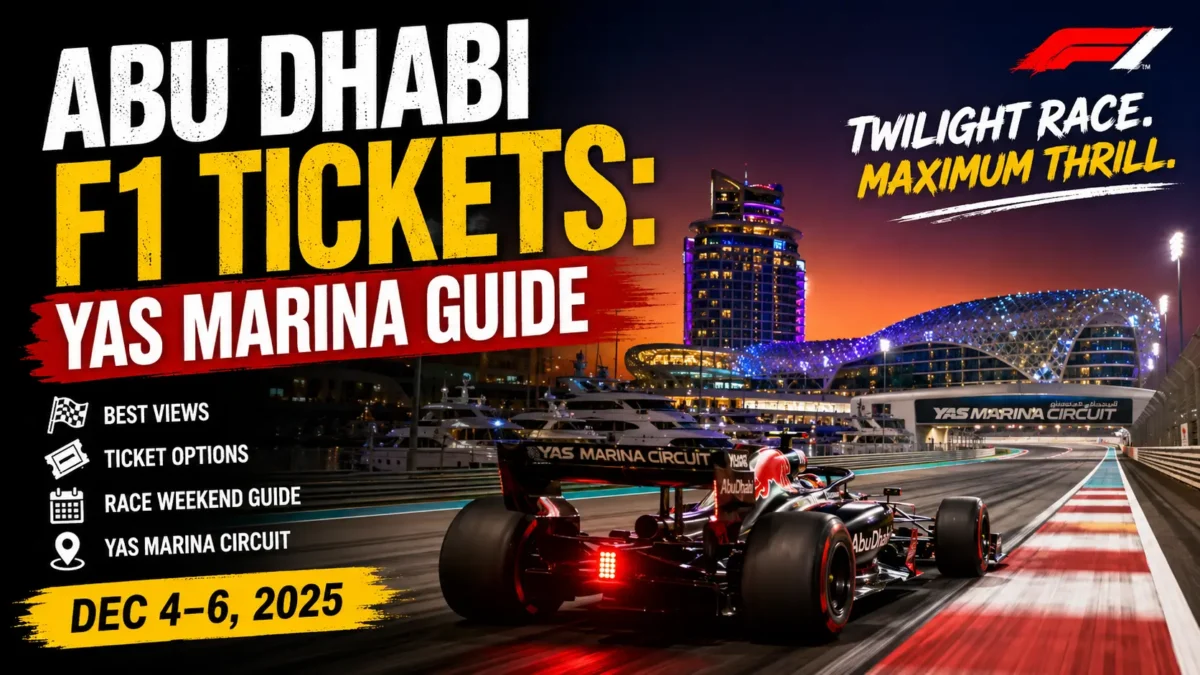
Yas Marina makes Formula 1 speed unusually easy to read. Cars disappear down a 1.2 km straight, brake heavily into tight corners and later pass the marina under floodlights, so the impression changes several times during the same lap.
Choosing a Ticket by View
A seat should match the part of Formula 1 you actually want to see. When checking Abu Dhabi F1 tickets, visitors can currently compare Friday, Saturday, Sunday and multi-day options for the December 4 to 6 race weekend. The choice of day can then be combined with a grandstand position instead of treating every circuit view as essentially the same.
Sunday gives the complete race, but qualifying can be particularly useful for anyone interested in outright pace. With drivers pushing for a single fast lap, braking points, acceleration and small differences through the corners are easier to notice.
Where Speed Looks Fastest
A long straight produces the highest speeds, but it does not automatically produce the most dramatic view. From a seat facing only a straight, an F1 car can pass your field of vision in seconds with relatively little indication of how hard the driver is working.
Braking zones add context to that speed. Seeing a car arrive at high velocity, slow sharply and turn into a corner makes the change in pace much easier to appreciate. Different areas therefore suit different spectators:
- The long back straight gives a clear impression of acceleration and top speed.
- The braking area after the straight adds possible overtaking and heavy deceleration.
- Turn 5 combines a slower corner with strong acceleration onto the following section.
- The Main Grandstand provides views of the start, finish and pit activity.
- The marina section offers close visual context from the surrounding buildings, water and lighting.
A braking zone is often the more informative choice for someone attending primarily to see how an F1 car behaves at the limit. Straight-line speed is impressive, but braking and corner entry show what the driver has to do with it.
The Twilight Race
Abu Dhabi has had a distinctive timetable since its first Grand Prix in 2009. It became Formula 1’s first race to begin at dusk and finish after dark, a feature documented in the history of Yas Marina Circuit.
For spectators, the transition happens during the race rather than before it. The early laps take place in fading natural light, while later laps run beneath the circuit’s floodlights, with the illuminated marina and hotel changing the appearance of the same corners.
Yas Marina in Numbers
The present layout is shorter and faster than the original version. Major changes introduced for 2021 removed several slower sections and simplified parts of the lap, including the sequence that became a banked corner.
The circuit now measures 5.281 km and contains 16 corners. Reuters also lists its approximately 1.2 km straight among the key characteristics of the Abu Dhabi Grand Prix, giving useful context for why acceleration and braking are so important here.
What Makes the Circuit Unusual
Yas Marina was built around the marina on Yas Island, and some of its details are difficult to mistake for another F1 venue. The pit lane exit famously runs through a tunnel beneath the circuit before drivers rejoin the track.
The setting also means the visual background keeps changing. Grandstands, yachts, the illuminated hotel and the pit complex appear across different sections, which gives spectators more reference points for judging how quickly the cars are moving.
Planning the Race Day
It helps to arrive knowing which part of the lap your seat shows rather than relying only on the grandstand name. Check the circuit map, locate the nearest braking zone or straight, and identify the pit lane and marina before entering.
Yas Marina has hosted Formula 1 since 2009, but its appeal is still built around a simple contrast: enormous speed followed almost immediately by braking, direction changes and acceleration. Choose a view that captures more than one of those moments, and the pace of an F1 car becomes much easier to understand.