Known for spectacles like “The Phantom of the Opera,” Broadway’s most commercially successful composer now wants to tell the story of the world’s most famous painting
Ellen Wexler
–
April 17, 2026
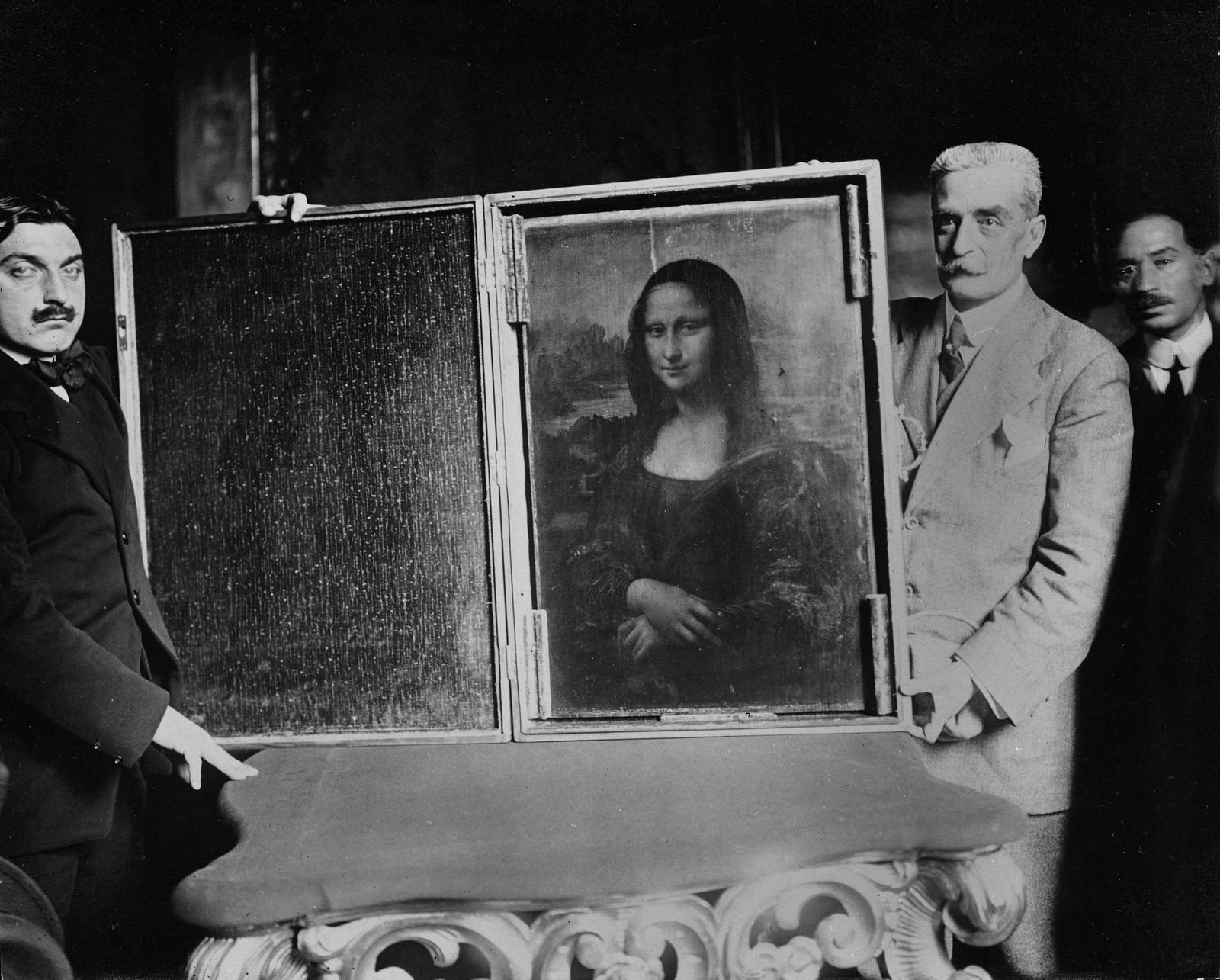
The Mona Lisa returning to the Louvre in 1914
Roger-Viollet / Getty Images
The most recognizable scenes from Andrew Lloyd Webber’s musicals are fever dreams: The subterranean lake beneath the Paris Opera House. The band of Jellicle cats longing to ascend to the Heaviside Layer. The Egyptian pharaoh singing about his prophetic dreams with Elvis-inspired vibrato.
Anyone with a passing knowledge of musical theater can picture these scenes—and hear Lloyd Webber’s scores playing in their heads. Now, the composer is working on a new musical inspired by one of the most recognizable images in art history.
“It’s a true story about how the Mona Lisa disappeared … and ended up in Italy,” the composer said in a recent interview.
Lloyd Webber already has a lot on his plate. He’s writing a musical called The Illusionist, based on the 2006 film of the same name, and his production company is backing Cats: The Jellicle Ball, a reimagining of his famous 1981 musical as a queer ballroom competition. The show opened on Broadway on April 7.
Hours after the premiere, Lloyd Webber alluded to his Mona Lisa musical, mentioning, almost as an afterthought, “the other one” he’s working on. “More than that I cannot really tell you,” he said, “for the simple reason that I’m going away next week to write it.”
The Mona Lisa in Italy soon after its recovery
Mondadori via Getty Images
The Mona Lisa heist
Lloyd Webber has always loved spectacle. In the art world, the Mona Lisa is the greatest spectacle there is. The Louvre in Paris, where it’s on display, is the most popular museum in the world, and some 80 percent of visitors come specifically to see Leonardo da Vinci’s masterpiece. Every day, tens of thousands of eager tourists crowd together to take photos of the 30-inch-tall portrait, sometimes waiting in line for more than an hour.
Quick fact: The Mona Lisa’s new gallery
Officials are planning to move the painting to its own underground chamber. Visitors will need to purchase separate tickets to access the Renaissance artwork.
In the early 1900s, the painting was already well known among scholars, but it was just beginning to captivate the public. “Mona Lisa often made men do strange things,” author R.A. Scotti wrote in Vanished Smile: The Mysterious Theft of the Mona Lisa. “There were more than one million artworks in the Louvre collection; she alone received her own mail. Mona Lisa received many love letters.”
Recognizing the painting’s rising profile, the museum decided to secure it behind protective glass. One of the men who helped install the glass was Vincenzo Peruggia, an Italian glazier and housepainter. “Since he had put her in the frame,” Scotti wrote, “he knew better than anyone how to remove her.”
On August 21, 1911, while the Louvre was closed, Peruggia—perhaps accompanied by associates—donned a worker’s smock to blend in. He easily removed the Mona Lisa from the glass case and carried it into a nearby stairwell. There, he separated the portrait from its heavy frame and fled the scene.
The painting’s absence was discovered 28 hours later, when an artist arrived to sketch it and found only an empty wall. At first, officials assumed the best, reasoning that it had probably been taken down to be photographed. They started to worry only after speaking with the house photographer and finding the empty frame in the stairwell.
“The thieves—I am inclined to think there were more than one—got away with it all right,” Louis Lépine, the Paris police prefect, told the New York Times on August 22. He speculated that the theft was a “case of sabotage” by museum staffers, or perhaps that the thief was planning to use the artwork to blackmail the government. “Anyway,” he added, “I think we will soon be able to locate the picture.”
But the Mona Lisa was nowhere to be found. Officials pursued several innocent suspects, including Pablo Picasso, who was living in Paris at the time. They interviewed Peruggia at his apartment—where he’d stashed the painting in a trunk—because he’d worked at the Louvre, but he didn’t arouse suspicion.
Two years passed with no new leads. Peruggia returned to Italy, and in late 1913, he contacted an art dealer and demanded a ransom. The dealer reported the affair to the police, who arrested Peruggia in mid-December. The Mona Lisa, now the subject of a riveting heist narrative, became a sensation.
The Mona Lisa’s rise to fame
When Leonardo died in 1519, the French king Francis I acquired the Mona Lisa. It spent many years mostly out of sight, with a brief stint hanging in Napoleon Bonaparte’s bedroom, before arriving at the Louvre in the early 19th century. It remained on display at the Paris museum until its disappearance in 1911.
Audiences noticed the painting’s absence more than they’d ever noticed its presence. Before the theft, “the Mona Lisa wasn’t even the most famous painting in its gallery, let alone in the Louvre,” writer and historian James Zug told NPR’s “All Things Considered” in 2011. But when the news broke, thousands of curious visitors—including Franz Kafka—crowded into the museum to stare at the empty wall.
After authorities arrested Peruggia, he claimed that he’d wanted to return the painting to its home country. “The stolen work of Leonardo da Vinci is in my possession,” he wrote in his ransom note. “It seems to belong to Italy since its painter was an Italian.”
Vincenzo Peruggia’s mugshot
Bettmann via Getty Images
Historians are still debating Peruggia’s motives. But after his arrest, the public was captivated, and many in Italy hailed him as a hero. He quickly embraced this identity, explaining that his work as a housepainter had allowed him to meet artists, and he’d always felt a kinship with them.
“I spent many hours at the Louvre enjoying the masterpieces of Italy, which should never have left my country,” he said. “I shall never forget the evening after I had carried the picture home. I locked myself in my room in Paris and took the picture from a drawer. I stood bewitched. … I fell victim to her smile and feasted my eyes on my treasure every evening, discovering each time new beauty and perversity in her. I fell in love with her.”
Regardless of Peruggia’s true intentions, the theft brought the painting to new audiences. It didn’t return to Italy permanently, but it did briefly go on display there before returning to France. When it arrived back at the Louvre, more than 100,000 visitors came to see it in the first two days.
Visitors crowd around the Mona Lisa to take photos.
Antoine Boureau / Hans Lucas / AFP via Getty Images
Today, most people first encounter the Mona Lisa through the lens of its own fame, making it difficult to consider the work on its own terms. Over the years, the painting has inspired countless artists, from Marcel Duchamp to Andy Warhol. In Ray Bradbury’s short story “The Smile,” it’s torn apart by a mob. In the movie Glass Onion, it’s destroyed by a tech billionaire’s ill-fated invention. It holds secret messages in Dan Brown’s novel The Da Vinci Code, and it represents enigmatic beauty in Ray Evans and Jay Livingston’s Academy Award-winning 1949 song, fittingly titled “Mona Lisa”:
Many dreams have been brought to your doorstep.
They just lie there, and they die there.
Are you warm? Are you real, Mona Lisa?
Or just a cold and lonely, lovely work of art?
A Mona Lisa musical
Much like Leonardo’s portrait, Lloyd Webber is a crowd pleaser. He’s often described as the most commercially successful composer in musical theater. His biggest hit, The Phantom of the Opera, drew audiences to the Majestic Theatre for 35 years—the longest Broadway run in history.
When the production closed in 2023, it had grossed more than $1 billion. Internationally, Phantom has been performed in more than a dozen languages, and it’s brought in more money than many of the world’s highest-grossing movies. Its mainstream appeal is central to its success.
‘The Phantom of The Opera’ | The Phantom Of The Opera
“It provided a night at the opera for people who, as a rule, did not go to the opera,” critic Andrea Long Chu wrote for Vulture in 2023. Lloyd Webber offered audiences “a pleasing impression of opera—continuous singing, throbbing vibrato, very high notes—without the infamous longueurs or unintelligible vowels.”
In the world of Phantom, music’s quality is determined by “its effect on the listener,” Chu argued. “This conveniently obviated the need for music that was actually good, as far as the critics were concerned.” The Phantom himself—more of “an aficionado” than a “musical genius”—sings songs with lyrics that tout “the virtues of music appreciation.”
Millions line up for Phantom because they want a prototypical Broadway spectacle to wow them. Millions line up at the Louvre because they want a beautiful Renaissance masterpiece to move them. Are they seeking the same experiences, and how often do they get what they’re looking for? The Mona Lisa may be Lloyd Webber’s most ready-made subject yet.
Get the latest Travel & Culture stories in your inbox.