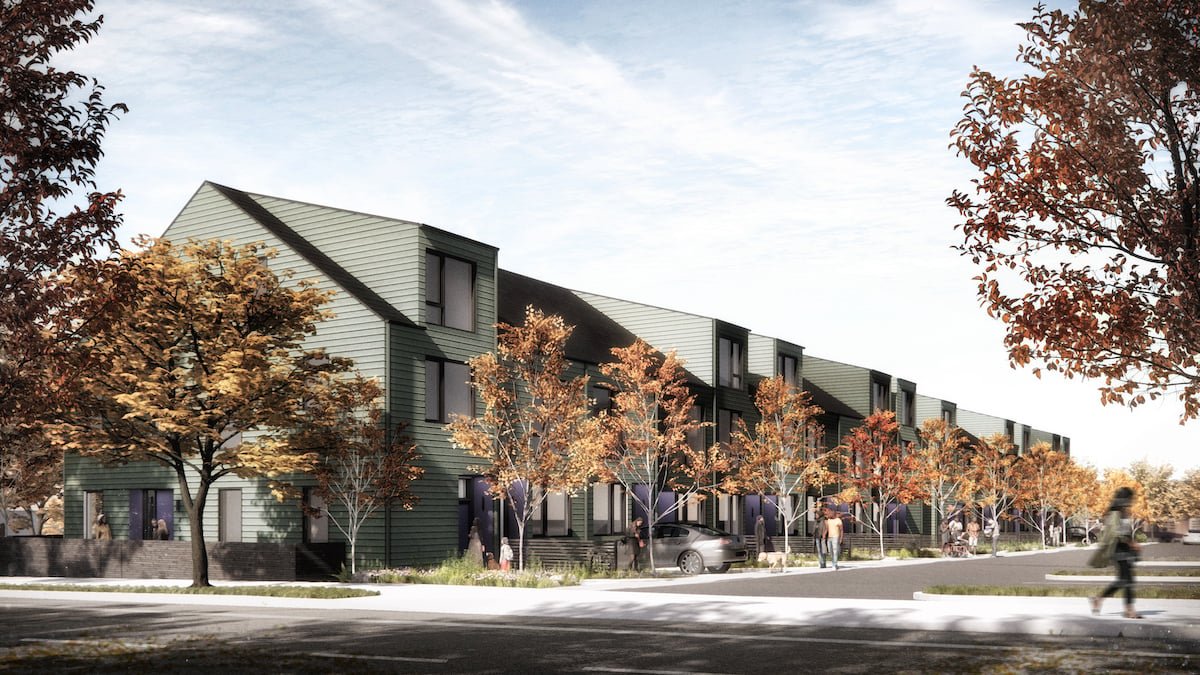
While the final price of the homes has yet to be determined, all townhomes are eligible for the Portland Housing Bureau’s down payment assistance program. Residents could borrow up to about $135,000 in the form of a forgivable loan. That sum would be forgiven after 30 years.
The down payment assistance will be provided to buyers who qualify under Portland’s Preference Policy, supporting eligible first-time homebuyers and making homeownership attainable.
“We’re looking into this model to be the great equalizer that will help get us away from the ‘us versus them’ mentality. It really is where cities, states, and federal governments and organizations alike are able to put money into a community solution where the solution is presented as place-based, and then the community drives the build,” says Reinfield.
The History
Last year, Next City reported on a historic settlement that returned $8.5 million and land to Black families displaced by a decades-old redevelopment scheme in Portland, which has been historically referred to as the whitest city in America.
In that settlement, 26 families won their suit against the city’s development commission agency, Prosper Portland, for its role in perpetuating the displacement of hundreds of Black residents from Albina, once a predominantly black community in northern Portland.
This land was home to 80% of the Black population in Portland until urban renewal policies of the 1970s forced the community out via eminent domain. Legacy Emanuel Medical Center claimed it needed the space to expand, and yet it never did. Consequently, more than 180 buildings, including homes, businesses, churches, and space for community groups, were demolished. Of those displaced, 74% were Black.
In 2017, before talk of development could even begin, Davis and others formed a working group to demand that Legacy Health give back the stolen land. Later that year, Legacy Health, which owns Legacy Emanuel and other hospitals in the region, acknowledged its wrongdoing and agreed to donate the land back.
By this point, the land was contaminated and would cost several million dollars to clean up. According to Davis, the working group demanded more. They didn’t want just the land back. They wanted their clean land back. In 2024, Prosper Portland agreed to a $10 million forgivable loan that ultimately led to the cleaning and restoration of the lot.
Paul Knauls, a 95-year-old resident who lost his business as a result of the urban renewal-driven displacement, says he was insulted by Legacy Emanuel.
“They gave us no money whatsoever for our displacement but in the atrium of the hospital, they had a list of all the names of the people that they had displaced. Like that’s going to be some type of satisfaction,” Knauls says. “There was ‘Paul Knauls’ hanging right in the atrium on a plaque. You know, no monetary compensation, no discussion…. No one has ever asked me about how I feel.”
The onion-shaped cupola was removed from the Hill Block building, located at North Williams Avenue and North Russell Street in Portland, Oregon, in 1971 during its demolition by Emanuel Hospital as part of urban renewal. The site has sat vacant since. (Photo via the City of Portland Archives)
Knauls, who has lived in the same home for nearly 65 years, says that before the eminent domain displaced his community, there were 91 Black-owned businesses in Albina. He noted that there were Black people offering services like television repair, plumbing and lawn care.
“We had a very nice neighborhood. You could get almost everything that you wanted in our neighborhood that you needed to purchase,” he says.
Knauls, who was invited to speak at the grand opening of this development project, is happy that the preference policy is going to allow the grandchildren of his once beloved neighbors to come back to where their ancestors lived. But he does not believe the people pushed out will return because they’re older now and some have already moved “15 miles or 20 miles away.”
“They’re not coming back because their doctors are there, their churches are there, their dentists, their pharmacy. Everything is out there where they live. They’re not coming back,” he says.
Knauls believes that the wealth that was lost by all those families is gone forever.
“What the grandchildren are getting ready to enjoy is the fact that they can live in a high rise that’s not theirs and live in a nice area that’s not theirs, where they could have been living in the house that their great grandparents had bought and paid for,” he says, adding that some of them could be millionaires, if it weren’t for the displacement. “Some of the houses are going [for] $600,000, $700,000 in that neighborhood.”
But that does not mean the groups leading this work aren’t going to try to bring them back.
Renae’, deputy executive director at Williams and Russell, says that in addition to helping former residents and their descendants return to the neighborhood, they’re also trying to bring back a specific culture.
“The difference in the community and the culture is so starkly different after gentrification but when you look at census data, more Black people still live in the northeast area. This is where we are. The culture is just not there,” she says. “That’s what we are also trying to bring back. That’s what’s also very important about our build… We’re thinking about all of those bigger things… It has to be beyond development.”
This story has been updated to correct the acreage of the site and the name of the city’s development commission agency.
This story was produced through our Equitable Cities Reporting Fellow for Anti-Displacement Strategies, which is made possible with funding from the Robert Wood Johnson Foundation.