Note: This story contains spoilers from “House of the Dragon” Season 3, Episode 8.
The battle for the Iron Throne in “House of the Dragon” has seen Emma D’Arcy’s Rhaenyra take an authoritarian turn by the end of Season 3 of the “Game of Thrones” prequel series — a path that D’Arcy said is cemented by Helaena’s tragic death.
In the final moments of the Season 3 finale, Rhaenyra discovers that Helaena (Phia Saban) has jumped to her death out of the castle’s window, taking her fate — and that of her unborn baby — into her own hands rather than be held captive by Rhaenyra in light of another heir to be battled. After tormenting an already fragile Helaena with questions of her rule and force-feeding her, D’Arcy noted the death marks the point of no return for Rhaenyra.
“Helaena is the moral heart of the show — I think she’s maybe the only character who has a proximity to power that is not compromised by it,” D’Arcy told TheWrap, adding that her death will “mark the end of any relationship” between Rhaenyra and Alicent (Olivia Cooke), which was already on thin ice after Rhaenyra’s execution of Alicent’s father, Otto (Rhys Ifans), and the subsequent capture of Alicent and Helaena.
“I think her death actually condemns Rhaenyra to her chosen path,” D’Arcy said. “In some way I feel that it condemns Rhaenyra to to be alone in her pursuit for power — I think we’ve already seen her becoming increasingly isolated as the series progresses, or at least increasingly skeptical of allies … Helaena’s death means that there’s no going back.”
Rhaenyra’s descent into a ruthless rule — which is also noted by Baela (Bethany Antonia) in the finale — is largely a product of the societal response to her claim to the throne as a woman, which showrunner Ryan Condal noted stands as the crux of “House of the Dragon.”
“Since really the first episode, [it] has always been about can this realm accept a woman as a leader, and … what will it do when faced with that as not just an eventuality, but it’s here,” Condal said during a finale press conference. “How does that impact Rhaenyra’s ability to lead?”
“On the one hand, we wanted to test — possibly to breaking point — an audience’s allegiance and relationship with that character,” D’Arcy told TheWrap. “But at the same time … if we’re actually broadly [wanting] to become smarter about our understanding of authoritarian regimes, we have to understand those actions better.”
It will all come to a close when “House of the Dragon” returns for its fourth and final season, which is slated for a 2028 release. Despite book fans anticipating a fateful twist for Rhaenyra as the series concludes, D’Arcy said they didn’t know anything “specific” about what’s to come.
“I know nothing. I mean … I know what we all know, but I know nothing specific about what comes next,” D’Arcy said. “I will be really interested to, because she does feel very different. The character feels very different by Episode 8, and [it will] be quite interesting to put her back on in her new state.”
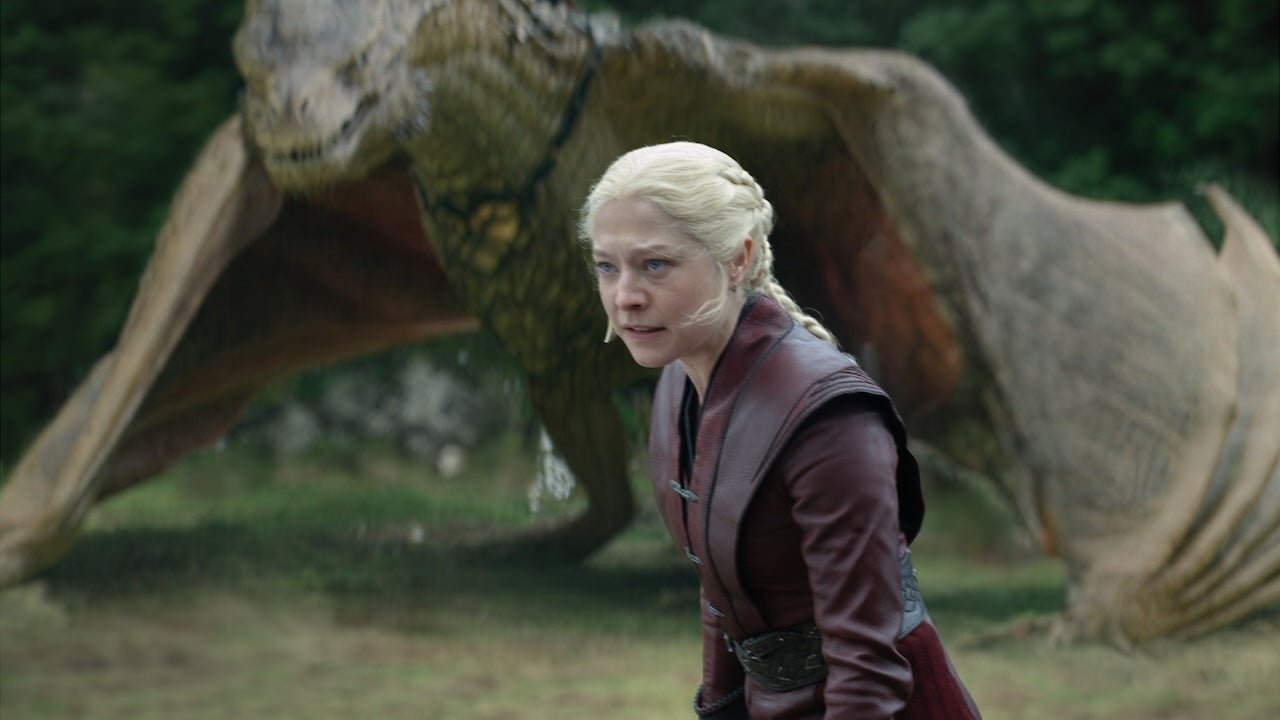
Emma D’Arcy in “House of the Dragon.” (HBO)
TheWrap: Rhaenyra has been seeking outward validation for her rule, but the realization that Aegon and Sunfyre are alive seems to shake her. How does she go into the finale feeling about her rule?
I think the revelation that Aegon and Sunfyre [are] alive totally disrupts everything that Rhaenyra has been building, and actually feels a bit like the kind of ogre of the first part of the season — this idea of a kind of legitimized form of or … a formalized legitimacy, which has perpetually eluded Rhaenyra, has kind of come back to kill her.
I was sort of excited by that scene. Rhaenyra comes in and she delivers the news to Daemon of the resurrection, and I thought there’s something … quite fun about seeing a monarch in a full body panic attack … at this point her sort of identity and political and military survival have become enmeshed, so this threat to her positioning feels like a threat to the self, a threat to the body.
We quickly see Mysaria (Sonoya Mizuno) get thrown out. Why did Rhaenyra decide to end her term, especially after their intimate moment last episode?
That banishment is a really significant one for me. It sort of marks … the red line in her descent into a kind of tyrannical authoritarianism. I think there’s something really nice this season where some of Rhaenyra’s constituent parts have been externalized — Alicent is the judge and Daemon is sort of the ego and Mysaria, I think, is sort of her conscience — certainly has been, I think in parts in this season and in Season 2. And I think the point at which you banish your conscience from the castle, you’ve set a much darker course.
If Rhaenyra is kicking out Mysaria, where is her head at regarding Daemon and his most recent lies?
This scene at the start of … the finale — that kind of resolves with Rhaenyra and Daemon, I guess, joining on the war path and returning to a kind of something that feels familiar, I think, a certain brand of Targaryen chaos mode. That idea that Rhaenyra and Daemon are sort of, I don’t know, in some way, of the same stuff, and that there is always access to … a profound belief in Targaryen exceptionalism. I think their unity — it feels sort of weirdly ageless to me because it refers back to a kind of much older form, sort of a Feudalism.
I really have enjoyed the increased use of High Valyrian this season because … I’m sort of reminded that there’s something kind of alien about the Targaryens. There’s something so profoundly other, and I think at the end of that scene … they sort of transcend their peers in some way, in some sort of awful way, and become … [an] ultimate force.
There’s this narrative that is thrown at Rhaenyra by both Baela and Helaena about Rhaenyra not caring about people who aren’t useful to her. How is does that hit her? Where does Rhaenyra stand with trust?
it’s a very astute observation that Baela makes. I think part of this tyrannical journey, or this journey towards authoritarianism that Rhaenyra goes on this season, tracks really well with the way that her empathy mechanism is affected by events in the series, and I think actually Jace’s death and the devastating grief that comes with that event does a huge amount to to chart a certain course, because I think it fundamentally disrupts her empathy and it affords her a kind of nihilism and a ruthlessness that wasn’t part of her armory before.
I think that conversation with Baela is interesting because I think they’re communicating at really different scales — something about what Daemon is sort of willing her towards is ultimate and historic, and it’s a horizon of possibility that is so much bigger, actually, than local allies or family members … it’s historic. It’s about a name in the annals. It’s about a legacy that goes on for generations … I think that part of that failure of communication between the two of them is about scale.
Rhaenyra tells the people of King’s Landing about the prophecy, which has been considered a sacred secret. Is laying out the prophecy to the public something she wants to do or is it a plow to win people over?
It’s a really good question. I don’t want to weigh in too much because I think it’s like an interesting interpretive question, and because I can be sort of swayed by different arguments, but I definitely think that’s something that I so appreciate about the way that the season was constructed. Rhaenyra starts the season in a position of great strategic military power, but with a lot of personal doubt about her tenure and about the nature of her potential leadership, and she ends it having had her military political positioning massively compromised, but resolute in her right to rule.
I do think part of that authoritarian mentality is a belief that the people don’t know what they want, and I think part of what’s happening in the speech she gives … it’s laying out a reality. It’s selling a reality. The scale of that disclosure, I think, is interesting because I think she is a person … in the way that she’s dressed, there’s a presentation as [a] demi-god. If once she had been like the people’s leader and her energy had been about sort of sameness and ‘your problems are my problems,’ it’s now sort of totally oppositional thinking … the strangeness and the size of that declaration, even if it’s not totally understood, is about selling a god, selling a leader as god.
Do you think she believes in the prophecy or just thinks its a story that further strengthens her claim to the throne?
I think Rhaenyra believes in the prophecy in the way that she is committed to a sort of fanaticism. I think she has scapegoated a lot of her concern or doubt about her tenure by choosing to believe in a religious right, in a divine right to lead, and so I think I actually think she holds to it. I think she requires it. I think the prophecy has actually become sort of strangely central to her belief system.
Rhaenyra ruthlessly orders the death of a priest. Does she believe she’s beyond religion and other sacred things?
It’s a massive rejection of external critical institutions of legitimization, which is a really scary authoritarian tool. When … she refers to the old gods. She refers to them as this sort of higher, older power.
It’s funny. I think having been a character for three seasons who has often sought to be quite a sort of force for mediation, quite a complex thinker … she’s landed somewhere without nuance and she is kind of leaning entirely on Targaryen exceptionalism as the sort of grounding for her tenure.
We’ve seen threaded throughout this season how much society’s not wanting to accept Rhaenyra has really set her on an authoritarian turn. What have you made of her overall arc this season, especially when it comes to just proving her right to rule as a woman?
I think me and Ryan [Condal] and the team wanted to make sure that journey felt legible. On the one hand, we wanted to test — possibly to breaking point — an audience’s allegiance and relationship with that character. But at the same time … if we’re actually broadly [wanting] to become sort of smarter about our understanding of authoritarian regimes, we have to understand those actions better. For Ryan and I, that was a real priority, which is why I talk about this kind of empathetic capacity. Because actually, as an actor, it felt much more sort of playable to think about how that mechanism is being changed and affected than solely her kind of relationship with authoritarianism.
It’s a triumph of the writing of what Ryan and Sarah [Hess] and the team have constructed that you can have a character who — and this is such a pleasure to play — but who starts a season in one place and then another .. as an actor, that’s a total pleasure.
How are you approaching Season 4? Are you anticipating the fate we’re expecting for Rhaenyra?
I know nothing. I mean … I know what we all know, but I know nothing specific about what comes next. But I will be really interested to, because she does feel very different. The character feels very different by Episode 8, and [it will] be quite interesting to put her back on in her new state.
I mean there have been some book changes as well.
Exactly.
This interview has been edited for length and clarity.
“House of the Dragon” Seasons 1-3 are now streaming on HBO Max.