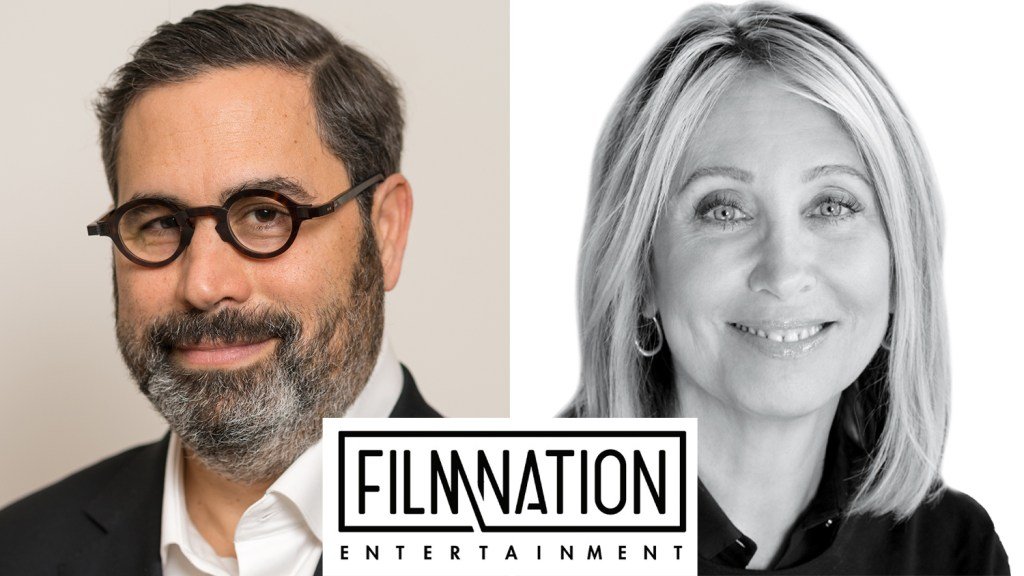
FilmNation‘s hire of former Universal, DreamWorks and Fox head Stacey Snider was a coup. But then again, FilmNation isn’t your average indie film and TV company. Glen Basner‘s blue-chip New York firm has been working on prestige and commercial hits for almost two decades: from Mud to Arrival and Conclave to Anora.
In a wide-ranging interview on the eve of the Cannes Film Festival and market, Deadline sat down with Snider and Basner to discuss their collaboration, new slate additions (including films with Richard Gere, Adrien Brody and Rachel Zegler and Jeremy Strong), the state of the business and what’s on the horizon.
I joined our call when the two were in the middle of a Jeff Nichols King Snake discussion…
DEADLINE: So how is it looking?
STACEY SNIDER: Real, authentic and spooky. They’re out at this remote location in Arkansas that feels like no one could hear you if you needed help…
DEADLINE: That’s probably what you want from a Jeff Nichols movie, right?
GLEN BASNER: I love that I get to see some actors from Mud that we made all those years ago, because not too many people are shooting in Little Rock, Arkansas. I’m seeing a lot of familiar faces that are taking me back to that film…
DEADLINE: So Stacey, how are you finding the rhythms of FilmNation?
SNIDER: I’m loving it. I feel like I’m really settling in. It’s been about five months, and it’s a great team, and we’re working on really great films. So I feel good and I feel motivated.
DEADLINE: There was a line in Mike Fleming Jr’s story about your hiring when he said that after your time at Sister that “this move seems a better fit for your skill set.” Do you agree with that?
SNIDER: I hope so. You have to ask Glen, but at least from my perspective it feels like a great fit. I love the movies that this company makes. I always have. They speak to me: They’ve gotten into the culture, they’re distinct. I think that’s what every executive and every producer wants to be a part of. It also speaks to me because I think there’s a need for what FilmNation does. Original movies matter, and they’re harder and harder to make. I felt that my taste overlaps with Glen’s and we’ve known each other for years. My experience and my drive can help these films be navigated toward production, so I felt like I could add value.
DEADLINE: How do you know each other?
SNIDER: We’re OG [laughs]. Glen can tell the story…
BASNER: When I was starting out as a young junior salesperson at Good Machine International, Stacey had the idea of buying the company and then taking the management team and merging it into USA Films to create what is now Focus Features. So it’s been, I don’t know, twentysomething years since Focus was created by Stacey and by James Schamus and David Linde, who were two of my mentors from the beginning of my career.
DEADLINE: And you got on well at that time?
SNIDER: We did. What was great about the studios during that time is there was a great variety of films that we could do. We were expected to do that. You were expected to present and distribute each year a variety of films from around the world. The bifurcation with specialty being its own thing was starting to happen, and I felt like we needed that at Universal. David and James and everything they built at Good Machine was a perfect candidate, and so my path crossed with Glen then. We made great movies at that time: The Pianist, Brokeback Mountain, Eternal Sunshine Of The Spotless Mind…But then all through the years, when I needed someone to really give me a sense of a film’s prospect and value and path to production, I would call Glenn at the various places that I was working at to be a touchstone…
L-R: Heath Ledger and Jake Gyllenhaal in ‘Brokeback Mountain’
Focus Films/Everett Collection
BASNER: I would add to that when we first became part of Universal and Focus was created, the initial instinct was a lot of nervousness and insecurity about what was going to mean for us and our indie credibility, but it was one of the great periods of my career where I learned so much and I became a fundamentally different executive through three years of working there. When I first thought of approaching Stacey about this role, it came at a time when things do feel challenged in the market and there isn’t a lot of certainty, except that I know that every day myself and this company we have to get better in a meaningful way every single day. That’s sort of what fueled my ambition to even approach Stacey about the role. But I’m a better executive today than I was the day before, and the experience, the creativity, the maturity and how to navigate complex situations…every day something happens where I’m like, ‘Oh, that’s a better way of doing something.’ That is really fueling all the optimism that we share as a company…
DEADLINE: How are you dovetailing?
SNIDER: Glen’s assembled a team of experts. As the Chief Creative Officer I’m keeping an eye on the film and TV productions, but we’re all engaged in Socratic decision making to be a nimble, decisive company. I’d say our skills complement one another, but they often overlap.
DEADLINE: This is clearly a creative role. Was there a strategic or financial design in mind when you made the hire, Glen?
BASNER: Stacey is leading the creative charge of FilmNation, but she’s run three studios. We have questions about things, and we have experience, but we don’t have that experience. So there’s no exclusionary like, ‘Okay, well, we’ll handle the strategy or the business’. We just work together as a team, and where Stacey can add value, and often does add value outside of a creative auspice, we’re fortunate to have it, and we’re definitely taking advantage of it every day. But it’s not part of sort of a grand plan of doing other types of businesses. It’s about doing what we’ve been doing really well for almost 18 years and saying ‘but really well isn’t well enough anymore. We need to do great’, and Stacey will lead us in that direction.
SNIDER: We both want to get stuff done, and the company is designed that way. It’s Glen’s personality to be decisive and want to get things done. There’s a real experience and bespoke attention to each step of the process so filmmakers can make the best version of their film.
DEADLINE: When the announcement was made, it probably took some people by surprise given your long studio background. Were there also conversations with studios at that time?
SNIDER: There were some conversations about what gig I might try for, but for the people that really know me, what I love is making movies. I think in this moment of consolidation, and even before that, during a time, when for understandable reasons, studios had abandoned the mid budget films and the variety of films, I’ve always been motivated by variety and originality and just getting stuff done.
DEADLINE: Have you started originating projects at the company? Any of the new projects announced for the Cannes market, for example?
SNIDER: Most of them have been in motion, and I feel really lucky to to be near them. But what I’m hoping for is that some of the filmmakers that I worked with at the studios will want to make original films…
BASNER: Our recently announced project Asymmetry by Ed Zwick is one we just agreed to co finance and produce and that came in from Stacey. She had worked with Ed making Legends of The Fall. That was a conversation I loved listening in on. ‘How can an Academy Award winner, a filmmaker that has made seminal movies in a lot of our lives, how can he go and make something just as great in the landscape that we face today?’ I think the combination of her creative instincts, but also her ability and relationship with Ed on a creative level, along with our ability to have a really flexible model and multiple models of how we can make something exist, is a really quick and straightforward example of something that we had imagined could come to bear and has happened really quickly.
So, Asymmetry I’m really excited about because it poses this real provocation of an asymmetrical age relationship and society’s viewpoint on that. But it gets to a really human place where it’s like, ‘well, who am I to tell somebody else who they can or can’t love, or should or should not love.’ At the same time, it’s entertaining. People are going to go see this, are going to have a real talking point, real fun afterwards with their partners and friends that they go see the movie with. But mostly they’re going to walk out smiling. They’re going to have a great time. And that has me really excited. And I could also say, Richard Gere. It’s the first time we have Richard Gere in a FilmNation movie, and that’s not a small thing to us. Richard Gere is an unbelievable actor, and again, like Ed, represents touch points in my growing up and learning about film. So to have Richard Gere in one of our movies is really fucking exciting.
SNIDER: Another example of stuff that gets me so excited is our film Passenger by Magnus Van Horn. I didn’t know his work but it has been so exciting to prep and learn about it.
DEADLINE: That one sounds like it has real awards potential. Jeremy, the subject matter, the director…When is it starting?
BASNER: Top of the year.
L-R: Adrien Brody, Rachel Zegler and Ben Platt
Getty/Courtesy/Getty
DEADLINE: You mentioned The Pianist earlier. It’s kind of a full circle moment then that you’re now making the movie after Adrien Brody’s second Oscar, for The Brutalist. Rachel Zeger will co-star and sing in it. Is the movie a musical?
BASNER: It’s not a musical, but it’s a film with a lot of music, because they’re on this cruise where Gloria Gaynor and disco are the best way to celebrate their lives and guard against what’s coming in the future. Ben Platt is writing some original songs for Rachel and Adrien.
Since we sent that out, I’ve been making dozens of calls and getting dozens of calls from distributors and I’m having the best time telling everyone my schmaltzy sales line. But I mean it. ‘This is not a feel good movie, it’s a feel great movie’. And that’s the sensation that I had when I was reading that script, and when I turn the pages and there are tears in my eyes, literally tears in my eyes. And I just feel on top of the world when a movie can do that for you and be about something. It’s it’s just the best.
DEADLINE: Looking at your slate, it feels like over the last few years FilmNation has stepped back from some of the $50-100M projects that you were involved in previously. There are fewer in the market in general but they still exist, but not really on the FilmNation slate. Has that been a conscious decision?
BASNER: It’s factual to say that that’s some aspect of where the market is and what the independent market can bring to bear. But at the moment, we just simply don’t think like that. It’s just not our starting point. We’re talking with storytellers, we’re reading screenplays, we’re reading books and articles, and we’re just looking to be inspired by something. It’s not more complicated than that. At the same time, it is fair to say that very expensive specialty movies feel very difficult for independent distributors in individual territories. There’s some price sensitivity because of the consolidation that’s happened in our business and in our industry. But there’s some talk that that’s a theatrical problem when it isn’t. It’s really more about the ancillary value, and in particular, pay and free TV.
DEADLINE: One of the ways companies can look to insulate themselves is through domestic distribution. There’s been talk for years you’re going down that road. What’s the latest there?
BASNER: Let me start by saying that at no point in time will this company ever think about ‘insulating’ itself. We want to be right there in front of it. We want to feel the edge, the pressure of the world, because that’s going to sharpen our instincts. That’s what’s going to allow us to maintain our ambition. The jet fuel is creative ambition, and we’re going to be just as daring as we always have been. It’s always been about finding a filmmaker who’s got a unique and singular story to tell, and then supporting them, often in multiple ways, to make sure that film can achieve the best version of itself.
In terms of distribution, everyone loves to talk about what other companies are doing. I’ve been called by journalists over the years to congratulate me on the sale of my company — a sale that never happened…
DEADLINE: Sure. But it’s a fact that you’ve discussed this as a company, that it has been part of the conversation…
BASNER: But not in the way you are suggesting. It’s been in our minds since we started producing movies. Because when you produce a movie and then you deliver it to the U.S. distributor, everything gets talked about as if it’s the U.S. distributor’s movie. And while you’re certainly happy to share that credit, there is an emotionality to that of like, ‘wait a minute, we made this movie, we want to be part of that recognition’. That’s always been something that I felt throughout the years, and it’s always something that we’ve talked about throughout the years. But it’s not the first and foremost thing what we’re looking to achieve right at this moment.
L-R: Margaret Qualley, Michael Shannon, Drew Starkey and Jeff Nichols
Getty Images/Juankr/Getty/Kyle Kaplan/Focus Features
But Neon just took King Snake for domestic in a partnership with us. That is actually a different structure to something we’ve done before. We didn’t need to start another distinct company to achieve it. FilmNation will share in the U.S. distribution risk with Neon. That’s a first for us in how we finance a film. It represents the confidence we have in our slate and will be part of our strategy going forward on 1-2 films per year.
DEADLINE: Do you still have the same backers as before at FilmNation?
BASNER: Yes, we have three partners the company: myself, a gentleman named Steven Samuels, who was has been my partner since the beginning (and he in turn has two partners), and then about ten years ago Roadshow distribution from Australia came in as a third partner and their investment was the capital with which we started financing movies.
DEADLINE: Any other parnters on the horizon?
BASNER: No
DEADLINE: You’re known as a blue chip film company: given that, what was the thinking behind taking on the controversial Melania documentary for international sales earlier this year? That raised some eyebrows. Was it a hard one to square with the team? Are there any other Trump adjacent projects on the horizon?
BASNER: Melania was a global release for Amazon. While we can’t comment further due to contractual obligations, we can say that we consistently work with a number of studios, streaming partners across many and varied film and TV titles to help them achieve best possible results.
DEADLINE: What’s the weighting right now at the company between film and TV?
SNIDER: I’m still getting my arms around our TV and film groups. Filmation is known as a film company. I’d probably say film is around 60 to 70% of my attention, but I’m loving what our U.S. and international TV teams are doing. The House Of The Spirits, our Spanish-language adaptation of Isabel Allende’s novel, was a great fit for us.
DEADLINE: Is it natural to assume that 30-40 percent TV will increase in coming years?
SNIDER: My hope is that our film talent can toggle between film and TV, which is what our TV head Courtney Saladino Gurney did on House Of The Spirits.
BASNER: Whether it’s a project for our production label Infrared for more mainstream films, or whether it’s a Graham Norton book Kirstie Macdonald has brought in for us in the UK or a project we’ve set up with MediaPro, we’re just focused on how we can do what we’ve done in the past, better. Our movie Skeletons for our Infrared label is one that we’re producing with JJ Abrams and Jack Heller and which we recently sold to Sony. It’s currently on the ground in Australia and they’re prepping that and doing the final casting now to join Brie Larson.
DEADLINE: You’ve both worked with so many great filmmakers. Can you each give me a name of someone you haven’t worked with that you would love to do so?
BASNER: Steven Spielberg.
SNIDER: Someone whose work I so admire, and who I’d love to find something for is Paul Thomas Anderson.
Paramount CEO David Ellison at CinemaCon 2026
Gilbert Flores/PMC
DEADLINE: Stacey, you’re well versed in the impact of major mergers and acquisitions from your time at the studios. What did your experiences teach you about the likely impact of a Warner Bros sale? What would you hope could come from it?
SNIDER: When I was at Universal and I worked for Ron Meyer and the studio was bought and sold four times, and in those situations, luckily, we weren’t bought by other studios. So the goal was to just keep our heads down to make great movies, deliver results financially, and I wanted to protect everyone’s jobs. When it comes to this type of consolidation, I’m hopeful that the commitment to theatrical and to volume and to keeping the studios separate, is true, because I think there’s a business reason and a cultural reason to do that. So, I’m hopeful that that is true, and and I feel for the people that are going through it because the uncertainty is just awful.
But even as optimistic as I am, I know that consolidation means fewer decision makers. You can commit to volume, you can up volume, you can commit to theatrical releases, but there’s just fewer decision makers and gatekeepers.
DEADLINE: Like many others, it sounds like you’d rather this deal wasn’t happening and the two studios could remain standalone…
SNIDER: For Glen and I this business is not just a business; it’s a vocation, it’s a passion, and I believe in variety. I know how motivated I was when I was at the studios by competition, and by an open market. I wanted to be as good as my competitors, and I wanted to beat them, and that made for a really vibrant creative and business culture. That’s what I believe in.
DEADLINE: Any advice for David Ellison as he navigates this tricky deal?
SNIDER: It would be presumptuous for me to do that. I’m here to be a thought partner to anyone in the business who is trying to wrangle through a difficult situation. And that’s why I wanted to join FilmNation, because you can only navigate difficult situations when you’ve got people whose values and tastes and interests align with yours.