It’s no longer a secret that Basque cinema is getting some overdue time in the spotlight.
Thanks to an almighty production boom in the region, powered by a whopping 60 percent tax rebate (increasing to 70 percent for projects shot in the Basque language, Euskera), the Basque Country’s film and TV output has never looked so healthy. And the proof is in the pudding: The Hollywood Reporter took an in-depth look at the record 45 nominations for Basque projects at this year’s Goyas, also known as “the Spanish Oscars,” after a decade of concentrated investment.
With San Sebastián’s profile rising exponentially every September, the people working behind the scenes to make sure Basque cinema is capitalizing on every single success are already pushing the next generation of original voices into the festival hot seat. At the 74th edition, a total of 31 titles with Basque production ties — including David Pérez Sañudo’s hotly anticipated competition title The Harvester — will screen across the festival’s many selections. Twelve are documentaries, marking a real moment for Basque docs at this installment. But with award statuettes firmly on the mantel, the Basque region now sets itself the task of sustaining this run of form long-term. The answer? Find and nurture the next generation’s emerging talent.
For example, the debut feature from Nitya López Saitua in Zinemira, Family Drill, a project fuelled by word-of-mouth buzz across northern Spain. “He’s been doing great as a first AD and second AD for so many years,” begins Mar Izquierdo, coordinator of Zineuskadi, a non-profit operating at the epicentre of the Basque film and TV industry, “and everyone was like, ‘But he’s got it. He’s not going to be an AD.’ And we really do hope that with this film, everyone else will be able to see it.”
Izquierdo’s company works strategically to promote the Basque audiovisual sector, partnering with every production output in the region, working alongside the Basque government’s culture department and public broadcaster ETB Basque to help facilitate co-productions, distribution and sales deals, as well as earning key projects coveted slots at the globe’s biggest film festivals and plotting awards campaigns.
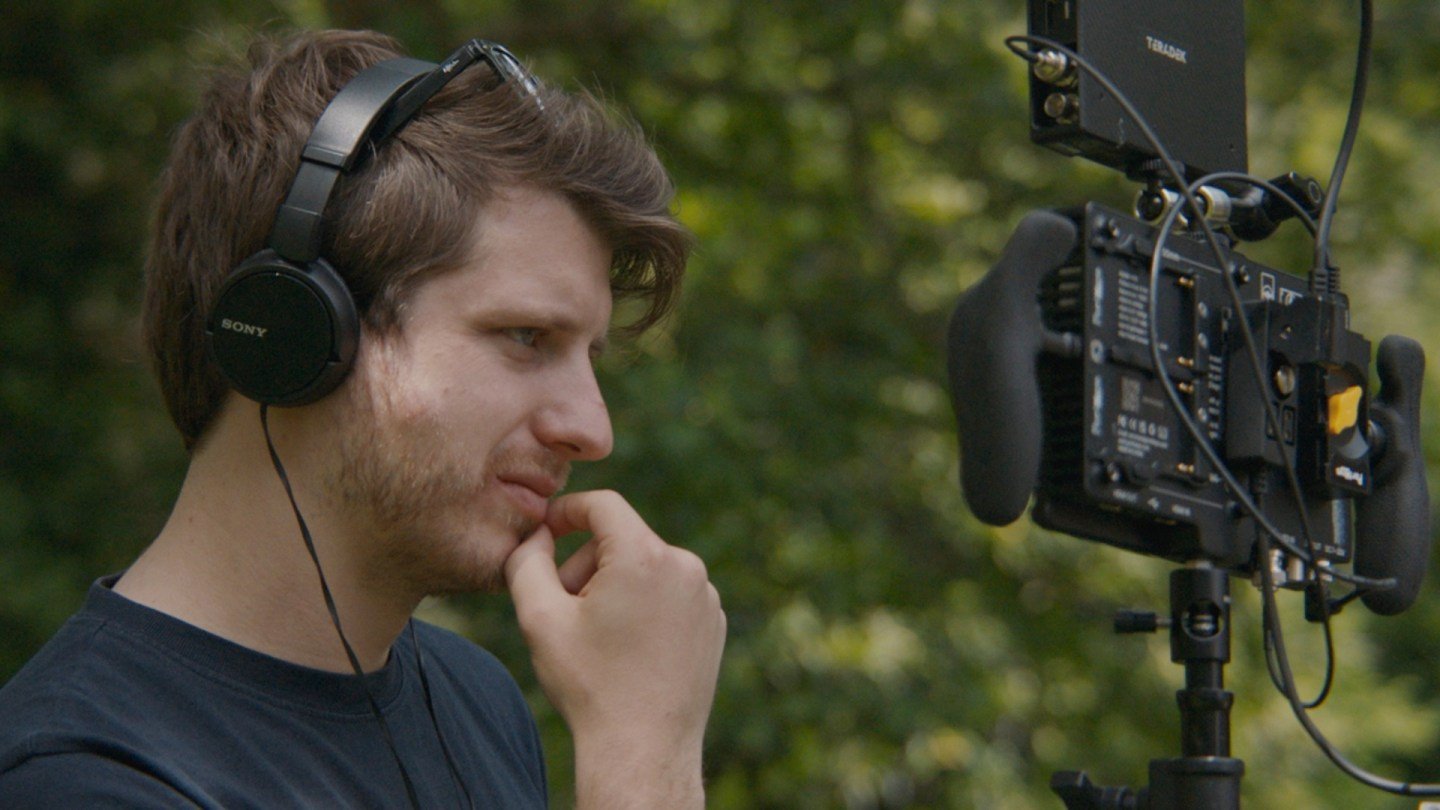
One young talent they’ve thrown their support behind is the 30-year-old López, who was in such a hurry to capture the creative process practically spilling out of his head that Family Drill — a co-production with Mubox Studio, who are distributing the film — was shot with just 10 people across three days in his childhood home on the Basque coast. He tells THR: “Iraia Elias and Miguel Garcés [play] my mom and dad and we recreate my parents’ relationship, [leading up to] the last argument that broke the relationship when I was four years old.” It is as deeply personal as it sounds. “This was a way to recreate memories that I didn’t have,” says López, firmly out of AD mode and in full-fledged director mode. “And I think it was very important to free-work on the scenes, without a script.”
Family Drill
San Sebastian Film Festival
López’s determination to start the shoot before he lost that powerful sense of direction in chronicling his parents’ split speaks to the strength of the Basque Country’s storytelling. “We have really great directors here in the Basque Country, and internationally they are [getting] more recognized,” continues the first-time filmmaker. “I have the opportunity of working with many of them, and I love their work, and I’m very proud to be part of the next generation making movies. I think that we are in a great moment [compared to] making movies here 20 years ago.” It used to be the case that, “if [creatives] want to direct, they must go to other places, go to Madrid,” he explains. Here in the region López calls home, there have never been so many reasons to put roots down.
One of his countrymen, Javier Giner, also arrives at the San Sebastián Film Festival with his first movie. This Solitude is premiering in the New Directors section. A debut feature it may technically be, but director-writer Giner has known global success with the International Emmy-winning I, Addict series, based on his own life and struggle with drug addiction. With This Solitude, Giner, who grew up in Bilbao, reacts to the unprecedented impact of that show. “I, Addict was a huge hit in Spain and it dealt with a part of my life where I suffered [with] the illness of addiction,” he says. “After that explosive TV series where I presented myself to the world with no mask, I needed to go back to my childhood, to a very intimate place, a very silent place — much smaller than I, Addict.”
Giner suddenly found himself shooting where he grew up, Bilbao, back to the places and locations that he says “have an emotional resonance” for him. The film, starring Oriol Pla, Marina Salas, Gemma Martínez, Kai Etxaniz and Itziar Lazkano, is a Balance Media Entertainment production, with The Embassy TV and Basajaun Filmak as co-producers, and Filmax handling distribution. “We meet two young people who live in Bilbao, Leo and Lorea, and we follow them through the grief process after they break a five-year-long relationship,” Giner explains. “And I use that journey as an excuse to talk about a lot of things like class, the housing [crisis]. […] Those moments in our lives everyone goes through, in a sense of reconstructing yourself because nothing works around you and you don’t quite grasp who you are [or] what you want.”
He speaks with as much gusto as López, who also, in some way, depicts his Basque youth on screen — a common theme running through many of these films — and seeing fellow regional filmmakers make a name for themselves in recent years only speaks to the urgency of the stories coming out of the Basque Country, according to Giner. “To be honest, it fills me with pride,” he says. “I think movies and filmmakers, when they’re honest with their upbringing and their roots, there’s something very beautiful in it. As an audience member, I love when I discover London through Mike Leigh’s eyes, for example, or I discover parts of the world that I don’t know about through some filmmaker’s eyes.”
Giner says that in the last 10 years, especially, Basque stories have been “very important to tell.” He continues: “I jokingly call This Solitude my very Basque movie, because there’s a reflection of identity in the movie… It tells [you] a lot about the place. And the Basque Country, it’s beautiful. It has beautiful landscapes. It has great possibilities. It is filled with really talented people, both in front of and behind the camera. So, I mean, it fills me with total pride if someone considers me the representation of the Basque Country at this year’s festival.” He is admittedly still pinching himself that he’s here: “It’s incredible. To be honest, a lot of my film education has to do with the San Sebastián Film Festival because when I was a teenager, I used to go from Bilbao to San Sebastián and watch movies.”
López concurs that Basque cinema has its own culture, but also lauds the region’s directors for still being able to make “really universal movies.” And Izquierdo says the variation across the projects this year is particularly exciting for her. “The best thing is we are covering every possible subject,” she says. “We have a biopic for a musical group. We have culinary cinema. We have a French co-production, a coming-of-age [film] within a school. We have everything.”
Basque filmmaker Javier Giner.
San Sebastian Film Festival
And naturally, the festival also serves as something of a springboard for those nail-biting awards runs. “It’s the most important film festival in Spain and one of the Movie Features A film festivals in the world,” says Giner about what a premiere in San Sebastián can do for one’s Goya hopes. “So it’s definitely a great trampoline. But it’s something that I don’t want to think about because I don’t want to get lost in that narrative and it take away from the pure pleasure of putting a film out there and sharing it with the public.”
Of course, it’s not just Basque filmmakers travelling to shoot here. Taiwan’s Tsai Ming-liang is presenting Dust in San Sebastián, a short film and exhibition piece as part of his Walker series, which is a Basque co-production. Nanni Moretti made the most of those tempting tax incentives, too, with his last movie It Will Happen Tonight filming in the region before its recent Venice Film Festival premiere, and the Catherine Zeta-Jones starrer Kill Jackie — releasing Oct. 2 — shot extensively across Bilbao. “It’s not only that we continue to have emerging talent, but we are able to co-produce and have A-class films as minority co-producers,” beams Izquierdo.
But she maintains that the most rewarding part of her job is platforming the next generation of Basque filmmakers, who are carving out a path by leading with instinct, leaning into personal storytelling, and celebrating each milestone. “The big names know how to [make] their way through the other festivals,” says Izquierdo. “But some of them need this in order to get the next one — it’s a window of opportunity for them, because otherwise maybe their documentary or small film would be just another small fish in the pond. Here,” she adds, “they get the chance on the big screen, where exhibitors and distributors will be able to notice them.”
The 2026 San Sebastián International Film Festival runs Sep. 18-26.