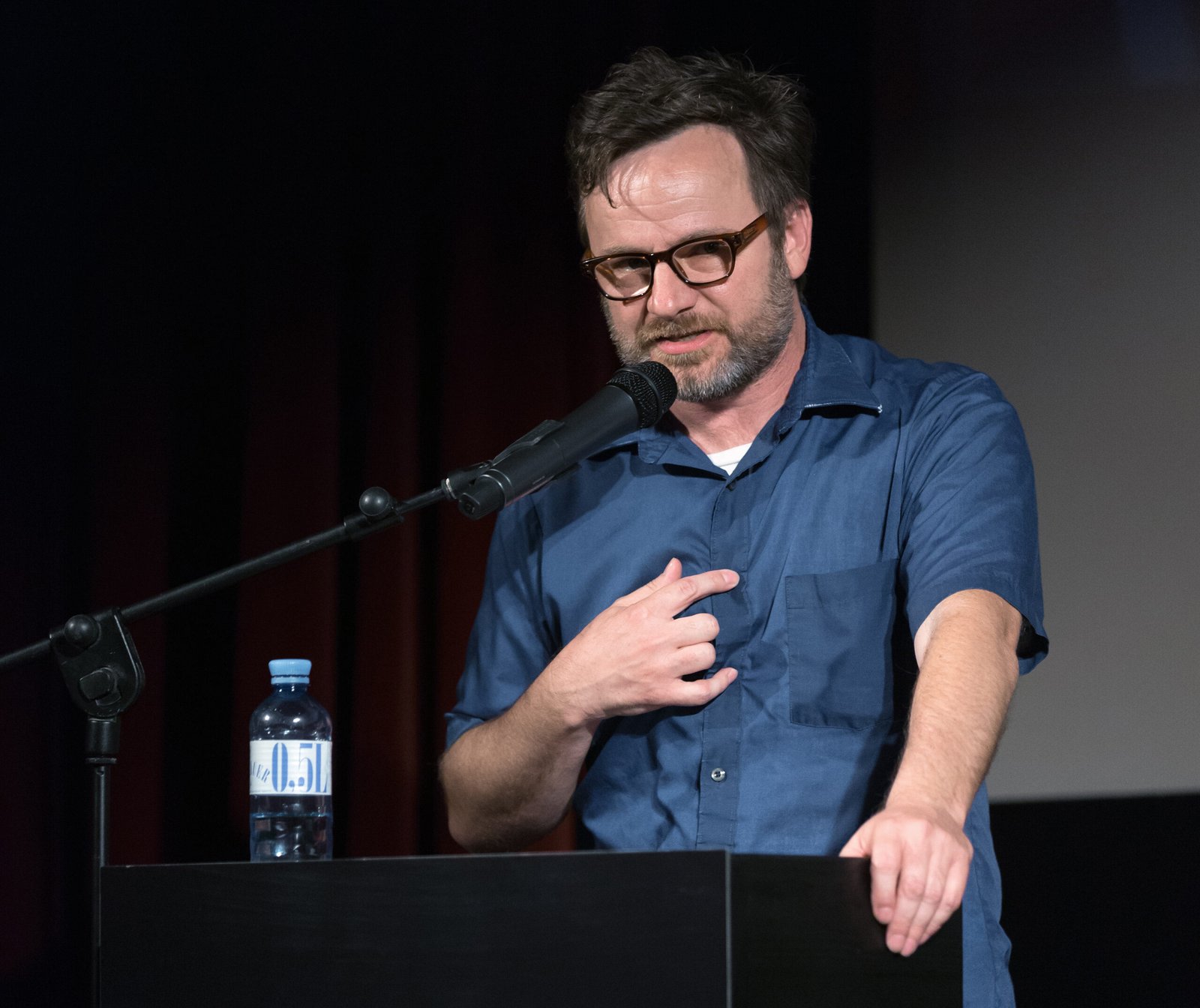
Mike Plante at the 2016 Vienna Independent Shorts festival. Photograph by Manfred Werner.
For a quarter century, Mike Plante, who passed away yesterday at 56, programmed short films for the Sundance Film Festival. Under Mike’s watch, Sundance’s short film programs became a standard bearer of excellence as well as a sanctuary for the genuinely bizarre and the formally radical, the deeply personal and the uniquely abstract. His eclectic and wide ranging taste was relied on by hundreds of friends, journalists, and fellow programmers; he eventually became Senior Programmer, and his work directly launched thousands of filmmaking careers over the years.
“Simply put: I would not be a filmmaker today were it not for Mike Plante,” read the first sentence of an Instagram tribute posted by director Alex Ross Perry. “When I think about people [to whom] I owe my career,” director Shaka King wrote to me, “Mike Plante is a name I’m always sure to mention.”
He was the rarest of creatures in the modern American film ecosystem: an institutional insider who retained the soul, habits, ethics, and sensibility of a 1990s zinester. After graduating from the University of Arizona in 1994, he cut his teeth as a projectionist at the Loft Cinema in Tuscon, where he would much later cofound a fantastic regional film festival by the same name. In 1998, he launched Cinemad, a cut-and-paste, black-and-white photocopied zine dedicated to films and filmmakers on the margins; after six issues, the zine moved online to become a blog, then a podcast. It was also an occasional distribution label in its own right, putting out such films as Don Hertzfeldt’s It’s Such a Beautiful Day (2012) and Jem Cohen’s Instrument (1999), a collaborative portrait of the band Fugazi. Their guitarist, Guy Picciotto, once described Cinemad’s ethos: “No suffocating pretentious toffee-nosed artspeak, no thumbs up/thumbs down Hollywood toadyism, just the good shit.”
Instrument (1999)
The generosity and expansiveness that defined his career and relationships has been evident in the outpouring of grief in the independent film community after news of his passing, due to complications from a brain aneurysm he suffered five weeks ago, began to circulate. An indefatigable champion of outsider filmmakers, Plante found venue after venue to share their work. With his Sundance colleague Trevor Groth, he ran the now defunct, but much beloved CineVegas Film Festival. His friend and collaborator Groth wrote yesterday on Instagram, “From the moment [John] Cooper and I interviewed him for Sundance, I was hooked. So I found a way to be around him 24/7 and hired him to run CineVegas with me. He made that festival legendary. He and Dennis Hopper, our chairman, connected instantly. They were two true renegades with a deep appreciation for art and for movies that rock our world. Mike was at home introducing a film to 1,200 people at the Eccles, part poetry and part stand-up, as he was dominating the lanes at our midnight bowling party.”
He was a filmmaker and author, too; his book Sensation Cinema: The Audacious, Defiant History of Louis Sher and the Art Theatre Guild was published in September. He approached his own filmmaking—among his projects are the 2011 feature documentary Be Like An Ant and the brilliant 2017 short The Polaroid Job, which became a breakout piece for the New York Times’ Op-Docs series—with the same underdog-loving populism and discerning eye that defined his curation. As a producer, he was committed to shepherding works that captured the eccentric margins of creative life. An especially lovely, underheralded film he produced is Adam Rifkin’s hilarious and weirdly moving 2014 documentary Giuseppe Makes a Movie, which follows the irrepressible DIY filmmaker Giuseppe Andrews as he directs a feature titled Garbanzo Gas in a Ventura trailer park over a single weekend with a cast of local vagabonds and amateurs.
I was last in touch with Mike—an occasional contributor to this magazine, who I knew socially and professionally for over 15 years—just a few months ago, about setting up a screening of a new documentary about Fugazi he was booking for the band. Beyond Sundance, CineVegas, and the Loft Film Fest, Plante was a programmer at large for various regional and international outposts—he even programmed one of my films own once, Redlegs (2012), at Kraków’s Off Camera International Film Festival, in a section called “From the Gut”—and had most recently settled in Vegas once more, as the lead programmer for the Beverly Theater.
The last time I saw him, at an LA Film Forum screening of recent short films by our dear friend Kevin Jerome Everson (just the type of outsider genius Plante so often heralded), he talked about the relative ease and affordability of life in Vegas in comparison to Los Angeles, where he had lived for several decades. Mike, at last, had a couple screens of his own to program whatever it was he felt like showing. To the legions of filmmakers and programmers who knew and loved him, Mike was an often unsung and unassuming connective tissue of the American independent film scene. We’ll miss him dearly.
Correction: A previous version of this piece misstated the venue where a Kevin Jerome Everson shorts program was held this spring. It is LA Film Forum, not Mezzanine LA.