This is your first of three free stories this month. Become a free or sustaining member to read unlimited articles, webinars and ebooks.
Become A Member
Before the streets of Nepal’s Bramhakhel fill with traffic, 40-year-old Pratima Poudel walks to a centuries-old stone spout carrying empty plastic bottles to collect water. The walk has become part of the Nepali language instructor’s daily routine.
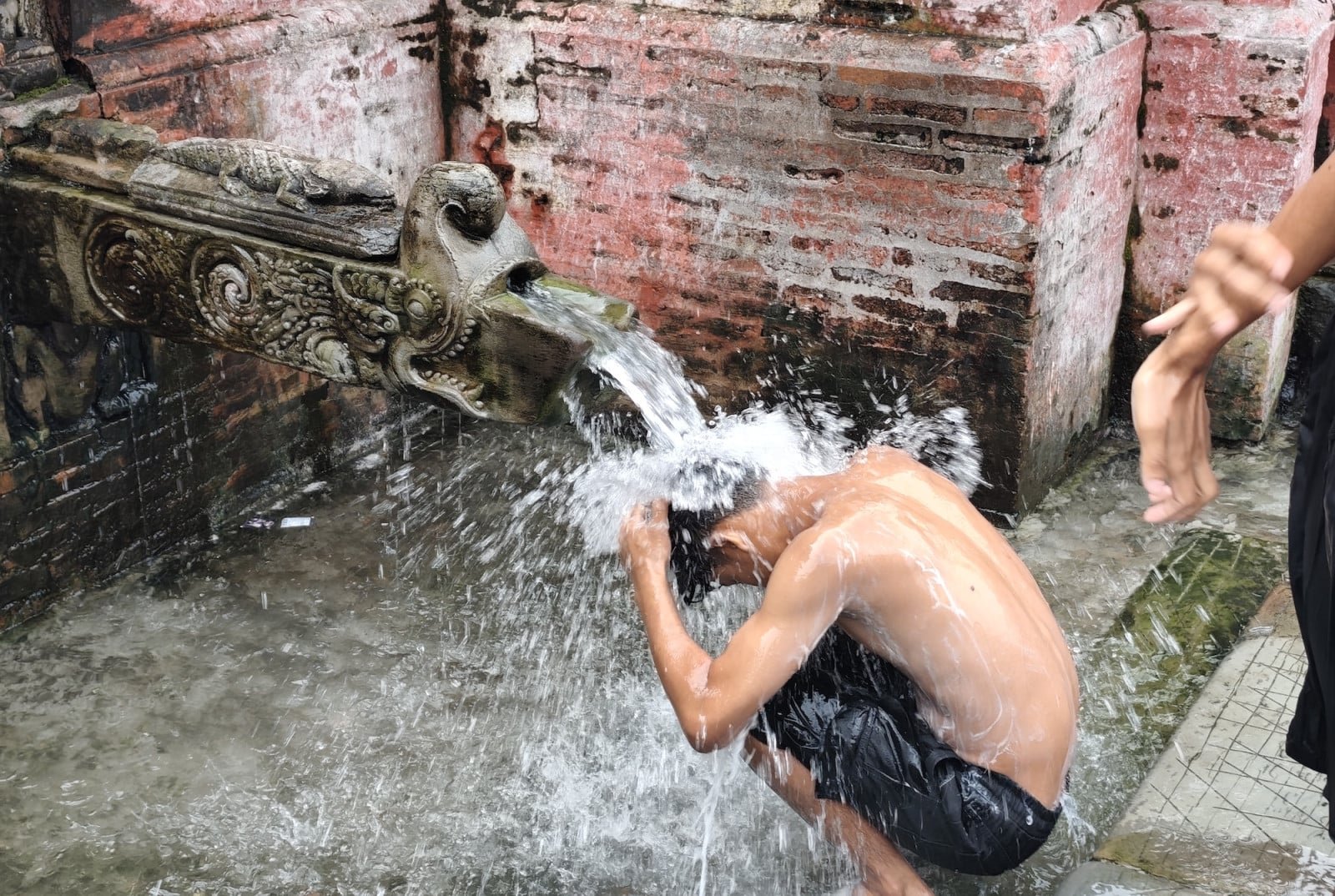
The spout she visits each morning is part of the Kathmandu Valley’s traditional water system, composed of interconnected stone spouts known locally as dhunge dhara or alternately as hiti. The network once supplied water to communities across the valley; today, it provides an alternative source for residents facing unreliable access to piped water.
“We don’t like tap water,” she tells Next City as she fills her bottles directly from the spout. From time to time, residents treat the spout’s water with chlorine. “This water is cleaner. Some neighbors have begun boiling the water before drinking, but I am not worried.”
In a country where only a quarter of the population has access to clean drinking water, Poudel is one of a growing number of Kathmandu residents choosing the spout over the tap. Nearly 70% of the city’s drinking water samples contain E. coli and faecal coliform, bacteria that indicate contamination by human or animal waste, according to the latest government analysis. Residents say the valley’s rivers have become open sewers and the pipes carry the same contamination into their homes.
Climate change and rapid urbanization are colliding in the Southeast Asian country, where increased monsoon intensity and frequent floods are overwhelming the capital’s water systems. Amid this failure of modern infrastructure, residents are reviving dhunge dharas in and around Kathmandu — in one case, even rebuilding an ancient fountain from the ground up after it was lost in the 2015 earthquake.
Pratima Poudel fills her water bottle at Brahmakhel Dhunge Dhara in Kathmandu, Nepal. (Photo by Pratik Ghimire)
A 1,400-year-old network
The oldest functioning spout — Manga Hiti in Patan, a city of ancient palaces and courtyards less than four miles south of central Kathmandu — has provided water since 570 AD.
These fountains rely on underground aquifers that channel water naturally through gravitational force, supported by networks of ponds and canals that store and regulate supply during dry seasons while preventing flooding during monsoons.
Beneath each stone spout lies a complex water system. A stone spout is essentially “the outlet of a spring connected to groundwater,” as climate change and springshed expert Ujjwal Upadhyay describes it.
“The stone structure is built by people, but the water flowing through it comes from a natural underground system,” he explains.
Rainwater enters the ground through a defined recharge area, accumulates in underground aquifers and eventually emerges at the surface as a spring. Traditionally, communities identified these natural water pathways and built spouts at points where water could flow to the surface.
“Even those who get tap water come to Bhinya Hiti for drinking water,” says heritage conservationist Rabindra Puri, referring to a spout in Bhaktapur municipality, about eight miles from Kathmandu. It’s believed to date back around 1,400 years.
“The spouts served a social purpose as well as providing water,” he explains. “They were designed as community spaces where residents could meet, exchange news, and socialize while collecting water, much like people gathering at tea shops today.”
The Bhinya Hiti fountain in Bhaktapur, an ancient city in Nepal’s Kathmandu Valley. (Photo by Pratik Ghimire
Short supply, uncertain quality
The public utility company Kathmandu Upatyaka Khanepani Limited is responsible for the management of the Kathmandu Valley’s water supply and sanitation system. Its 2024-2025 annual report says the capital’s water demand is about 136 million gallons (514 million liters) per day, while the company’s average supply is only 61.4 million (232.4 million liters) daily with seasonal variation.
The gap between supply and demand has pushed people to alternatives like groundwater extraction, private tankers, jars, and bottled water. But in places where functioning stone spouts are available, people continue to use dhunge dharas.
For 18-year-old Mohin Thapa, Brahmakhel Dhunge Dhara has made collecting drinking water easier.
“When my parents are busy with work, I collect the water myself,” the university student says. “Rather than going every day, I fill four or five bottles at a time, which lasts a couple of days.”
His family uses tap water for bathing, cleaning, gardening and washing, while relying on water from the stone spout for drinking.
“I prefer drinking water from the dhunge dhara,” he tells Next City. “Ever since I was a child, that has been my primary water source, and I love its natural taste and freshness.”
Children drink water from Alko Hiti in the city of Patan. (Photo by Pratik Ghimire)
Sher Bahadur Pun, chief of the Tropical and Infectious Disease Hospital’s Clinical Research Unit, says the hospital receives around half a dozen patients presenting with symptoms of waterborne diseases, including fever and diarrhea, every day. Patients do not typically identify stone-spout water as the source of their illness, he says, but he still encourages caution.
“That does not make untreated stone-spout water automatically safe,” Pun says. “Boiling or purifying would be better.”
A 2022 review of research on Kathmandu Valley’s stone spouts reported that previous testing had detected total coliforms, E. coli and nitrates in some spout-water samples, with water quality varying by season. The review noted that many stone spouts rely on shallow groundwater, making them vulnerable to contamination.
A system under pressure
A survey by the Kathmandu Valley Water Supply Management Board in 2019 counted 573 spouts in the valley with a combined discharge of 2.4 million liters a day.
Of those spouts, many were in disrepair and 94 had been lost entirely. Just 224 were still functioning. In 2022, the valley’s water fountains were placed on the the World Monuments Fund’s watchlist for heritage sites urgently at risk.
Like the city’s modern water infrastructure, the ancient water network has also been increasingly under pressure due to extreme weather and development. Kathmandu receives around 57 inches (1,450 millimetres) of rainfall a year, but more often, that rain is falling in shorter, more intense periods, Upadhyay says.
“Heavy rainfall over a short duration is more likely to run off rather than infiltrate and recharge groundwater,” Upadhyay points out.
Houses, roads, agriculture and other changes in land use can interfere with the areas where water needs to infiltrate, he explains: “A spout can be cleaned, repaired or restored on the surface, but if its underground conduits are broken, its recharge area is blocked, or its water source has been disrupted, the flow can disappear.”
Sushil Shrestha stands beside Alko Hiti in the city of Patan, Nepal. (Photo by Pratik Ghimire)
Sushil Shrestha, a stone-spout expert, conservationist and chairperson of the Historic Stone Spouts and Ponds Conservation Association, says that this has happened at stone spouts across the valley.
He points to Sundhara, or the Golden Spout, in Kathmandu, where surrounding buildings and infrastructure have disrupted the underground system and contributed to the spout drying up. But he says the spout could still be revived by reconnecting it to viable water sources.
Bringing spouts back to life
Residents are now more aware of the importance of this heritage, Shrestha says.
The nearly 600- to 700-year-old Alko Hiti in Patan, Lalitpur — which alone produces more than 200,000 gallons (about 800,000 liters) of water a day, he says — was restored after its water was polluted from a leak from a local bone mill factory in 2000. A surge in water-borne diseases triggered a local conservation movement, which culminated in the community-led revival and renovation of Alko Hiti in 2003.
In Thamel, the historic Ga Hiti spout supplied thousands of residents until April 2015, when a neighbouring hotel collapsed in a massive earthquake that devastated the region, and the spout was destroyed. Reconstruction cost more than $30,000 (Rs4.6 million), with Kathmandu Metropolitan City covering 80% and residents raising the rest. The Ga Hiti Youth Club and local volunteers finished the work in about six months, and the spout was flowing again by early 2017.
According to Shrestha, there is a massive gap between water demand and supply, and functioning dhunge dhara are “actively helping to minimize that gap.”
“They are priceless ancient heritage and very old living historic monuments – beyond easing daily shortages,” he tells Next City. “If Kathmandu Valley loses them or they stop flowing, the water crisis will deepen further, and we will lose a very important part of our history.”
This article was produced in collaboration with Egab.