During the Hays Code era, when Hollywood operated under a self-imposed system of censorship from 1934 to 1968, sex could only be alluded to on screen: a closed door, fireworks exploding in the night sky, a train entering a tunnel. In more recent decades, directors have had greater freedom over what they can show, including sex, the occasional nipple and even, sometimes, a flaccid penis. Our reactions to on-screen intimacy have naturally evolved alongside wider cultural attitudes towards sex. This may help explain why, amid an apparent sex recession, studies have found that almost half of Gen Z want less sex on screen. But Yehuda Duenyas, lead intimacy instructor at Cintima, a SAG-AFTRA-accredited training programme, says this is only part of the story.
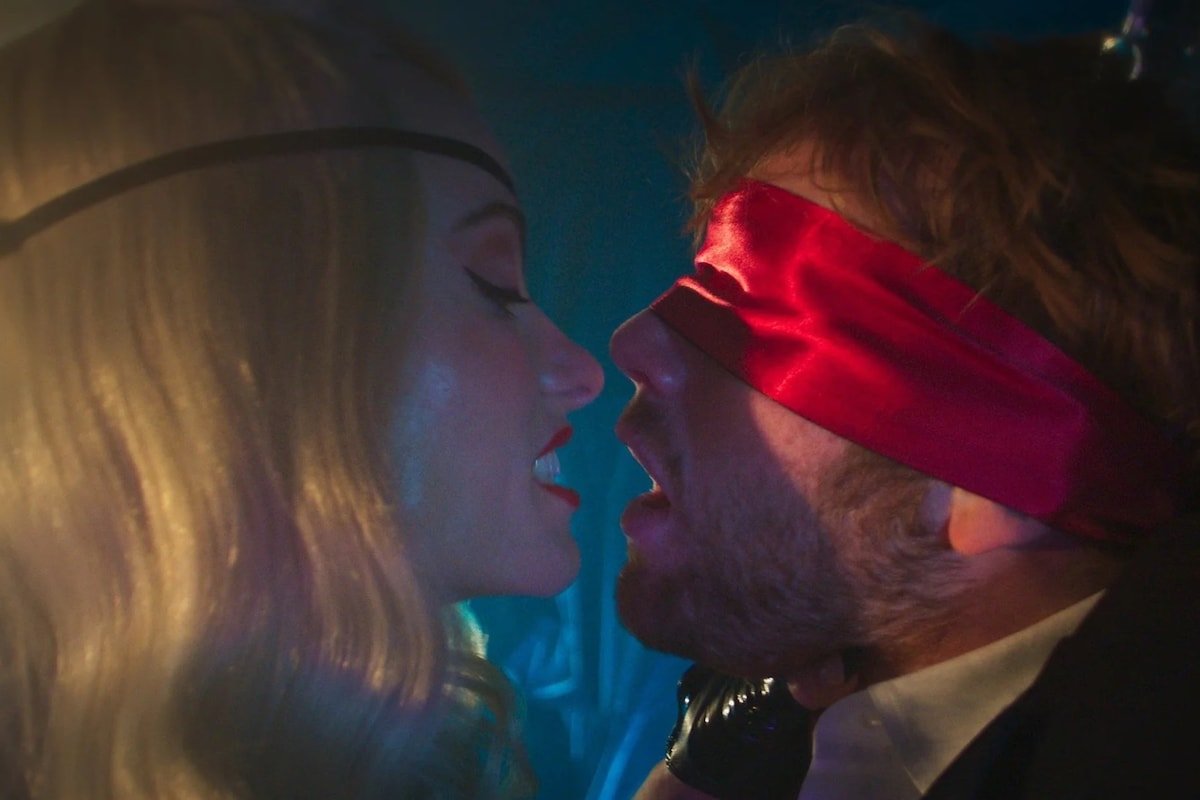
When I speak to Duenyas, he begins by pointing out that neither of us would be on the call without an act of intimacy having taken place somewhere along the way. “Intimacy is the story of what it is to be human,” he says. As the intimacy coordinator for Gregg Araki’s new film I Want Your Sex, Duenyas, like Araki, is interested in exploring what modern connection looks like on screen. The erotic thriller follows fresh-faced Elliot (Cooper Hoffman), who lands a job with artist and provocateur Erika Tracy (Olivia Wilde) before becoming her unlikely sexual muse. It contains exactly the kind of layered intimacy that Duenyas says young people are still interested in watching play out. And it’s true: the appetite for sex scenes included purely for their own sake may be dwindling, but interesting and complicated erotic stories are on the rise. You only have to look at Heated Rivalry, Pillion, Challengers or Babygirl to see it.
I Want Your Sex is a study of desire that boldly confronts Gen Z’s apparent aversion to sex head-on (Charli xcx plays Elliot’s man-hating girlfriend, who is, for the most part, uninterested in it). The film also embraces a number of cultural taboos, including an age-gap relationship, a workplace power imbalance and a reversal of traditional gender dynamics. “This powerful woman artist has brought this young man into her life as a play toy, but they clearly both have feelings for one another,” says Duenyas. Like all the most compelling stories, he says, it’s “really complicated”. The sex on screen is equally unfiltered, complex and, at times, awkward.
Ahead, we speak to Duenyas about the art of orchestrating threesomes, BDSM power reversals and the raw vulnerability that Gen Z audiences are craving on screen.
I feel like people don’t know much about what an intimacy coordinator does. How did you get into this line of work?
Yehuda Duenyas: I started directing performance in New York City in 2007. I was directing shows that had really extreme sexual assaults and incestuous situations, and I was amazed how there was so much structure around fight choreography or regular choreography. Every other thing you might do on stage already had protocol, structure and a method of how to do it. When it was intimacy, it was just left to whoever was doing it to figure it out. There were a couple of situations when a director would do, ‘Go out in the hallway and make out with your scene partner and come back and show me what you did’. So it was really born out of necessity. It was a much different world, different climate, different cultural story than we’re in right now, but the need was the same. By 2018 it was a named role on set, and then it just continued.
What do people get wrong about choreographed intimacy?
Yehuda Duenyas: The scope of the work, and how it translates into other areas. Intimate moments aren’t just sexual moments. Also, that this role was sort of born out of some kind of woke fragility people have. I think it’s so much more about resilience – creating resilience in actors to bravely tell stories of intimacy. The stories we tell each other are so important. There’s so much shame and division in the world right now. If we can get stories of intimacy told in such a brave, nuanced way, I find it to be a real benefit to culture.
We often see people ask actors (like Zendaya) about on-screen kisses. Why do you think people are fascinated with on-screen intimacy?
Yehuda Duenyas: Isn’t it funny? Do people ask the same thing about a bar fight on screen? Across different societies, we have very strong feelings about intimacy. Even stronger than we have about violence. It’s easy to see someone’s head get cut off or someone shot on screen and accept it’s just part of the script. But the second it comes to something like closeness or tough, there’s such a mystery about that. It’s such a mysterious human thing. We’re wired for this deep intimacy, and yet we feel so disconnected from it. I feel like it’s that deep connection that humans are really underneath everything. We just want to be seen, we want to be felt, we want to be heard, we want to be loved.
What’s going on behind the scenes?
Yehuda Duenyas: We are at work. No one knows how to be in a bar fight, so you have to teach people to do that, but everyone thinks they know how to be intimate. They think they can fumble through it and figure it out. We as intimacy coordinators are there to help come to a place where we can all tell the story that we want to tell together in a way that makes sense for everyone. We’ve created a professional context and protocol around an area that has typically been overlooked, felt like taboo and had a lot of shame around it. It’s a little uncomfortable for a minute, but it can actually really incredible experience working on these scenes.
Since you’ve been in the business, the world of on-screen intimacy has changed. I’m thinking of the times when the door used to close, and you’d allude to intimacy.
Yehuda Duenyas: One of the first few film experiments had intimacy in it, so it’s not a new medium. The film industry has gone through all sorts of ups and downs of what you are and aren’t allowed to show. During the Hays Code, there were all these metaphors for intimacy, like a train going through a tunnel. Then it lifted, and there was this new boom of intimacy on screen that was really interesting.
“Across different societies, we have very strong feelings about intimacy. Even stronger than we have about violence… We’re wired for this deep intimacy, and yet we feel so disconnected from it”
Now we have more raw and real sex scenes like in I Want Your Sex Interview. How does this shift reflect how we think about intimacy today?
Yehuda Duenyas: Lately, I’ve been feeling like the stories of intimacy have become so much more nuanced – so much more about the characters and their relationships. Heated Rivalry, a gay centered relationship based on love, longing and cultural taboo in a field where they couldn’t be out in took the world’s consciousness by storm. Some studies say Gen Z don’t want to see sex on screen, and maybe that’s true, but I feel like the deeper story is that people just want meaning on screen. There’s flesh everywhere. Flesh is not at a premium anymore. That is easy to find. What’s hard to find is stories [about] how people relate to one another and the complicated lives that we lead as humans, so that’s what people are craving.
For a movie that literally has sex in the name, how do you help facilitate an environment where people can kind of get straight into it on set?
Yehuda Duenyas: It was a very tight shoot of around 17 or 18 days. Because of everyone’s schedules, they were like, ‘We have to do all the intimacy from day one to five’. The fact that we had to get straight into some of even the harder scenes, like the threesome scene, which was this threesome that ends in a drunken fight. It’s comedic, but it’s also intense. And so I said, ‘Let’s meet for 90 minutes and just touch base’. We met and chatted, established safe words and actor-y stuff like understanding how much pressure you can apply to someone’s body.
It became this really collaborative space where everyone was like, ‘Let’s try some stuff’. Then Gregg came in and was like, ‘Try this’. Instead of thinking about what we can’t do, everyone was throwing ideas out because suddenly we’d created a permission structure for what we can do. That shift in mindset can be so freeing for everyone. The boundaries are still there, but now we can actually have a creative conversation as opposed to having a fearful conversation.
The film has been described as an antidote to modern puritanical culture and screen trends. Was this something you were actively hoping for?
Yehuda Duenyas: Did you have that response as well to seeing it?
I liked how the film even brought up the conversation on Gen Z not having as much sex. I haven’t seen a film address it in that way, but what it communicated so well was that young people are still obviously very interested in exploring their sexual lives.
Yehuda Duenyas: Totally. We live in a culture that is trying to algorithmically fracture us and to dissociate us from one another. Of course, it’s hard to connect. We live in a really strange moment in history. But I feel like this whole film was Gregg being like, ‘Please, let’s get back to connection’. It is what makes us human. It’s one of the reasons I was so excited to work on this when I read the script. It’s such a beautiful message to remember that we are human and we are wired to connect – we should learn how to do that better.