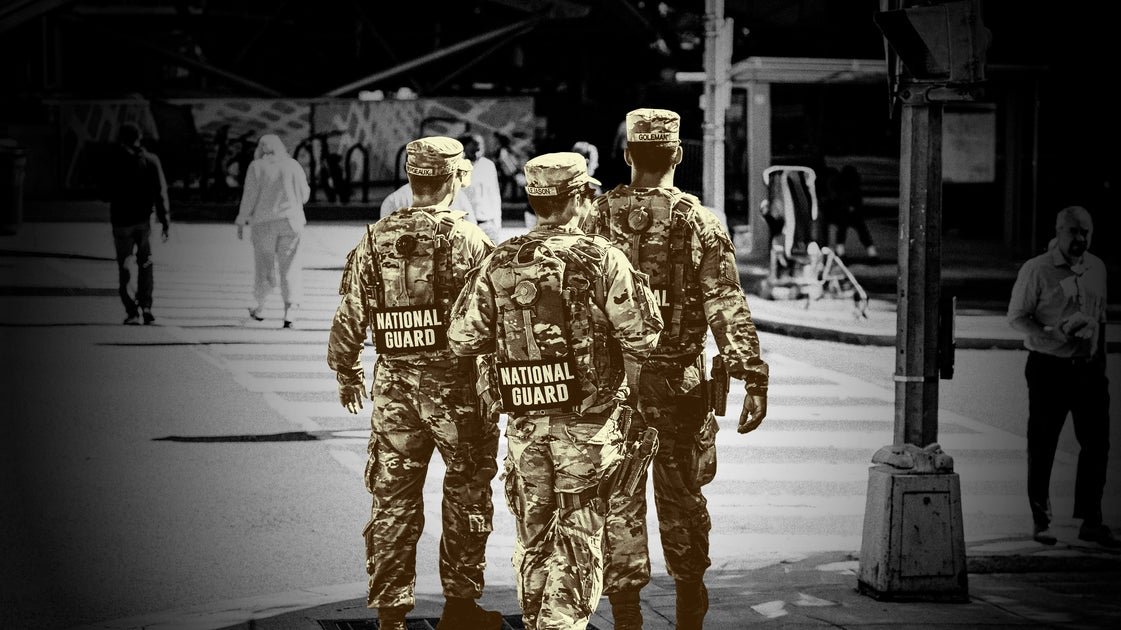
Despite federal judges’ rulings, Donald Trump keeps activating and deploying thousands of National Guard troops to Democrat-led cities across the United States to fight what he calls a “hell hole” of crime and an “invasion from within.”
Over the objections of local and state officials, armed National Guards members are now appearing in places civilians frequent. They are walking down pedestrian streets in Washington, D.C., and they have patrolled outside the Immigration and Customs Enforcement office in Los Angeles and outside a Memphis landmark.
Could your own city be next? Since he took office again, Trump has discussed deploying troops to New Orleans, New York City, Baltimore, San Francisco, Oakland, California, and St. Louis, Missouri.
Joseph Nunn, counsel for the Liberty and National Security Program at the Brennan Center, said it’s likely not the last time civilians will encounter National Guard troops in a U.S. city.
“The Trump administration has inserted the military into routine law enforcement in a way and on a scale that has no precedent in modern American history,” Nunn said. “We have never in 250 years had a president use the military in this many ways and this frequently for what is fundamentally routine law enforcement.“
The Posse Comitatus Act bans using the military for domestic law enforcement. Officials in California, Oregon and Illinois say the Trump administration’s National Guard deployments are illegal and unnecessary, setting off ongoing legal battles where federal judges are blocking National Guard deployments.
Just this week, a judge temporarily blocked the Trump administration deployment of National Guard troops in Chicago for at least two weeks, finding no significant evidence that the city is in “danger of rebellion.”
The fight is far from over, though, if Trump has his way.
“There shouldn’t even be [National Guard] interactions with civilians, but undoubtedly there may be,” said William Banks, a Syracuse University law professor and an expert in constitutional law.
During Trump’s unprecedented push to federalize the troops, here’s how to be better prepared about knowing the limits of the National Guard’s power, and what they cannot legally ask and do to civilians.
Who controls the National Guard?
Illustration: HuffPost; Photos: Getty
Even when they are federalized, National Guard members are still bound by the U.S. constitution.
First: a brief civics lesson. Ordinarily, the National Guard is under states’ control. In these cases, “Their commander-in-chief is the state governor,” explained Nunn.
But the president also has the power to activate them. “When they’re federalized, they temporarily become, for all intents and purposes, members of the active duty Armed Forces until they are returned to state status.”
Famous historic examples of this include them being deployed to California in 1992 in response to riots related to the beating of Rodney King and in the 1950s when Southern segregationists in Arkansas refused to allow Black students to attend school.
The National Guard is sometimes deployed overseas but is most often used to handle civil unrest and help out with humanitarian disasters.
“We’re comforted by having the National Guard in our states, because we know that if there’s a fire or a flood or a storm or some great disaster, that the governor will call in the National Guard to help us,” Banks said. “That’s what we expect, but we don’t expect them to be enforcing the laws. That rubs against the grain.”
Do I need to answer any questions the National Guard asks me?
No. “They can ask, but you don’t have to answer anything. People can walk away from them. People do not have to engage,” said Rachel VanLandingham, a professor of law at Southwestern Law School in Los Angeles.
National Guard members are bound by the U.S. constitution, including the rights for due process and rights protecting us from unreasonable searches and seizures.
So that means generally you have the right to remain silent, and you don’t have to answer any questions related to your immigration status for example.
You can ask one helpful question too, to confirm your legal rights, as the American Civil Liberties Union suggests in its guide on interactions with National Guard troops: “Say, ‘Am I free to go?’ If the answer is ‘yes,’ you are free to walk away. If the answer is no, you have been stopped and must remain where you are until you have been told that you are free to go.”
What kind of force can the National Guard use?
Typically, VanLandingham said the National Guard would use nonlethal means to protect a federal building, as an example.
“If you have a big crowd advancing toward them and not adhering to orders to stop, they could use tear gas,” she said.
If troops are facing imminent threat of serious bodily harm or death, they could use more lethal force like a police officer can, VanLandingham noted. And there have been historic examples where lethal force has been used against civilians. Infamously, National Guard troops summoned by an Ohio governor fatally shot students demonstrating against the Vietnam War at Kent State University in 1970.
Kent State was a situation with “guard troops that were pretty poorly trained, and were put in a tense situation,” VanLandingham said. But she is concerned that putting National Guard members who are not experts in policing in volatile situations is “setting up a situation for a tragedy like Kent State.”
Can the National Guard arrest me?
No, the National Guard can’t enforce local laws, block traffic or pull over your car to ask you questions, like a police officer would.
“Right now they’re not allowed to act as police officers, even if they’re allowed to be deployed today,” VanLandingham said.
Troops can briefly detain you, but they can’t arrest you. VanLandingham said when the troops were guarding the front of a Los Angeles federal building, she saw a few civilians get too close, and troops would “temporarily detain and immediately handed them over to [Los Angeles Police Department].”
“And so that seems to be the extent of what they can do,” she continued. “But we see this administration engage in a significant pattern and practice of going well beyond what has been considered appropriate.”
Of course, you should still avoid agitating a National Guard member if you interact with one. As the ACLU suggests in its guide on interactions with National Guard troops: “Remain calm and never physically resist or obstruct law enforcement. Keep your hands visible.”
How would the Insurrection Act change what the National Guard can do?
If Trump does invoke the Insurrection Act, as he keeps threatening he will, he can dispatch the National Guard to states that fail to put down an insurrection.
“It really takes the gloves off for the president,” Banks said. “He can call in any force that he wants, and he can essentially take over the area that he says is under insurrection and do what he needs to do to make sure that the laws can be enforced.“
If this happens, then “they would absolutely be able to arrest people,” VanLandingham said. “They’d be able to do whatever police officers are able to do.“
Nunn noted though that whether the Insurrection Act allows the National Guard to arrest civilians “is a question that would be fought over in court.“
And even under the Insurrection Act, it will only let the military execute the law, Nunn added. “It doesn’t let the military do any more than that. The military is still bound by the Constitution.”
But Trump has aggressive ambitions that may go beyond legal precedents. The Posse Comitatus Act which prohibits the National Guard from policing duties is what makes Trump’s push for them to be “a national police force with the President as its chief,” as a federal judge in California put it, so unusual.
Banks called the idea of a national police force “frightening.”
YourSupportMakes The Story
Your SupportFuelsOur Mission
Your SupportFuelsOur Mission
Join Those Who Make It Possible
HuffPost stands apart because we report for the people, not the powerful. Our journalism is fearless, inclusive, and unfiltered. Join the membership program and help strengthen news that puts people first.
We remain committed to providing you with the unflinching, fact-based journalism everyone deserves.
Thank you again for your support along the way. We’re truly grateful for readers like you! Your initial support helped get us here and bolstered our newsroom, which kept us strong during uncertain times. Now as we continue, we need your help more than ever. We hope you will join us once again.
We remain committed to providing you with the unflinching, fact-based journalism everyone deserves.
Thank you again for your support along the way. We’re truly grateful for readers like you! Your initial support helped get us here and bolstered our newsroom, which kept us strong during uncertain times. Now as we continue, we need your help more than ever. We hope you will join us once again.
Support HuffPost
Already contributed? Log in to hide these messages.
“And it is trending in that way. I think a lot of us…are all pretty much concerned and worried about this prospect,” he said.