No major spoilers! Read with confidence!
Can you witness so much but tell so little? So went the question in the movie — and, maybe even more important, outside of it — as Nathan Fielder and Lance Oppenheim‘s Elizabeth Holmes doc You Can See Everything premiered at the New York Film Festival Wednesday night.
Until now, only audiences who had made their way to Telluride had witnessed the burgeoning phenomenon that is YCSE. But the Lincoln Center screening Wednesday night offered a glimpse of what will come when the buzzy and well-reviewed portrait opens in just over two weeks — an urbane audience of 1,100 (with dozens more waiting hopefully on standby lines outside) screaming with such gusto at every plot twist that you’d think A24 was re-releasing Midsommar, not putting out a three-hour documentary about a disgraced Silicon Valley founder. Yet scream they did.
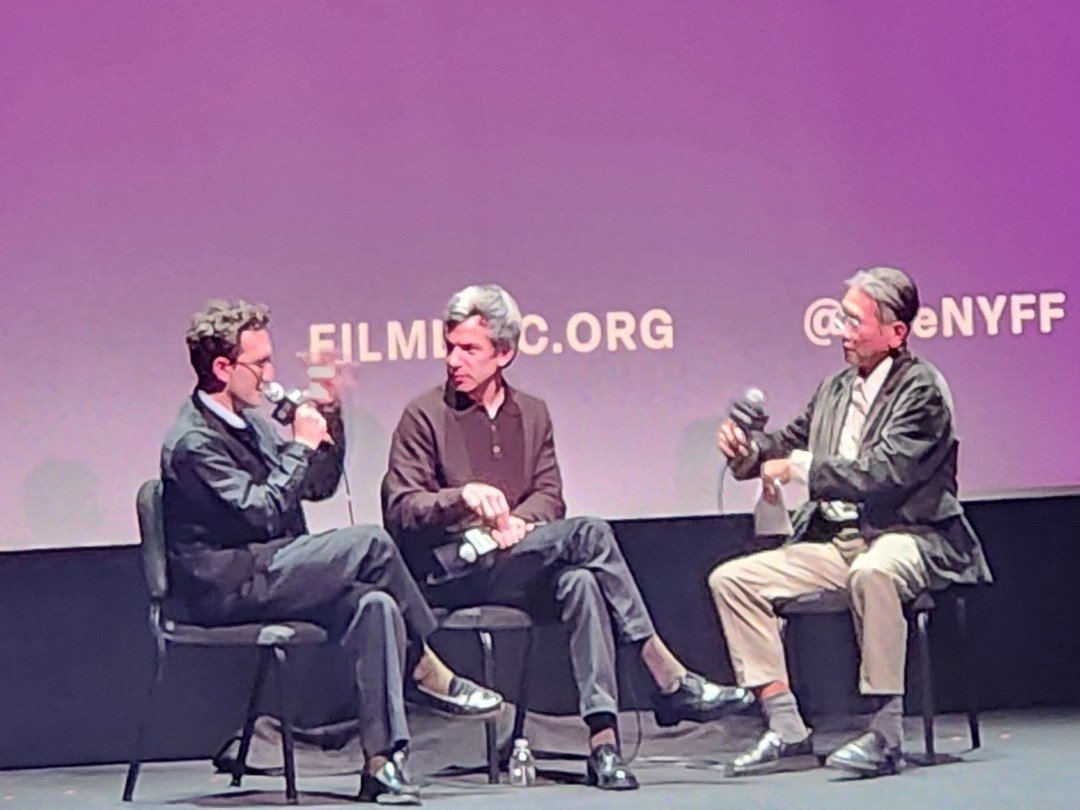
“You know the one minute of the teaser that made the world, or at least the Internet, lose its collective mind?” NYFF programming chief Dennis Lim said on-stage introducing the screening. “This is three hours of that.”
The filmmakers just hope those many revelatory minutes stay inside the theater. “We really want audiences to have the experience we had,” Fielder asked earnestly of the Alice Tully Hall crowd from the stage after the screening, saying even the directors had no idea where the story was going minute-to-minute. “So if you can preserve the discovery that would be great.”
Holding back may not be quite as hard for filmgoers after watching the movie; after all, they have a good model. For nearly the first (relatively conventional) two hours of the film, Fielder comes at the convicted Theranos founder before her prison term begins in 2023 by lobbing every big and sometimes not-so-big question at her inside her family home, and while she insists she’s telling the truth and has always done so, she seems constantly not to be telling us everything she knows.
The last hour gets considerably wilder, and while every audience member will be on the hot seat not to reveal a formal fact about how Fielder and Oppenheim shape their movie, the truth is that even knowing that fact doesn’t diminish the film’s outlandish pleasures. I did, and was still howling with everyone else at each surprise/unbelievably comic turn, at the sheer postmodern pleasure of it all. Like so much of Fielder’s work, you can’t really ruin the film because the whole experience is so ineffable. It would be like trying to ruin ice cream by describing its texture. You simply need to consume it.
Fielder said he spent months of shooting Holmes not knowing if anything would materialize. “I didn’t see a documentary project in her because I thought the story was very well-told,” he said to the NYFF audience. A24 — which had initially called him with the idea after execs met with Holmes — even gave him an escape hatch at any point should he decide there wasn’t enough, no questions asked.
That turned out to be unnecessary. Holmes and her husband Billy Evans threw their doors open wide to let in the film crew (really, two crews, Fielder and Oppenheim’s, and three cameras) and the pair turned out to be compelling and inscrutable objects, letting the YCSE directors read them like a book, even if it was a book with an occasional chapter in a foreign language. Every time you think you know them, you wonder if you do — or if you instead have to revise everything you thought a minute before.
“Everyone going through the movie had similar moments of cognitive dissonance,” Oppenheim said from the stage, laughingly reassuring the crowd. “I am still struggling to this day to understand what I went through,” Fielder said.
Holmes did not seem to know Fielder’s work beforehand, the director said, which makes the choice that much odder. “Why me?” he asks in the movie. And indeed, if you were going to embark on an image-rehab project, the guy who messes with heads in The Rehearsal (or the guy who takes cinematic liberties with sensational real-life stories like that of Primetime) would not seem like the person you’d tap for the gig.
Yet the fit also couldn’t be more perfect: an artist in Fielder who has made a career out of piling on so many layers of reality, of zigging back on everything we thought we knew, now taking on a woman who spent a decade in real life doing that to the most powerful people on the planet. In other words, with Elizabeth Holmes, Nathan Fielder had met his match. This is a movie about a magician by a director who specializes in tricks.
“I had this weird experience where she seemed so genuine at times, but also clocking — tracking my thoughts — that she’s a liar,” Fielder said, describing a version of the emotions some may feel, admittedly in a more benign context, watching an episode of The Rehearsal. [Lim, a film-studies professor (in fact, he was Oppenheim’s film-studies professor], at one point suggested the film has so many layers of meta-reality it will one day be taught in documentary classes.)
As to why Holmes and Evans decided to make a movie at all, well, the question will return answers ranging from the psychological (she’s a narcissist!) to the capitalist (she wants to launch her business again!), but the most on-point answer, I suspect, is more old-fashioned: she wants to clear her name.
If one of YCSE’s characters seems too broadly a villain, that vibe gets offset by a muddle of motivations from another character — or by just the sheer dark pleasure of watching a subject trying to dominate a filmmaker only to realize the latter is in control). The true thrill here for audience members, and certainly for people in the entertainment industry, may be the triumph of Hollywood over Silicon Valley — of storytellers over engineers — since no matter how much the Steve Jobs wannabe Holmes and techbro Evans keep trying to pull off acts of authorship, ultimately it is Fielder and Oppenheim who have final cut over their story, offering a kind of wish-fulfilling reversal of this Big Tech Age.
Standby hopefuls stretch around the block before the NYFF premiere of ‘You Can See Everything’
What it all leaves us pondering is not only who these people are but, really, who people are in general, how much is a construct and how much their innate personality — how much of what they (or we) let others see reflects our truest selves. Every attempt to know the Holmes-Evans pairing individually or collectively, every belief they have finally been figured out, is so charged that even when a clear touchstone scene unfolds, like when Fielder shows Holmes a classic comedy sketch that partly confounds her, you wait for the next turn to pull the rug out from under you. The most telling moment in the entire documentary, at least for my money, comes with a detail Holmes’ father drops, almost casually, and it’s such a whopper you feel like it unlocks everything about Holmes. In true Fielderian fashion, we never hear about it again.
After the screening, A24 hired people to stand in the Alice Tully hallway and hand out promotional buttons, which filmgoers eagerly took. I did, too. As I exited into the balmy New York night, I ran my thumb over the button’s smooth surface, its black letters stark on a white background. “I’ve Seen Everything,” it proclaimed.
I certainly had, even if I understood nothing.