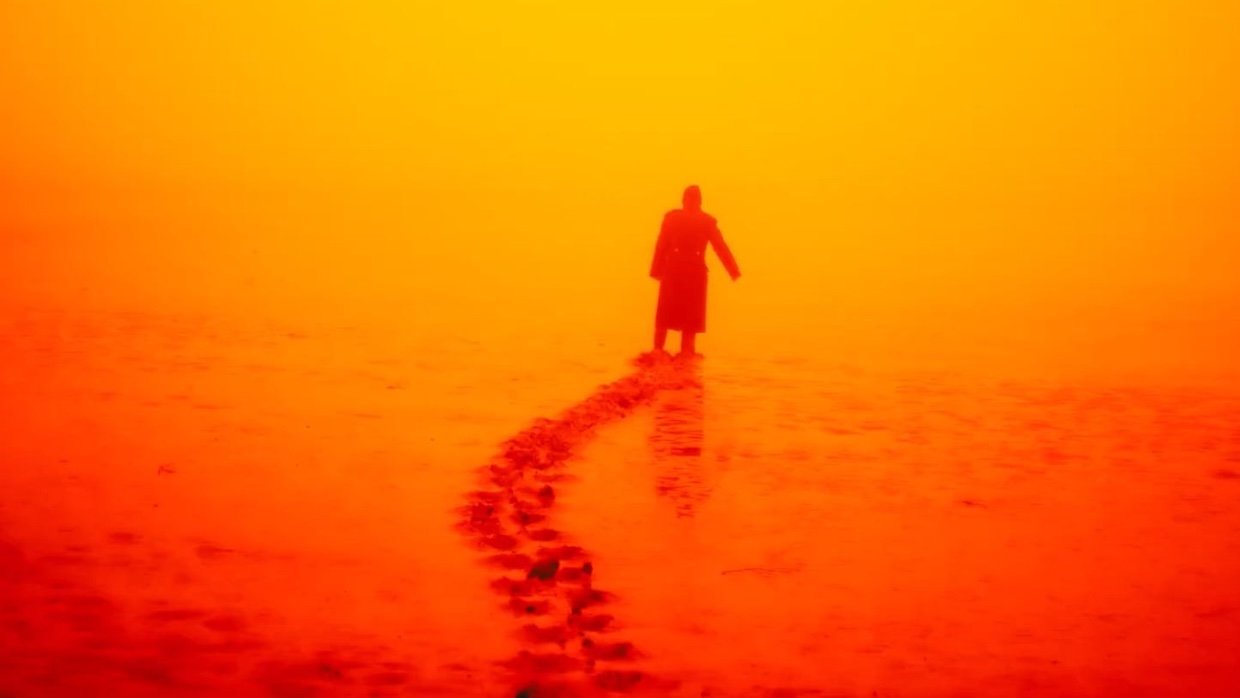
Sermon to the Void
In 2021, the Tokyo International Film Festival decided to leap out of mediocrity. It was, acquaintances told me, previously the kind of place where they’d show Princess Diaries 2 for red-carpet celebrity purposes, and in terms of its relationship to local fare, The Hollywood Reporter’s Gavin J. Blair wrote that the other TIFF “faced criticism in the past that it was run mostly by, and for the benefit of, the ‘big four’ Japanese studios” (Toho, Toei, Shochiku, Kadagawa). With the 2021 appointment of programming director Ichiyama Shozo, Tokyo—like the Busan International Film Festival—is now designed to be a launching pad for art-leaning pan-Asian cinema in its geographically most-broadly-defined sense. As a locally-based friend described it, Ichiyama was poached for the sharp curatorial sensibility he formerly exercised at Tokyo’s other film festival, FilmEx (which he co-founded), and the results are credible.
The final film I saw here, Yang Liping’s Echoes of the Orient, is an prototypical example of TIFF’s programming remit, a sophomore feature by a Shanghai-born, Japan-trained director who’s obviously spent a lot of time with Taiwanese New Wave staples and is otherwise cinephilically inclined (his 2023 short Gone with the Wind‘s poster straightforwardly proclaims “A Love Letter for French New Wave”). Over 156 leisurely minutes, Liping observes the trio of Japanese salarywoman Rin (Osu Mizuho), who meets-cute-ish with Chinese transplant Buliang (Zhang Ninghao) while very drunk at a show by legendary Japanese rocker Midori (Tamura Morocco). Midori thrusts the mic in Rin’s face and asks her what she wants: “I want to get married!” she screams with counterintuitively grrl-rock fervor, then the band gets into it. (The songs are actually by good, new-ish Japanese group Ray?Oh…Needa!!, so the movie gets bonus points for introducing me to music I wouldn’t know about otherwise.) After vomiting in the venue’s bathroom, Rin meets Buliang in the lobby and falls over onto the floor as she leans in for a high-five, waking up at his place; the rest of the movie basically watches them hang out in low-key situations.
Echoes’s distinguishing features include its adept widescreen compositions—an aspect ratio unusual for this pocket of slow cinema—and its equally non-standard, lowkey but consistent sense of humor and extreme awareness of the present moment. There are a record number of scenes where characters disapprovingly listen to radio reports about Gaza, while on the comparatively local level of Tokyo, attention is given to the ongoing devaluation of the yen and how real estate development displaces the homeless, for whom unlikely roommates Buliang and Midori regularly make rice balls. Most perversely, Echoes unfolds the arc of a relationship that’s never actually seen: a non-platonic bond between Rin and Buliang does seem to develop, but they’re never seen so much as holding hands, let alone sharing a bed, and whatever emotional intimacy they have is only perceptible in its mention to other parties, a curious structuring absence that never quite contradicts what we see.
My other world premiere highlight was also a sophomore feature. Arash Aneessee’s Far in the Middle of the East begins disorientingly with an animated sequence that kind of looks like A Scanner Darkly’s rotoscope technique but with different overlaid shifting patterns coursing over people’s faces. A man deliberately hit-and-runs a woman: the questions of why, and what the connection between the two was, remain open until the film’s larger logic becomes clear at the very end. In the interim, Anessee ironically juxtaposes a difficult film shoot and a multi-million dollar art heist; the former’s first day is supposed to happen, unknown to production, at the same time and place as the latter. The joke is that making a movie may be even harder than stealing a Jackson Pollock, though somehow the latter gets less respect; both the financier for the heist and the police that arrive to investigate state that “my aunt could paint better than that.” “So let’s invest in your aunt,” is the heist’s nervous mastermind’s correct response.
The heist acts as a B-plot comic counterpoint to the truly serious business of making a film whose director and producer are a couple probably about to divorce. The latter brings his girlfriend and wants to cast her in the movie; the director pushes back by casting an untested theater performer who’s never been on-screen before. This part of the movie is well-executed, dramatically bracing and well-composed, giving static scenes of hotel-room confrontations an extra charge via ever-changing reflecting lights coming up from the ground-floor fountain. It’s also a little dour, which is why it’s surprising when, as shoot and heist converge an hour in, the film makes a hard pivot to farce, with lots of different parties running around to achieve irreconcilable goals. There’s also the perpetual novelty of seeing contemporary Iranian life; oversized-leisureware-hoodies are in fashion there as much as anywhere else, and there’s an unexpected Cleveland Indians shirt sighting. By film’s end, we’re back in more sadly familiar territory as the theocratic patriarchy asserts itself once again.
Following its Vancouver premiere, Keiko Tsuruoaka’s Saikai Paradise represents a less adventurous approach to its cinematic lineage. It begins nicely, with what’s essentially a five-minute documentary showing a solitary woman making tofu from start to finish; the rest of the trim 72-minute film builds out the world around her. Saikai is a town in Nagasaki whose population is dwindling—one character predicts it’ll be merged with another city within 30 years—and the marginal plot is primarily an excuse to observe a dying rural community that I imagine has rarely, if ever, had a chance to see itself onscreen. The big coup location-wise is the titular Buddhist theme park (?), long out-of-business and containing, among other oddities, a room with hundreds of miniature gold Buddhas; the plot is much more generic and non-notable—actor visits home, finds himself distanced from old friends, mopes around, eventually talks to his brother—and is so determinedly “gentle” and “low-key” that it made me wonder how many Japanese movies I’ve seen that could be called Still Walking beyond Kore-eda Hirokazu’s tonal prototype.
Having appropriately premiered at Locarno, Fabrice Aragno’s Le lac presents as the most stereotypically “Swiss” movie imaginable, setting an implicitly wealthy white couple on a sailboat journey throughout lovely landscapes whose only visible inhabitants are other well-heeled white people. As one might imagine from a director who, in his capacity as cinematographer and general helpmate, enabled Godard to produce some of the most worked-over images of his career, the film’s primary mission is capturing endless stunning images. This is a very cinematographer-forward movie; there are four credited DPs, plus another credit for “additional images,” and all involved deserve a gold star. The images can be breathtaking in part because of what, to me, seems like way too much physical danger to be remotely enjoyable, with waves and windlashings captured very much on-the-water, but often for more staid reasons: especially at night, both the water and the lit-up urban surroundings are gorgeous to a degree that I couldn’t resist. As for the thematics, final Merleau-Ponty quote and all: as with much late Godard, I’m declining to actively engage.
The festival’s (and, honestly, year’s) most idiosyncratic images came from Hilal Baydarov’s Sermon to the Void, which premiered out of competition at Venice. The film is fundamentally not a narrative experience; while it theoretically centers around a quest or journey of some kind, whatever throughline there might be is barely detectable, in keeping with the narrator proclaiming that “Art is a journey towards unknown feelings.” The film’s real business is the non-stop purveying of images you’ve never seen before, building off a strong foundation of material shot in a desert over the course of 11 months. While Badyrov is Sermon’s writer-director-DP-editor, his most important credit is arguably as the film’s lead colorist, as the already plentifully dramatic, spectacularly scaled desert-scapes have all been heavily…painted over? I’m not entirely sure how to describe the film’s technical approach; suffice it to say that every image has been luridly, heavily adjusted to attention-getting affect, and the movie’s trajectory is really a journey through color—I cheered in surprise when, 80 minutes in, purple entered the room.