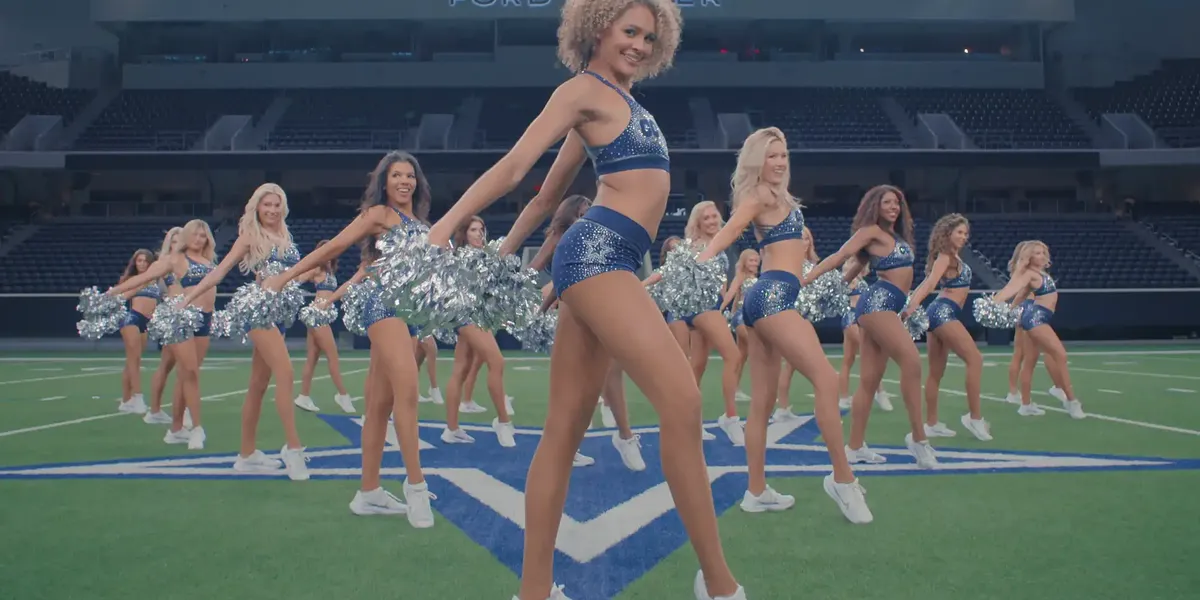
How many times have you seen a docuseries go viral? Well, everyone on Social Media was doing the dances and choreography from Netflix’s America’s Sweethearts: Dallas Cowboys Cheerleaders.
But behind the scenes, the challenge wasn’t just capturing the technical precision of “Thunderstruck,” it was pulling out the humanity buried beneath the iconic uniform.
Editors Zachary Fuhrer, Noah DeBonis, Stefanie Maridueña, ACE, and M. Brennan, ACE, came together to find a complex exploration of identity, ambition, and the “perfect imperfections” of real life.
We sat down with the team to discuss the nature of their collaboration, the rule of being “less explainy, more lampy,” and how they navigate the responsibility of cutting the lives of the women who give everything to the team.
Let’s dive into the interview.
– YouTubewww.youtube.com
NFS: Each of you came to editing from very different backgrounds. How have those non-traditional paths shaped the way you approach storytelling today?
Zachary Fuhrer: I’ve always pursued a lot of things intensely, whether sports, music, theater, or journalism, and documentaries ended up being the form that combined all of my interests. I got into them almost by accident, making a film about US-Brazilian relations and public health policy because I figured it’d be easier to get my friends to watch an hour-long doc than read another paper. I ran around Brazil and the US with a cheap DSLR and a shotgun mic, taught myself Final Cut 7, and fell completely in love with it, even if the movie I made is hardly watchable.
After that, I landed at Prologue, a title design and motion graphics house in LA run by Kyle Cooper, who was always chasing what you might call “perfect imperfections.” He’d shoot on 16mm, do in-camera double exposures, intentionally jam the camera, then have us scrub through dailies looking for beautiful mistakes that lasted a fraction of a second. That kind of obsessive, frame-specific work shaped me. Later, I assisted editor Jim Helton (Blue Valentine, The Place Beyond the Pines, Roofman), who became my mentor and my film school. He brings the same intensity to a 30-second spot as a feature, and that stuck with me.
So now, whatever the format, I try to hold two things at once: a high-level story approach and the frame-specific instinct I learned cutting titles. America’s Sweethearts is a great example because we get to play with so much in a single episode, whether it’s verité, big musical montages, or biographical packages, and each mode asks for something different. I think about editing in musical terms, phrases, movements, symphonies. You can’t just float. You need contrast and dynamics, point and counterpoint, tension and release.
Noah Debonis: I got into documentary filmmaking by falling in love with a story, and then spending the next seven years turning that idea into an independent feature documentary, Strangers to Peace. I was directing, producing, and eventually editing the project. I’d worked as an editor before, but that process of long-form documentary storytelling, especially working with observational footage, where the narrative isn’t inherently clean or obvious but has to be excavated from a mountain of material, really clicked for me.
That experience made me very comfortable sitting in the messiness of real life and prioritizing the emotional truth of a scene. I’m usually looking for the quieter, authentic moments that make our subjects feel human and relatable. If something resonates with me in the footage, there’s usually something there that an audience will connect with as well.
On a show like Dallas Cowboys Cheerleaders, that becomes especially important because you’re balancing large-scale spectacle and performance with very intimate, personal stakes. I tend to lean into a verité-driven approach and try to find the space where people can feel real, complex, and human on screen.
Stefanie Maridueña, ACE: I have an educational background in science. Science requires a lot of precision, organization, and logical thinking. I’ve come to find that these skills have been quite useful as an editor. They come in handy in the obvious ways, like organizing media, keeping track of footage, and making sure that my edits have clarity. But most importantly, for me, my pursuit in the sciences was driven by passion. I find that as a storyteller, I’m equally passionate about what I’m doing in the edit. It’s interesting because science also requires a great deal of creativity. Designing experiments to test a hypothesis often means thinking creatively about how to approach a question, and you don’t always know where the results will lead. Similarly, in the edit, we are always experimenting and testing ideas to see if they take us where we want to go and are often surprised by where they lead us.
M. Brennan, ACE: I started out as a photographer and poet in college. I began to bring those things together into mixed media projects. Then a few Scorsese, Spielberg, and Maysles films later, I knew I wanted to be a film editor.
As an editor, I work very much on instinct, similar to how I began in photo and poetry. I look for what makes me feel the most emotion – excitement, heartbreak, joy – and follow those threads. Often, I find ways to pull out VO or dialogue in order to focus on the emotion of a scene. People often say the opposite of what they mean or feel, so I watch what’s happening on someone’s face or how their voice sounds or how their body moves in order to figure out what’s really underneath the words.
‘America’s Sweethearts: Dallas Cowboys Cheerleaders’Credit: Netflix
NFS: You’ve now collaborated multiple times as a team. What makes this group creatively “click”?
ZF: We’re very much a “yes and” team. Everyone feels comfortable not just pitching ideas, but cutting and presenting them without fear. Adam Leibowitz, our showrunner, says that when he hires, he cares more about passion, positivity, and character than how many credits you have on IMDb. We’re all driven and want to make great work that gets seen, but the work demands real empathy, both for the people whose stories we’re telling and for each other. I like to think of us as the Mighty Morphin Power Rangers. Everyone’s independently a top-notch martial artist with high-flying kicks, a moral compass, and their own superpower, but when you get us together, and we’re really cooking, we’re the Megazord. It helps that we genuinely like each other and love learning from each other.
ND: I love this team! I feel incredibly fortunate to get to tell stories with such a wildly talented group of filmmakers, led by Greg Whiteley and Adam Leibowitz. We’ve all worked together on multiple shows now, so there’s a real level of trust and fluidity in how we collaborate. We’re constantly sharing scenes between each other, not just for feedback, but actually passing them back and forth to work on. I might start something, someone else will take it further, and sometimes it comes back around again. No one’s precious about their cut, which creates a very iterative process where the focus shifts from individual scenes or episodes to the arc of the series as a whole.
We’re also just a very communicative group. There’s a lot of conversation about the story, about ideas, and honestly just joking around with each other, which makes it easier to take creative risks. That openness creates an environment where you can take big swings without fear. And I think at the core of it, we all just genuinely care about the characters and the stories we’re telling, and there’s a shared trust that everyone is trying to do right by them.
SM: I’ve been so fortunate to have worked with One Potato Productions for 5 seasons across three different TV shows. It’s probably my favorite place to work because of how we’ve all become a work family of sorts. As Noah mentioned, it comes down to the level of trust that’s fostered in our work environment. As editors, we are granted a lot of freedom to explore ideas and are encouraged to experiment and take risks. Everyone is welcome to give creative input, and all of our voices are respected. I think this lends to creating a very healthy work environment, and the quality of our work is a reflection of the care that we have for our show and each other. I would also like to take a moment to acknowledge the other editors whose contributions also carried this series: Kate Hackett, ACE, Sharon Weaver, Susie Maridueña-Barrett, Deijah Lee-Carroll, Helen Yum, and James Atkinson.
MB: We are all great editors who thrive on collaboration. We’ve developed similar sensibilities and can toss work back and forth with ease. And we all care immensely about the subjects we follow.
The One Potato team has a habit of sharing scenes and moments on Slack that have made us laugh, broken our hearts, or been amazing in some way. Everyone brings a deep knowledge of the footage and a smart sense of storytelling to every scene in every episode. It’s pretty fun to work with a team that is always at the top of its game!
NFS: What drew you to America’s Sweethearts beyond the surface of it being a show about famous cheerleaders, and why do you think audiences connect so deeply with America’s Sweethearts?
ZF: I didn’t know much about the Dallas Cowboys Cheerleaders before season one, but I was floored as soon as I started watching the dailies Greg and the field team were capturing, especially the look our DP Jonathan Nicholas had dialed in. Where things really clicked for me was a conversation we started having in post: what do you give up of yourself to be part of a team, or a sorority, or even a mission-driven startup, and is it worth it? These dancers are uniquely gifted solo performers with wildly different personalities, but when they’re performing together, it’s all about uniformity and collective precision. I got hooked on exploring that trade-off, what it costs to belong to something storied and traditional.
Beyond that, I just love dance, and I love editing dance. My wife grew up dancing at a high level and started taking me to shows all over New York when we started dating over ten years ago. There’s a certain flow state you enter watching the best companies perform, whether it’s Alvin Ailey or Pina Bausch. I hope our show has helped demonstrate the artistry and athleticism it takes to be a professional dancer, and honestly, I think there should be dozens more films and series about dancers and the dance world.
I think audiences connect with America’s Sweethearts because the show features a high-stakes dance competition alongside real heart and humor, and because the dancers themselves are so open. That openness isn’t automatic; it’s earned. The field team shoots for around 100 days, and you feel that trust in the footage.
ND: I think our filmmaking team has created a deceptively layered show. On the surface, it’s a story following a year in the life of a cheerleading organization, with a built-in competitive arc of who will make the final roster. But underneath that, we’re really exploring questions around identity, ambition, feminism, workplace dynamics, and what it means to navigate the modern world within a traditional institution.
Zach Fuller Credit: Impact24
We try to weave these ideas naturally into the storytelling and let the audience come to their own conclusions. Editorially, we consciously avoid telling the audience how to feel or relying on heavy-handed techniques, and instead focus on presenting these lived experiences as honestly as possible.
That’s ultimately why I think people connect to the show: you’re watching real people chase something meaningful to them while navigating pressure, rejection, and growth, and those are experiences anyone can relate to.
MB: I was interested in the group dynamics of an all-female elite team and the opportunity to explore how hard these women work. They are athletes, which I think gets lost sometimes in the flashier aspects of the football world. I think audiences connect with the team’s work ethic and their dedication.
SM: I strongly believe that what makes America’s Sweethearts so captivating is our distinct approach to storytelling. Our process prioritizes shaping the personal stories and arcs of the cheerleaders in a way that invites the audience to become invested in their journeys. Coming off my experience working with One Potato Productions on Cheer and Last Chance U: Basketball, I knew we would apply this narrative style and was excited to see what we would uncover.
Separately, the Dallas Cowboys Cheerleaders are an iconic institution with a lot of history and tradition. Exploring the ways that this decades-old culture influences the present-day team dynamics is fascinating and something we knew audiences would gravitate to. We’re also highlighting the level of athleticism required to make the team in a way that conveys the physical demands of the sport. I’m not sure that’s something that’s been closely examined before. Combined with the emotional and mental implications of the pressures created by this environment, it makes for a truly compelling narrative. Ultimately, we owe it to the women on the team who are fascinating in their own right and have trusted us to tell their stories in such an intimate way. Their vulnerability, motivations, and honesty drive the series and elevate it beyond a typical sports docuseries.
NFS: How did your understanding of the series evolve by the time you reached Season 2 and now Season 3?
ZF: The shows we produce at One Potato are all present tense, so we never want to just run it back. We also have to acknowledge how the show itself impacts the people we feature. One of the big conversations that came out of Season 1 was around the cheerleaders’ pay. Audiences were moved by the talent and the sheer amount of work these women put in, on and off the field, and then shocked to learn that being a DCC was a part-time job. DCCs were expected to hold down full-time careers while giving so much of themselves to the team. The cheerleaders, maybe motivated by that external conversation, started advocating for themselves, and their fight for higher pay became a major storyline of Season 2, alongside stories about body image, social media scrutiny, mental health, and the cost of always chasing perfection.
We don’t work in a vacuum. Because we’re a vérité documentary at our core, we have to react to what’s happening in real time. We never want to go in with preconceived notions of what the show will look like or where a subject’s arc will land. We want to be surprised by the material, and to engage with all the messy, twisty parts of the lives we’re capturing.
While we can’t share details about Season 3, our approach is the same. We never want to manufacture a false reality. We need to respond to exactly what our field team and post team observe over nearly a year of production.
ND: It’s interesting working across multiple seasons because your understanding of the world really evolves over time. In Season 1, both the audience and the editors are still getting to know the world of DCC, figuring out the tone, the structure, and who these people are. But by the time you get into Season 2 and 3, that understanding deepens, and you start to build a much closer relationship with the characters. By now, I feel like I have a strong sense of what fits within the world of the show, what feels true to its tone and style.
With that familiarity, you begin to recognize little patterns and nuances, traits that feel specific to each person, and you can start to build on them in subtle ways. For example, I introduced a small idea in Season 2 that one of the cheerleaders loves a certain type of candy, and now whenever I come across a moment of her eating it, I try to include it as a kind of callback. It’s a small detail, but those kinds of touches help enrich the characters and make them feel more human and relatable, and it’s just fun!
SM: I agree that we come into every season with fresh eyes and no agenda. While we have a deeper understanding of returning characters and the ins and outs of the Cowboys organization, we are following the story in real time over the course of an NFL season, and it’s hard to predict where this leads. The edit begins in September, so there’s a lot that has yet to unfold as we start shaping the earlier episodes. I do think that we’ve developed a muscle to identify potential themes early on that could further develop by the end of the edit. But sometimes we’re also just lucky that things unfold in a way that gives us the missing puzzle piece to an existing storyline. We experienced this in season 2 with the plot point around pay. We had been following the cheerleaders’ fight for fair compensation the entire season, and at one point, the conversations stalled. It wasn’t a satisfying ending, but we edited the season to reflect this. And then, at the last minute, during our final days of shooting and post-production, the women received a better contract for the following year. Suddenly, we had the payoff that we were hoping for and a truly amazing resolution to a storyline that we’d all become deeply invested in. It was so satisfying as editors to be able to conclude the season with this information, and we knew that the audience would feel the same way.
NFS: How do you each personally find a scene? What tells you that a moment is emotionally truthful and worth building around?
ZF: The footage is the truth. I try to watch everything and make my own selects, which are really based on instinct, just trying to get at the purest idea of what happened that day and what story is best told. You have to maintain a certain amount of objectivity as an editor, not letting yourself be influenced by whatever happened behind the scenes on a shoot day, whether someone was sick or lunch was late or whatever, but I still love talking to our supervising field producers, story producers, and co-directors Zoe Lyrintzis and Claire Onderdonk about what they experienced out there. I want to understand broadly what they felt on the day, and then see what they and the other producers respond to in the footage through their notes and selects. Zoe, Claire, Greg, and Adam are an amazing brain trust, able to see things from a super high level while focusing on tiny details, and they trust each editor to uncover things they may not have contemplated themselves. The beauty is we’re all pulling on the same rope.
My rule is that a scene has to work as a scene first, before it becomes anything else. Even if I know something will eventually live inside a montage or a biographical build, I cut it as its own piece first. My mentor, Jim Helton, taught me to mute all the audio after cutting a scene. If it works without score and dialogue, and you’re still following the story and the emotion, and really feeling something, then it’ll work once you add in music or words. And if you later need to weave it into a bigger montage, you’re not reverse engineering the emotion or hunting for b-roll to fix a structural problem. You’re building from something that already stands up.
As for what tells me a moment is emotionally truthful, it’s really just instinct. It’s when you see the mask melt away and the subject’s sense of the camera disappear. There’s a meme that Claire, Zoe, and I kind of live by. A meme that may or may not actually exist, like a Mandela Effect Fruit of the Loom cornucopia kind of thing. It’s an image of a moth flying by a light, and it says “LESS EXPLAINY, MORE LAMPY.” I think about that daily. Showing is always more powerful than telling.
SM: I like to find the strongest moments based on what stands out when I watch the raw footage and the selects from our story team. During my watchdowns, it helps me to pretend that I’m the audience, and so I look for instances that bring genuine reactions out of me. Of course, there are obvious emotional moments like a rookie candidate bursting into tears when she’s cut from the team or Jada making everyone laugh around her. But I also gravitate to moments that are subtle but hugely illuminating. It can be anything from a slight smirk from the coaches, to a cheerleader smiling through an injury, or a change in the pitch of someone’s “yes ma’am.” Honing in on these very subtle human reactions is integral to building a connection with our audience. This is something that helps us to maintain the honesty and authenticity that Zach mentioned, and is something I feel we’ve all, from the editors to the story producers, become accustomed to finding.
Stefanie MaridueñaCredit: Impact24
ND: I think editing a scene, especially for an observational documentary, is a bit like grocery shopping for a meal you don’t fully know how to cook yet. You might have a general sense of what ingredients you need or the beats you want to hit, but you’re not exactly sure what the final dish is. Then you start “shopping,” pulling selects, exploring moments, and suddenly you realize, oh, this is what the scene wants to be.
As I shape and cut down the scene, the heart of the story usually reveals itself. And honestly, the biggest indicator that a scene is working is when I’m watching it back for the 50th time and I forget that I’m editing it, and I get lost in the story as a viewer. Then I’m usually like, “Oh, ok, this feels nice, I forgot I was editing for a second.”
MB: As with the earlier questions, I look for what makes me feel something. I get a physical zing of recognition which tells me I’m on the right track. I also look for things that might not be part of the main purpose of a scene – a comment before a scene has begun or ended, a look off to the side, or an unguarded moment.
NFS: What does the first 4–5 week stretch toward a rough cut actually look like day-to-day?
ZF: For Cut 1, you typically get five to eight weeks, which isn’t a lot given how much material we’re working through. The goal is twofold: the cut needs to play well enough to generate valuable notes, and it needs to build a framework we can iterate on.
You’re not working alone. From day one, you’re collaborating with one of our amazing story producers, and you kick things off with an outline and a plan together, informed by what the story and field team have been discussing. Once Cut 1 is in, subsequent cuts are usually only one to two weeks each, so we start each round with a kind of “rules of engagement” conversation, walking through internal and external notes and agreeing on what this pass is actually trying to do. Sometimes it’s a complete overhaul, sometimes it’s targeted scene work. And we’re constantly flipping episodes or tag-teaming one with another editor. You sometimes jump to whatever the hottest potato is, or whatever needs fresh eyes. That kind of handoff only works because everyone’s pretty egoless about it.
We’re often building the plane while flying it, because we love to experiment. You might start out thinking you’re making a sandwich and end up painting a fresco. That openness matters because when we have a little breathing room, and it’s never much, we go back and rewatch dailies to see how our read on the material has shifted with new context or new footage. It’s a constantly evolving story, so you have to really hang on.
ND: On DCC, we’re working very closely with an incredible team of story producers, led by Zoe Lyrintzis and Claire Onderdonk, who help shape the broader arc of each episode and the series as a whole. They’ve usually spent a lot of time with the footage before I even begin cutting, building outlines, pulling selects, and assembling stringouts, so we’re not starting from scratch. They do a great job of helping us cut through the sheer volume of material and focus on the strongest story beats.
From there, I usually start cutting quickly to get something up on its feet as soon as possible. Even if it’s rough, having a version on the board helps everyone see what we have and start reacting to it. That said, our “rough cuts” tend to be more refined than you might expect; the structure, tone, and style are usually already taking shape, even if things are still a bit long or loose.
Ideally, I like to watch all the raw footage myself, but when that’s not feasible, I rely on the story team’s selects as a starting point and then dig back into the raw to find additional moments or expand on ideas. The footage is also really well marked, which makes it easier to search for themes, characters, or beats we might be missing.
It can feel overwhelming at times, but because this team has worked together so much, there’s a strong shared instinct for what’s working and what isn’t. And we’re not precious about anything; we’re constantly iterating, reshaping, and sometimes completely reworking the story. From the first rough cut to final delivery, an episode can evolve dramatically, sometimes to the point where it’s almost unrecognizable.
Noah DeBonisCredit: Impact 24
MB: Watching dailies and selects, roughing out options for scenes (sometimes multiple options), getting feedback and direction from story producers/co-directors Zoe Lyrintzis and Claire Onderdonk, producer Adam Leibowitz, and director Greg Whiteley, and then putting that feedback back into the scene to see how it feels.
SM: This early on in the process, it’s really a matter of assembling the episode to the best of our abilities and understanding that it doesn’t have to be perfect. I think it’s important to note that we deliver staggered cuts to Netflix, and each episode has anywhere from 5-7 cuts that we send out over the span of 6 – 8 months. So Cut 1 is important and gets the ball rolling, but oftentimes the locked cut is very different from that initial assembly. I find this helpful to think about in order to relieve some of the pressure of working under a quick deadline.
As Zach pointed out, the scenes vary in difficulty, and some can get edited faster than others. What’s great about this is that we get a lot of flexibility in the earlier stages to edit scenes in the order that we want, so I like to alternate between easier, more straightforward scenes and ones that are a heavier lift. As the season goes on, the needs and urgency change, so I try to spend as much of my time during these earlier weeks setting myself up for success down the line.
I take some time going on YouTube and search for soundtracks with a similar sound that I can pull as a temp score to use during the season (we have composed tracks from the previous seasons, but it’s always fun to refresh these and see how else our sound can evolve!) I also start familiarizing myself with the footage as much as possible, and I try to have a lot of conversations with our story producers to clarify any questions I may have about our subjects or emerging themes.
NFS: Are there specific scenes that best represent your editorial approach on this series? What made them click?
ZF: There are honestly too many to name, because this show lets you flex every editorial muscle, and by the end of an edit, you’re really thinking about the totality rather than any single scene. Cutting a great self-contained scene is a fun challenge, but it doesn’t mean much if it doesn’t play into the larger structure.
That said, the one that sticks with me most from Season 2 is Armani’s final performance. Stef Maridueña and our producers did such a beautiful job setting up Armani’s struggles with alopecia earlier in the season, which made it possible to pay it off when she takes the field in the final episode without her wig. We think about character introductions the way you’d meet someone at a party. You don’t want to be hit over the head with someone’s whole backstory; you want to be curious and come back for more. With seven episodes, you can plant an idea and trust you’ll return to it later. Armani’s story was developed so organically and completely in the earlier episodes that you come to want what she wants, and her payoff in the finale really lands.
When I cut her performance, I tried my best to place you in Armani’s boots. I’d been thinking about Nickel Boys, which my friend Dan Timmons mixed, and how the filmmakers used first-person POV and immersive sound design to create what the director RaMell Ross calls sentient filmmaking, or radically empathetic filmmaking. We didn’t shoot first person, but I cut the scene with just Armani’s lav mic to start, so when she took the field, you were basically hearing and feeling her experience. The washed-out echo of “Thunderstruck” under her breath. The pom poms rustled and hit with each movement. I thought about how she might experience the performance in a series of moments, and jump cut through some of the dance’s most iconic phrases. Cutting it that way helped me avoid being emotionally manipulative or leaning too hard on the score. I’ll never know Armani’s experience, and I’ll never really know what it’s like to walk in her boots, but I think what it means to be empathetic, as a human and as a filmmaker, is to try.
The other one I keep coming back to is toward the end of the season, when the cheerleaders perform with Kacey Musgraves. There’s something really sweet about coach Kelli Finglass and Kacey’s connection, despite Kacey being on the surface a much more alternative, free-spirited Texan. After a trying season, Kelli latches onto the idea of a “Saturn Return” that Kacey talks about in her music, and gets really candid about having this cosmic wake-up call. There’s humor in it, too, Kelli getting a bit philosophical about astrology, but it’s genuinely moving. And getting to close the season on the pay raise paired with a montage set to Kacey’s “Deeper Well,” which was cracked by the brilliant editor Sharon Weaver, felt like landing the plane. Funny enough, the whole team had been spinning that album on repeat during Season 1, and I’d pitched Greg on using “Deeper Well” at the end of that season. It turned out to be the right spot after all, just one season later.
ND: I’m always drawn to pure vérité scenes, especially when they’re active and a little chaotic. I love taking something that may have been scattered in the field and shaping it into something that flows and resonates emotionally. There’s something really satisfying about finding the internal rhythm of a scene and making it cohesive without losing that sense of authenticity.
That said, I’ve also been lucky to work on some of the larger montage sequences in the show, which are a completely different kind of challenge. You’re often pulling footage from across the entire season and trying to make it feel cohesive while still driving a clear story idea. It becomes a balance of structure and rhythm, figuring out how music, pacing, and visuals all work together.
One that stands out from Season 2 is the “Busy Season” montage in Episode 6, where we follow the team through a grueling stretch of performances leading up to the big performance at the Jake Paul vs. Mike Tyson fight. It incorporates a lot of voices, action, and overlapping ideas, but the goal was to keep it feeling fun, rhythmic, and propulsive. Cutting it to a Charli XCX track really helped define that energy. I’m really proud of how it came out, and it felt like all these wild and distinct moments we were playing with were all locked into place.
MB: We all work across the episodes, so there are too many to choose from. In season one, I spent a lot of time following Victoria’s path with the team, but nearly everything I worked on for the series followed my approach in looking for the emotional core underneath what was actually happening in each scene.
SM: Over the years, I have developed a sensibility for scenes where we slow down and learn about our characters. I really gravitate to building moments that highlight the humanity of our subjects and embody the emotions they encounter on a day-to-day basis. I want to understand their experience and what’s driving them as much as possible in order to accurately portray it to an audience. I rely on slower pacing and softer music that’s edited intentionally to subtly highlight or build alongside the interview bites. I love to emphasize moments with silence or a longer beat between bites to give the audience an opportunity to really absorb the information that’s given to them. You can see this approach in the Cold Open for season 2.
I inherited the scene later in the edit, so I had a lot of great material already in the sequence, and my job was to tighten it and focus the emotion that we wanted to highlight to introduce the season. We wanted to reinforce the pressures that the women face as part of the team and how much of that is influenced by the established culture. I relied on imagery that identified this “traditional” presence – the archaic “rule book” from decades past, archival of the DCC– and weaved it with current day footage to reinforce this tension. I was also very intentional about the bites we used to ensure they were in conversation with the visuals, and, with the help of story producer Claire Onderdonk, we were able to find additional bites that further emphasized this aspiration to be perfect. This was a very intentional lead-up to Jada’s bites about disrupting the status quo, which kicks off the super tease for the season to Tom Petty’s “American Girl.” It’s that contrast from the dreamy and slower-paced, pensive section to the energetic supertease that delivers emotional impact. After my pass, Zach did a wonderful job polishing and tightening the Cold Open even more.
NFS: With such a massive volume of footage, what systems or habits help you stay creatively engaged rather than overwhelmed?
ZF: The story team has a tried-and-true logging system that’s a huge help when you’re reviewing dailies, and it also does a great job of showing what different people on the team gravitate toward. The hot sheets and field notes are another great resource. But honestly, the secret weapons are Claire Onderdonk and Zoe Lyrintzis, our co-directors and phenomenally creative, hardworking producers. They have wildly different and complementary personalities, and they have complete and total recall of what’s been shot and what might be the perfect solution to whatever problem you’re having in the edit.
Editorially, when you’re dealing with 100 days of footage and no set roadmap, it can be intimidating. There are no shortcuts to learning the material. You just have to make selects instinctively and let the material organize itself in an organic way. I liken the early days of an edit to making a bunch of puzzle pieces when you’re not yet sure if the final puzzle will be a sailboat or a majestic lion posing amongst the stars. Either way, you know you have the right pieces because they made you feel something when you were working through the dailies.
I always try to start simple. What’s the story best told? What’s the one moment in a five-hour practice that expresses what actually happened that day? There’s sometimes a desire to use as much footage as possible, to chop it all up and throw it into a montage soup, but we often find ourselves late in the season untangling overbuilt sequences and getting back to a pure, straightforward story. When things feel overworked, get back to the basics of that original idea.
ND: With that volume of footage, it’s easy to get overwhelmed, so a big part of it is finding ways to stay curious and have fun with the process. One thing our team does a lot is share favorite moments on Slack, quick clips like, “hey, look at this thing I found.” Sometimes that alone can spark an idea, or someone else will see it and realize it’s exactly what they need for a scene they’re working on.
On a more personal level, I’ve found that when I hit a creative block, it helps to focus on a single moment that really resonates with me and build outward from there. I’ve also gotten into the habit of taking notes at the end of each day, charting where I’m at, what’s working, and what still needs to be done to finish a scene or episode. It helps me start the next day with clarity and saves a lot of time that would otherwise be spent retracing my steps. And honestly, nothing beats stepping away for a bit, taking a walk, and watching down again with fresh eyes.
MB: The story team is incredibly good at pulling rough scene selects together for the editors. From there, I get the sense of what the focus and purpose of a scene needs to be, and then often I return to the dailies to fill in the subtext.
At this point in my career, I don’t really get overwhelmed by huge amounts of footage. It’s exciting to me to be able to create and develop a story over multiple episodes, like a novel. If I hit a block, I search through b-roll to get a burst of inspiration. I’ll look through footage that might be unrelated to the scene I’m working on because it will help me see things in a different way, and I’ll be able to find new emotional connections.
M Brennan Credit: Impact 24
SM: This is where that scientific background comes in handy. I like to partition my work into episode folders containing Premiere projects for each scene. Each project is then structured in a way that is simple but efficient. Then, I strategize and bring in everything I could possibly need to edit the scene into this project and organize the media into its respective folders: selects, raw media, BROLL/Slo-mo, music, etc.
While reviewing footage, I jot down ideas in my notebook and use a personalized color-coded marker system in Premiere Pro to visually track and identify what I’ve reviewed. Doing this at the start of each scene helps me to feel in control, and having everything in one place makes it less overwhelming. As far as staying creatively engaged, I make an effort to listen to my body and take breaks when I feel stuck. I’ve found that this helps to boost my creativity because it allows my brain to reset. Something as simple as walking across the street to get a chai latte, walking my dog, or going for a run after work can have a big impact.
I avoid working long hours unless it’s truly necessary. And I can’t underestimate the value of a proper night’s sleep, you’d be surprised at the number of times that I’ve woken up with a solution to an edit that came to me in a dream!
NFS: After working on a series like this, how has your approach to documentary storytelling evolved?
ZF: I’m incredibly lucky to have worked with Greg, Adam, and the One Potato team on eight seasons of documentary television now. And I always come back to a mantra Greg often says: that our goal as filmmakers is to film with cold eyes and edit with warm hearts. To me, that’s about being honest with the material and with each other, being empathetic, and being as vulnerable with each other in the edit as the subjects are with our field team.
What’s changed for me is the understanding that the work gets better the more open you are to other people’s ideas. This team has a pretty flat hierarchy, where everyone brings their own artistry to the table, and somehow it coalesces into a beautiful whole. Working with these editors and producers feels like playing H-O-R-S-E with your friends. You think you just hit a cool trick shot, and next thing you know, you’re gawking at the genius of whatever the editor on your left just tossed up at the rim. I find myself constantly learning from my peers and being pushed by the material to sharpen every tool. We all have our own editorial superpowers, but to edit on these shows, you have to be the filmic equivalent of a five-tool baseball player.
I’d be remiss not to mention Jason Arnot, who we lost during the edit. Jason was one of the first producers I worked with on this team, on Cheer, and he produced on Season 2 of America’s Sweethearts. He was the epitome of an artist who fought hard for an idea and sought truth in every story, endlessly empathetic, with a wicked sense of humor, and the kind of producer who’d happily go down a narrative wormhole with you, excited by the exploration itself. We all miss him. Whenever I post a cut, I still try to think about how he might note it.
ND: This series has really pushed me to embrace nuance as much as possible. You might think you understand what cheerleading is, or what the Cowboys Cheerleaders represent, but the stories and personalities within that world are much deeper and more complex than they first appear. It reinforced the importance of trusting the footage and trusting the audience, resisting the urge to be too heavy-handed, and allowing people to connect with the material without over-explaining it. It’s also about trusting where the story goes naturally, rather than pushing it toward where you think it should go.
It’s also reinforced the importance of not getting too precious about any one idea. Just because something works doesn’t mean it’s the best version of itself. A big part of the process is staying open, experimenting, and being willing to reshape or even completely rethink something in pursuit of a stronger story.
And more than anything, it’s deepened my sense of responsibility to the people whose stories we’re telling. At the core of everything, the goal is to tell their stories honestly.
MB: America’s Sweethearts deepened my faith in trusting the characters to tell us where the story should go. There was never an insistence on a particular agenda or lens through which the filmmaking team wanted to tell the story of DCC, to Greg and Adam’s great credit. Always follow the emotion.
SM: Over the years, working alongside this team, I’ve come to really appreciate and value what our footage can offer, and finding when it can speak for itself. Sometimes letting a raw moment play out is more impactful and immersive than a heavily edited scene; it’s these moments that are at the heart of our Emmy-contending series. And I’ve always been empathetic towards the subjects in my work, but One Potato Productions has pushed me to further hone in on this skill and prioritize approaching my edits with care and fairness. I also can’t underscore the value of working in an environment that fosters collaboration and respect to the degree that our team at America’s Sweethearts has. I’m really so grateful to work alongside my fellow amazing editors and the rest of our team, led by Greg Whiteley and Adam Leibowitz. What a blessing it is to have so much fun and passion in what we do!
NFS: In one sentence, what did you personally bring to this series as an editor?
ZF: I bring a sharp sense of story and a willingness to experiment, plus a ton of energy, heart, humor, and fun, and I really do treat every frame like it matters.
ND: I brought a lot of overthinking, about 60 layers of audio tracks per scene, endless rambling Slack voice notes, and hopefully a light touch when it came to not destroying the good stuff.
SM: I deeply care about the women that we feature in our show and approach all my edits with a passion and commitment that reflects this.
MB: I’ve always felt a deep responsibility to the people who are willing to give themselves over to a documentary team. It’s a very vulnerable position. I take that very seriously. It was extremely important to me that the women of DCC feel that they were heard and that their lives were being represented truthfully and with compassion.