The Short Shorts Film Festival & Asia (SSFF & ASIA), an Academy Award®-qualifying event and one of Asia’s largest international short film festivals.
The Short Shorts FilmFestival & Asia (SSFF &ASIA), an AcademyAward®-qualifying and one of Asia’s largest international short film festivals, this year, put the focus squarely on the hottest issue in filmmaking: artificial intelligence.
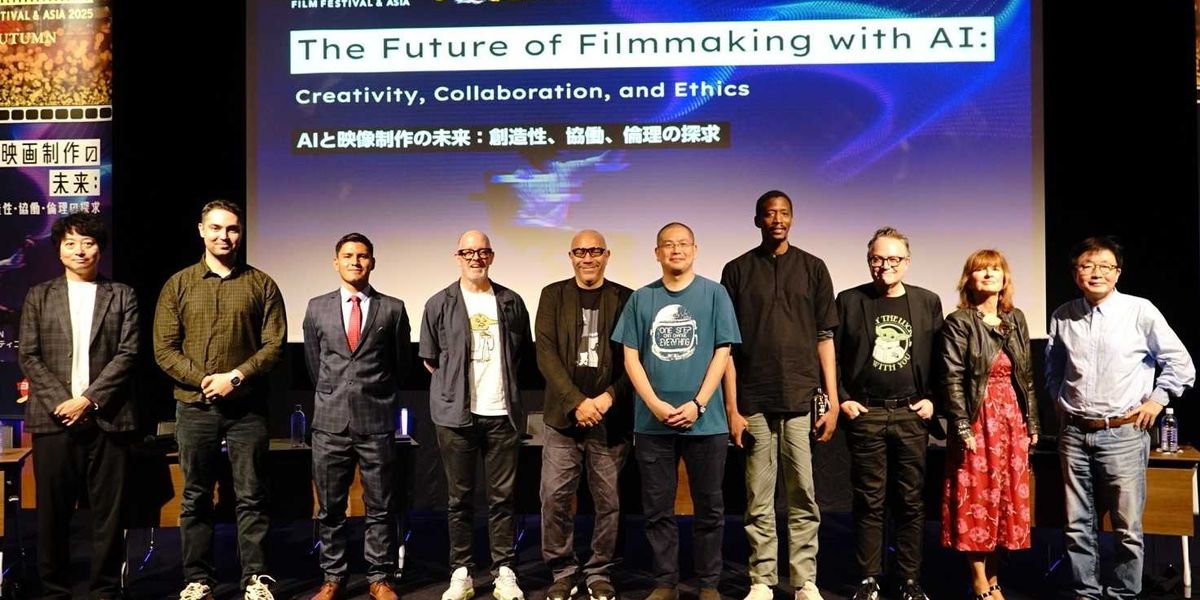
At their last event, they gathered industry leaders to discuss the revolutionary impact of artificial intelligence and what it means for people who want to work in movies.
Let’s dive in.
Credit: Short Shorts Film Festival
AI Film Submissions Skyrocket at SSFF & ASIA
The SSFF & ASIA conference kicked off with news that AI is officially becoming a force in cinema, and we’re seeing it in festival submissions.
Executive Director Seigo Tono highlighted the surge in AI-powered projects among the festival’s roughly 5,000 submissions.
- 2024: Only about 2% (112 films) featured AI.
- 2025: That number jumped to an estimated 6% (275 films).
AI Is Your Next Creative Partner
The panel titled “The Evolution of Creativity & Collaboration Brought by AI” was a deep dive into how filmmakers are actually using AI as a co-pilot, not just a tool. They want to find ways to collaborate with AI to get their visions out of their imaginations and onto the screen.
So who is doing it and how are they using it?
Japanese filmmaker Takeshi Kushida (Last Dream) captured this idea beautifully, calling AI a “dialogue partner that draws out humanity’s memories through words—something that goes beyond being a mere tool.”
And director Hiroki Yamaguchi (GRANDMALEVIT) agreed, noting that while AI currently serves as an assistant for visualizing ideas, he sees a future where it becomes a “true co-creator.”
Even with complex new tech involved, the fundamentals of filmmaking remain. C
Composer and filmmaker Marcel Barsotti (Germany), whose AI film Imperial required layering over 30,000 prompts, brought everyone back to earth: “No matter what technology we use, the core of cinema remains the story.”
Co-screenwriter Gundula Barsotti-Bastadded that, while the fundamentals of writing do not change, AI production introduces a new kind of labor: “At the beginning, there is no big difference between real and AI films, but once prompting starts, you have to rewrite over and over because the prompts never come out as you want.”While AI feels brand new, this isn’t the first time technology has changed the way we create art.
French media executive Alexandre Michelin offered a crucial historical perspective: while some worry AI is a cultural threat, “looking back at the history of art, new technologies have always reinvented creativity.”
If there was one message that echoed throughout the entire conference, it was this simple idea: “AI Does Not Take Away Creativity; It Expands It.”
Tetsuya Bessho, Founder/President of SSFF & ASIA, wrapped up the event by reaffirming his organization’s mission: “Our mission is to continue celebrating the power of storytelling, no matter what era of technological innovation we are in.”
– YouTube youtu.be
The Global View: Six Filmmakers on the Reality of AI in Production
Panelists from around the world shared the current state of AI adoption and the challenges emerging in their respective regions. Javid Sobhani, programmer for the Tehran International Short Film Festival (Iran), stressed that AI’s role cannot be reduced to a single label: “I can’t call it just a tool, and I can’t romanticize it as a co-creator either,” noting instead that in constrained environments AI becomes “a shield” that can even function like aproducer or co-writer.
Senegalese filmmaker Hussein Dembel Sow echoed this view from another context, emphasizing AI’s potential for leapfrogging production barriers: “Where I come from, we are happy because it will help us build new industry,” adding that without AI, large-scale VFX-driven genres such as fantasy or science fiction would remain out of reach.
Douglas Montgomery, former strategic advisor at Warner Bros. (USA), highlighted the expanding possibilities and future outlook enabled by AI, saying that “AI is not perfect and does not replace humans, but it is getting better every day,” and predicting that animationproduction timelines will likely be shortened not by smallmargins but “by a factor of two to five going forward.”
On the other hand, Mexican director Oscar Parres pointed out that Mexico is still in an early stage of adoption and that institutional frameworks lag behind creators: “They told me AI is not creative or copyright—it’s just a tool,” insisting that education and ethical awareness will be essential as technology spreads.
In addition, Shin Chul, Festival Director of the Bucheon International Fantastic Film Festival (Korea), warned that“every morning a new game-changer AI tool appears,” and expressed concern that a drift toward “full auto-creation” could be frightening, risking the loss of a filmmaker’s intent—yet he also emphasized the democratizing upside, arguing that AI allows young creators to start from “the same starting point as James Cameron,” shifting the competition toward originality.“
Looking Ahead
The entire event was buzzing with energy, marked by high attendance and a collective excitement for what’s next.
Storytelling always shifts alongside technology, and there’s a real sense of anticipation for a new era of filmmaking—one where humans and AI truly create together.
Let us know your point of view in the comments.