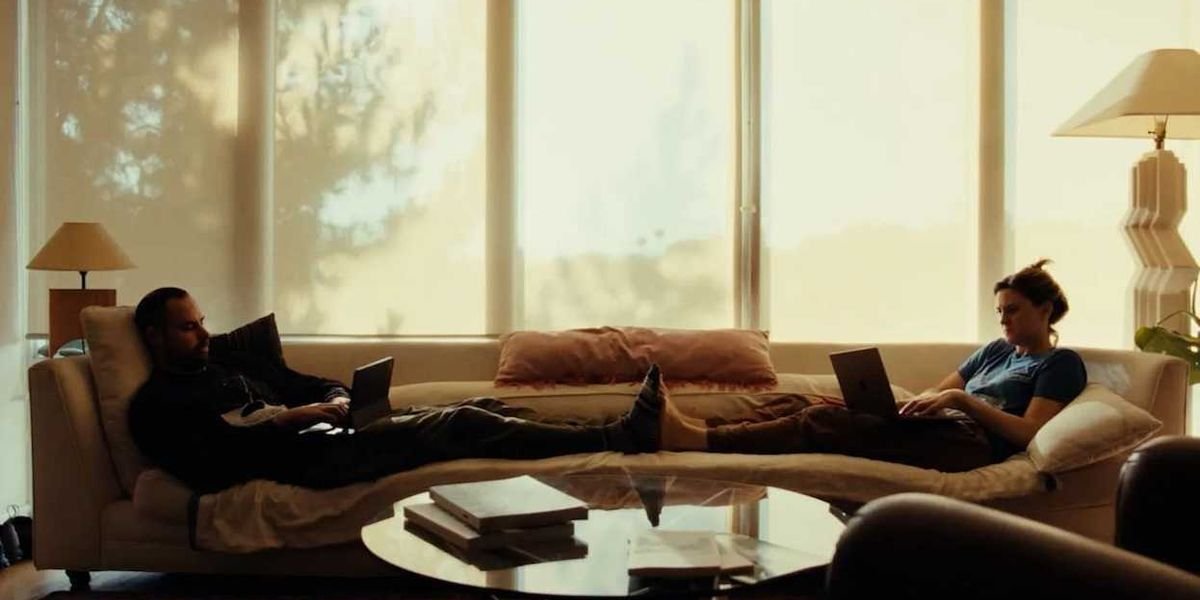
For years, NFS podcast alum Sam Baron has been using filmmaking as a form of personal excavation. Across a body of short films he has written, directed, and starred in, Baron has repeatedly returned to a warped semi-autobiographical character named Sam, a version of himself designed not to flatter, but to expose. A self-professed “nice guy,” emotionally literate on the surface, yet deeply avoidant underneath, disconnected from his anger, riddled with shame, and quietly keeping score. The films Fragile Package, Tippy Toes, and Useless invite discomfort, contradiction, and recognition. (Check out his episode from June 3rd, 2024, to hear even more about his process)
That ongoing inquiry now expands into feature-length form with Circles, Baron’s first time leading a narrative feature as an actor. Directed by Ariel Heller, who co-wrote the screenplay with Baron, the film takes the same impulse toward radical honesty and places it inside a high-concept framework. Principal photography is set to begin in early 2026, with production in Idaho and Los Angeles under Heller’s banner Good Point.
In Circles, Baron and Alli Brown star as Sam and Emma, a couple in crisis who retreat to a remote cabin to repair their marriage, only to find themselves trapped in a mysterious time loop that resets every time they lie.
As the film moves through prep, Circles already bears the imprint of a long-running collaboration between Baron and Heller, one rooted in personal storytelling, radical transparency, and an equity-driven production model inspired by films like Jockey and Sing Sing. Together, they are testing whether a film about honesty can be built through systems that practice it.
Let’s dive in.
NFS: You’re both deep in prep right now. How does this stage feel compared to writing or development?
Sam Baron: The momentum is incredibly exciting. Our writing process was unusually fast, only a few months, but we’ve been building to this moment for nearly a decade. We’ve been through this process many times before with short films, and we want to preserve as much of that process as possible as we gear up to make a feature. We have incredible producers in Kyle Smithers and David Breschel (who has just been shortlisted for the Oscars for his amazing short film The Singers), and my amazing co-star, Alli Brown (who also starred in our short film Useless), is stepping up as a producer now, too, so I feel like we have an insanely strong team around us.
NFS: Can you speak to the process and how you got to this script?
Ariel Heller: Well, the premise called for a take-no-prisoners examination of a marriage in crisis, full of secrets and lies. It’s a story about a couple learning to tell the truth, so in order to match that honesty in the writing, we took our ‘radical transparency’ approach to new levels, outlining the film in a Google Doc which our real-life romantic partners had access to. The comments section was full of confessions, confrontations, disclosures, and disagreements as we all opened our hearts and shared about our private lives. We were amazed by the commonalities. It felt like we were all struggling with the same issues and wrestling with the same existential questions about how to show up for the people we love. And the more we talked to our friends, the more we realized that the material that felt most personal to us was also the most universal. The Google Doc became a sort of siphon for the collective unconscious, and with Sam being willing to portray himself as the ultimate embodiment of the flaws of modern masculinity, we took our gloves off and let rip. We’ve poured ourselves into this script and relished the outrageous fun of the premise, and we now hope to tell a complex personal story that will resonate with anyone who has ever navigated a long-term relationship.
NFS: What does prep look like day-to-day right now?
AH: The three big categories are locations, cast, and crew. By design, we wrote a majority of the film to take place at a cabin owned by Kyle Smithers’ aunt and uncle in Idaho, a location we had access to on the border of Wyoming in the shadow of the Grand Teton National Park. It’s a stunning location that will bring so much value. Then it’s Sam and Emma’s home, which is (shockingly) going to be my house. And in the crucial role of their son, Arlo, will be my own son, Rafi. That wasn’t an easy decision to make, but given the proximity and his interest, we decided to do a little screen test, and it went amazingly well. It’s kind of incredible for me, and he absolutely loves Sam and Alli. We’ve gone to the big agencies for the two remaining roles, and hopefully we will be able to announce those last remaining pieces of casting very soon.
NFS: I understand you’re using a version of the finance model Clint Bentley developed with Greg Kwedar. Why did you choose this model
AH: First of all, those guys are truly trailblazers, and I’ve fully bought into their finance template. We are using the equity finance model because Good Point exists to realign the incentives of filmmaking around both sustainability and care. In the traditional finance model, indies rely on underpaid labor, opaque accounting, and the promise of exposure that rarely materializes into real participation. Whereas in this equity model, everyone from director to PA works for the same rate (a competitive indie wage pegged to the SAG minimums) in exchange for equity.
Our belief is simple: tell stories people care about, and create an environment where the people making them are cared for. Being pro-profit and pro-labor are not opposing values. In fact, they depend on each other. When everyone on set knows that the better film we make, the more we all benefit, the work becomes sharper, more focused, and more honest. That is how you make films for less money that feel more expensive.
Radical transparency is essential to that trust. Most crews never see a budget, never understand a waterfall, and never receive a dollar after wrap. By opening the books, educating collaborators on the model itself (most crew don’t know how a waterfall works), and giving access to budgets and cap tables, we remove the suspicion that has defined so much of the industry. Transparency builds confidence, and confidence builds better work.
At a moment when Hollywood remains fixated on scale, spectacle, and IP, audiences are hungry for films that feel specific, human, and alive. The current incentive structures of studios and streamers make that difficult, and the workforce has paid the price. We see this moment as an opportunity. Rather than waiting for the system to change, we are quietly and confidently changing it ourselves, working alongside existing infrastructure while building a reputation rooted in fairness, craft, and shared success. The goal is not disruption for its own sake. It is stewardship. By aligning passion, people, and profit, we believe this model can help jumpstart a new independent golden age, one project at a time.
SB: I can honestly say that watching the way that Ariel, David, and Kyle work, they really embody the principles of this model. It connects the nuts and bolts of production to the deep vein of personal connection we’re tapping into with the script, so we all feel personally invested.
NFS: How did you two meet?
SB: My film, The Orgy, was screening in the same block as Ariel’s student Academy Award-winning USC thesis film, Mammoth, at the Austin Film Festival in 2018. I really admired how Ariel’s film truthfully explored a cancer diagnosis without ever falling into the maudlin trappings of the genre. My Nicholl script was about cancer, and I’d lost my Mum to cancer two years earlier, so my standards for a cancer drama were impossibly high, but Mammoth exceeded them.
AH: And I was blown away by Sam’s ability to put so much depth, nuance, and honesty into a sex comedy. We actually met for the first time on stage for the post-screening Q&A, and I remember looking at him as he answered questions and thinking, “I love this guy”.
NFS: Sam, your work is fearlessly autobiographical, and this is your first time taking a lead role in a feature film. Can you talk a little bit about how you’ve gone from director to actor, and isn’t it usually the other way around?
SB: To be honest, a few years ago, I found myself questioning the value of continuing to make films as a male filmmaker in the current landscape. I had to ask myself, “Is the best thing I can do for society to step back and shut the fuck up?” But as I went through therapy to recover from the death of my Mum, I became fascinated by the Jungian concept of “shadow work” – the process of examining aspects of the psyche that have been pushed into the darkness, that can only be healed when they are brought back into the light. I was concerned that if men stopped seeing themselves represented on screen, male audiences could be pushed even further into the arms of “red pill” anti-feminists – but for the last century, male filmmakers have told stories with a male gaze that has objectified women and glamorized men, so clearly a new approach was needed. I decided to turn the lens around – to focus on stories about modern masculinity in crisis – but I figured that if I wanted to invite men into the conversation, rather than alienating them, I should offer myself as the sacrificial lamb, and make myself the most vulnerable and exposed.
So I starred in a series of short films (Fragile Package, Tippy Toes, and Useless) in which I played a semi-autobiographical character, “Sam,” who embodies the toxic traits of millennial men. He’s the kind of ‘nice guy’ who thinks he’s an ally, thinks he’s a hero because he doesn’t shout, he’s sensitive, he’s always there for you with a smile, but beneath the surface, there’s a cauldron of repressed emotion. He’s so disconnected from his anger that when he does snap, it’s awful. When we started screening those films, a funny thing happened – all the things I was most afraid to put in there, the stuff I thought no one would ever relate to – time and time again, those were the things that men would come up to me and want to talk about. It felt like our own sheepish, shameful version of ‘me too’. So many of us had similar fathers, and similar memories of the macho 90s culture that gave us warped lessons about how we were meant to behave as men. I saw an epidemic of gentle, big-hearted men like me who felt lost, who hadn’t been taught what to do with their feelings, how to talk about them, or process them, who now found themselves acting out in ways that exacerbated their shame and hurt the people they cared about most. That gave me the confidence that I could now do the same thing in this feature film.
NFS: You’re gearing up to shoot in early 2026. What are you keeping in mind as production gets closer?
SB: I’ve learned that the best thing to do is to trust the process and to see any curveballs that come along as opportunities for creative discovery. Ariel is a master of nuanced storytelling – the kind of tonal dexterity that eschews easy answers and keeps audiences leaning in – so with him directing, I feel safe, free, and just truly grateful for this chance to do what I love to do.
AH: As usual, I couldn’t say it better myself. From the second I heard Sam answer questions on stage at the Austin Film Festival, I fell in love with him. He is an extraordinary talent, and I feel so lucky to be getting this chance to collaborate with him again.
CIRCLES is produced by Good Point, with Kyle Smithers, David Breschel, and Caleb Heller serving as producers alongside Heller, Baron, and Brown. Executive producers include Alice Seabright (Sex Education, Margo’s Got Money Troubles), Eric Pearson (Thor: Ragnarok, Thunderbolts), and Netflix executive Alexandra Canosa. Also joining the cast is Sundance alum Alexandra Qin (Thirstygirl), with two additional roles to be announced.
The creative team most recently completed the short film Useless, starring Sam Baron and Alli Brown, about a man who begins using an AI therapist and quickly faces humiliating consequences. The film will tour festivals in 2026, with a premiere date to be announced.
Founded by brothers Ariel and Caleb Heller alongside Kyle Smithers, Good Point is a production company rooted in an equity-driven finance model and radical transparency, inspired by the ground-up, community-based approach behind films like Jockey and Sing Sing.