Visual referencing has become a core part of production today, maybe even more than ever. As a creative assistant to the director, I spend hours pulling picture references and film stills from the internet for every scene in a 120-page script, then getting them approved. Sometimes, that’s my only job during pre-production. Every time I did referencing for a film, I wondered what it would have been like to do so much visual referencing without the internet.
We turn to master storytellers like Stanley Kubrick, David Fincher, and Guillermo del Toro for inspiration, but who do they turn to?
If you guessed fine arts, you’re right. Before film, there were paints and brushstrokes to do their job. So it’s only natural for filmmakers to be inspired by them.
In this article, let’s look at movie frames that are inspired by paintings of great artists.
9 Film Frames That Mirror Famous Paintings
1. Guillermo del Toro’s Pan’s Labyrinth
Saturn Devouring His Son by Francisco Goya (1823)Credit: Museo Nacional del Prado
A part of Francisco Goya’s “Black Paintings,” Saturn Devouring his Son tells the story of a time when Saturn was frightened by a prophecy that said that he would be overthrown by one of his sons. In a desperate attempt to nullify the prophecy, he began devouring his sons.
Del Toro’s Pan’s Labyrinth is notable for blurring the lines between fantasy and reality; however, we all know that Ofelia’s magical world is as much literal as it is psychological.
Pan’s Labyrinth (2006)Credit: Warner Bros. Pictures
For her second task in proving her royalty as Princess Moana of the underworld, she comes face to face with the Pale Man, who eats little fairies. The visual of him devouring the fairies is directly inspired by this particular Black Painting, which was painted on one of the walls of Goya’s house, where he spent his last days.
2. Martin Scorsese’s Taxi Driver
Nighthawks by Edward Hopper (1942)Source: Art Institute of Chicago
Edward Hopper’s oil painting depicts a brightly lit late-night dinner on a deserted street corner of New York City. Considering that the painting was completed weeks after the Pearl Harbor attack, and the city was under siege with the fear of another attack, Hopper’s creation underscores bitter alienation and urban isolation amidst wartime anxieties.
The nightly visuals of Martin Scorsese’s Taxi Driver are deliberately focused on highlighting Travis Bickle’s loneliness in a big city, and that’s where Hopper’s painting comes into play. The inspiration is reflected more in the compositions than in the colors, while Scorsese maintains the fluorescence in his frames through neon lights.
‘Taxi Driver’Credit: Columbia Pictures
Scorsese’s Nighthawks-inspired visuals, especially in scenes where Bickle is all alone in public places such as diners, perfectly encapsulate what it means to be lonely even in a crowd, for a man being tormented by war memories.
3. Christopher Nolan’s Shutter Island
The Kiss by Gustav Klimt (1907)Source: Belvedere Museum
The Kiss by Gustav Klimt marks the pinnacle of his “Golden Phase” and a departure from his earlier work, which typically featured nude female forms. The painting depicts a couple in a flowery meadow. Both are kneeling, with the man embracing the woman lovingly from behind as he kisses her cheek—both covered in a golden cloak.
While the painting underscores otherworldly romance through its lavish use of gold leaf for shimmer, inspired by Byzantine mosaics, Nolan subverts the context by using it in Shutter Island to signify unbearable grief.
‘Shutter Island’Credit: Paramount Pictures, DreamWorks Pictures
In this scene, Teddy is hit with the harsh realization that his wife, Dolores, is dead. He shot her after he returned home one day from work to the floating bodies of his three children in the nearby lake, where his wife had drowned them.
4. Lars von Trier’s Melancholia
Ophelia by John Everett Millais (1851)Source: Tate Britain
Millais’ Ophelia depicts the tragic death of the titular fictional character from Shakespeare’s Hamlet, who commits suicide after being rejected by Hamlet in love and learning that he has killed her father.
MelancholiaCredit: Magnolia Pictures
Trier’s Melancholia prologue is a montage of surreal images, one of which is Kristen Dunst’s character in a bride’s dress, floating in a slow-moving stream as she holds a bouquet close.
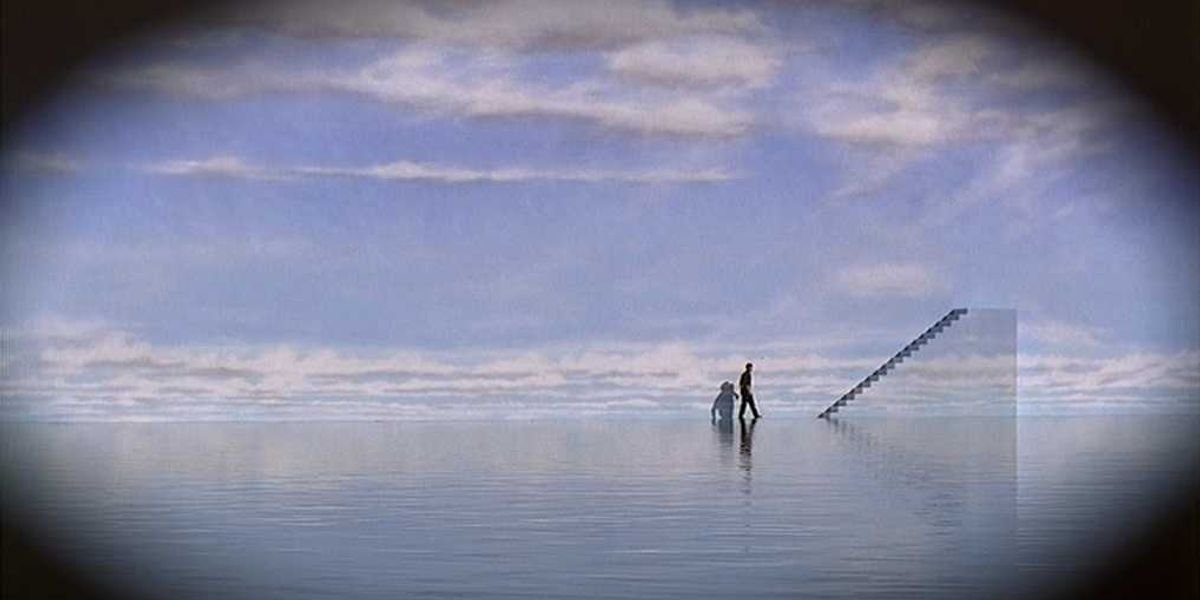
5. Peter Weir’s The Truman Show
Architecture Au Clair De Lune by René Magritte (1956)
Belgian surrealist artist René Magritte is notable for his illusionistic style that invites quiet contemplation. Architecture Au Clair De Lune’s dreamlike arrangement of geometric elements against the ethereal moonlight creates a calm yet uncanny atmosphere.
‘The Truman Show’ (1998)Credit: Paramount Pictures
The Truman Show’s ending sees Truman walking up the stairs, choosing freedom over a perfect life under someone else’s control. Magritte’s painting inspires the climax.
6. Stanley Kubrick’s A Clockwork Orange
Prisoner’s Round by Vincent Van Gogh (1890)Source: Pushkin Museum
Van Gogh drew Prisoner’s Round during his stay at the Saint-Rémy asylum. At the time, the painter was suffering from acute depression, desperate to leave the asylum, for which he was not deemed fit. Therefore, his requests for dismissal were denied.
While the painting is a copy of an engraving by Gustave Doré titled Newgate Exercise Yard, it is believed to symbolize Van Gogh’s feelings of being trapped within the four walls.
‘A Clockwork Orange’ (1971)Source: Columbia Pictures, Warner Bros.
In A Clockwork Orange, during the minister’s visit to the prison, we see the inmates walking in circles in a courtyard-like area with high walls, much like in Van Gogh’s painting, waiting for the minister, who visits the cells and goes through their things.
6. Michael Mann’s Heat
Pacific by Alex Colville (1967)
The man in Alex Colville’s Pacific is Neil McCauley in all his spirits. The gun on the table, the isolated apartment overlooking the ocean, and him standing there all alone—it’s probably McCauley in an alternate reality in which he successfully evaded Detective Hanna to dodge his bullet, and began a new life by the sea.
‘Heat’ (1995)Credit: Warner Bros.
In Mann’s recreation of the painting in the film, we see McCauley before his last job, standing in his apartment all alone, overlooking the sea.
‘Heat’ (1995)Credit: Warner Bros.
In every reality, the painting reminds us of McCauley because it beautifully expresses his loneliness.
7. Alfred Hitchcock’s Psycho
House by the Railroad by Edward Hopper (1925)Source: Museum of Modern Art
Alfred Hitchcock created the Bates Motel in the spitting image of House by the Railroad. Other than the absence of the chimney and a few windows, and the addition of a flight of stairs, it’s pretty much the same house.
‘Psycho’ (1960)Credit: Paramount Pictures
8. Chris Columbus’ Home Alone
The Scream by Edvard Munch (1893)Source: National Museum (Nasjonalmuseet)
Edvard Munch painted The Scream to express his experience of a panic attack while he was out with his friends.
While the context is completely different in Home Alone, the shot’s resemblance to the painting is outright funny. Kevin McCallister is left behind at home by his family during a family vacation.
‘Home Alone’ (1990)Credit: 20th Century Fox
In this scene, he is taking a bath with all adult products, and it’s his first time applying an aftershave cream. The moment the solution touches his face, poor Kevin screams.
The above are just a few of the many film frames that take direct inspiration from paintings. So the next time, try researching paintings for visual references.