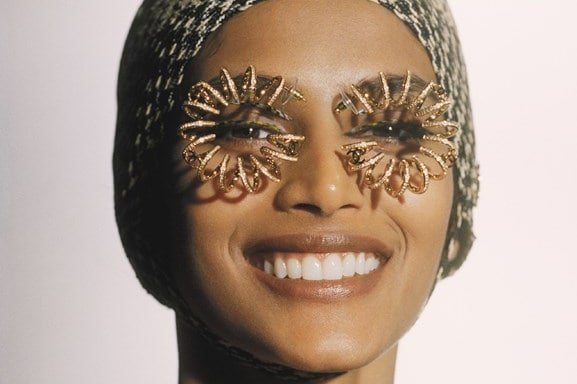
Bhavitha Mandava – The Winter 2026 Issue
Gallery / 13 images
The last time Bhavitha Mandava and Diya Joukani got breakfast together, they were in New York. The Chanel supermodel and buzzy gen Z designer met in a cafe, where they discussed how their lives hadn’t exactly gone to plan.
“We were just being funny,” says Mandava, who was born in Vijayawada, by the Krishna river, and grew up in Hyderabad. “We were like, ‘Oh my God, I did a master’s, and now I get paid to walk,’” Mumbai-born Joukani chimes in, her eyes twinkling. “I studied international relations and politics and sociology. We were laughing about the fact that now we just walk around.”
In the summer of 2024, product design student Mandava was scouted by a modelling agency while waiting for the subway in New York. The chance encounter led to a new, unexpected career. It was also the start of a giddy creative partnership with Matthieu Blazy, who cast her in one of his final shows for Bottega Veneta before handing her a starring role in his Chanel Métiers d’Art 2026 presentation. Striding through a set that looked, fittingly, like a subway station, Mandava made history as the first Indian model to open a show for the luxury fashion house. A video of her parents excitedly watching via livestream went viral.
All clothes, shoes and accessories worn throughout Chanel Cruise 2026/27Photography Camille Vivier, Styling Imruh Asha
Meanwhile, Joukani was stomping around her neighbourhood of Bandra, in Mumbai. She was filming videos of herself running errands while dressed in her own designs: impossibly cool baggy jeans and embellished oversized hoodies. In early 2026, her videos started to blow up online, spawning copycat “cool girl” street-style videos from young women across the world. They were also a clever way of promoting her label, DiyaDiya, which sold 3,000 items overnight when she listed her clothes on her website.
This year, in Paris, Mandava shone against a backdrop of giant toadstools. She was a coveted Chanel bride, shimmering down the runway in iridescent ivory couture, a crown of delicate white feathers fixed to her head. During that breakfast in New York, Mandava says she realised something: “All my life, I’ve valued a certain thing about myself [referring to her educational achievements], and now the world is rewarding me for something else that I never even cared much about, which is my looks.” She and Joukani, who are both 26, bonded online and in person after going viral around the same time. Across three time zones, with Mandava video-calling from her childhood bedroom in Hyderabad, Joukani from a glamorous hotel bathroom in Sydney and Dazed from London, the two friends discussed the burden of representation, “big bindi culture” and what real style looks like.
All clothes, shoes and accessories worn throughout Chanel Cruise 2026/27Photography Camille Vivier, Styling Imruh Asha
Diya, you recently got to see Bhavitha walking for Chanel in Paris, at the Grand Palais. What struck you about her walk?
DIYA JOUKANI: The way you walk on the runway and the way you walk in the street? That’s very different. If we’re hanging out, just us two, and we’re going to a cafe or something, you’re a little bit more reserved. But on the runway? I don’t know what to tell you; that walk is nasty! [Bhavitha giggles] She’s so composed, with so much decorum. She knows exactly what she’s doing. It’s so fire. I was so proud. There were also a lot of Desi models walking. In a lot of other shows, I think Indian and Desi girls are very tokenised. If there’s one, there can’t be more. I was like, “Oh! Another one, another one, another one!” That’s not something you ever see on an international runway.
BHAVITHA MANDAVA: Whenever I used to go to castings and see another Indian girl, we would make eye contact. We kind of knew: it’s either gonna be you or me. But at Chanel, it could be you, me or ten other girls.
All clothes, shoes and accessories worn throughout Chanel Cruise 2026/27Photography Camille Vivier, Styling Imruh Asha
DJ: So cool to see.
BM: I wouldn’t say I’m a trailblazer whatsoever, because so many incredible Indian women have paved the way for me. But I think because my story went so “viral”, now I see every agency going to India. India wasn’t somewhere they would go to scout in [previous] years. Why do you think the fashion industry is suddenly so interested in India?
DJ: I keep saying this: we’ve always been here. Everyone’s been cool. Everyone’s been beautiful. But now the world’s paying attention in a different way. Maybe that’s because a few things went viral at once, and now there’s this resurgence of Indian influence within the industry.
Diya, one of those viral moments was your series of “cool girl” videos on TikTok. How would you describe the Mumbai It girl?
DJ: I could see someone walking down the street in another country, anywhere in the world, and from the way they dress, the way they carry themselves, their aura, I’ll be like, “Yeah, you’re from Bombay.” I can just tell. We don’t really care what other people think. We’re very loud. We’re very expressive in the way that we dress. The way we put outfits together, I’m sorry, it’s chicer than everyone else.
BM: I feel like Mumbai is where dreams become reality.
DJ: That’s why it’s called the city of dreams.
All clothes, shoes and accessories worn throughout Chanel Cruise 2026/27Photography Camille Vivier, Styling Imruh Asha
Is that because it’s the home of Bollywood?
BM: Bollywood is the least interesting thing about Mumbai, in my opinion.
DJ: I’m with you on that, and I’m from Bombay. Love to Bollywood –no disrespect–but there are cooler things. There’s so much talent there outside of just the film industry. The film industry, like the fashion industry, is very hard to get into. It’s very small. You need to be someone to get somewhere. But that’s really not what the city’s about.
BM: But what we are seeing right now is people using the internet, right? Diya has pioneered this format that has been recreated by so many different girls from different parts of the world. She’s showing people that it really doesn’t matter where in the world you live; you can show up in a way that is authentic to you and where you belong.
DJ: My whole thing is like, “You don’t have to be someone [who is already well-known] to get somewhere.” I don’t need anyone else’s approval; I’m gonna take what I’ve got and put it online.
All clothes, shoes and accessories worn throughout Chanel Cruise 2026/27Photography Camille Vivier, Styling Imruh Asha
BM: The first time I met her I was like, “Diya, isn’t it crazy that this is our life now?” But she was like, “As soon as I posted that video, I knew.” She’s the epitome of cool girl. And it has had such a ripple effect. Look at Rachel Ojuromi; she also walks around her hometown in Nigeria, and she’s blown up too.
DJ: [Rachel] walked the Chanel show too; that was dope to see. Everything you see from India, from content to creators, influencers, Bollywood, everything, it’s so polished. But I literally just go walk outside my house or studio, and I’m wearing my own creations. It shows that you can stay where you are and decentre the western fashion world. I feel like people think India is some small village. I found that a little bit from living in New Zealand and London, but [even more so] when I started posting videos and reading my TikTok comments section. People didn’t know anything about India. It was giving first day on Earth vibes.
All clothes, shoes and accessories worn throughout Chanel Cruise 2026/27Photography Camille Vivier, Styling Imruh Asha
What else do you want people to know about style in your hometowns of Mumbai and Hyderabad?
DJ: We’ve got our old aunties and uncles in salwar kameez, saris and all that on the daily, which I personally have the most respect for. I think that they’re the flyest. I don’t know why everybody stopped wearing that. And then we also have a more westernised version, where people will wear a lot of jhumkas and Indian tops and stuff like that. My biggest style inspirations are all millennials. Then we’ve got gen Z. More than wearing western clothing, gen Z especially are getting back into wearing homegrown Indian brands that work with different traditional methods and materials; all the ways of making clothes that are very localised. I think that is the biggest fashion trend right now in India.
BM: Where I live it’s the same, but it’s also different, because in south India we have different traditional wear. Maybe I would catch aunties in churidars, and uncles in a shirt and pants. I think there’s this surge where gen Zs are trying to reclaim their “culture”. They will add a bindi, or go crazy and wear a fully western outfit with Kolhapuri chappals.
All clothes, shoes and accessories worn throughout Chanel Cruise 2026/27Photography Camille Vivier, Styling Imruh Asha
DJ: Exactly, that happens a lot in Bombay.
BM: I wouldn’t say Indo-western, but it’s like they just want to add a hint of something. I’ve worn bindis since I was a kid, but I feel like right now people are not just wearing tiny ones; they’re wearing ones that are as visible as possible.
DJ: Big bindi culture!
BM: It has become a big bindi culture, which I’m very happy about.
DJ: We love to see it. It’s very maximalist, very unapologetic.
BM: Maximalism is big here. But then, so is minimalism. Even with traditional wear, you’ll see uncles and aunties wearing plain outfits… Often when people think of Indian fashion, especially in the west, they just think of bridalwear. You almost have to be blinded by this maximalism. But we’re not showing up every day wearing rhinestones.
All clothes, shoes and accessories worn throughout Chanel Cruise 2026/27Photography Camille Vivier, Styling Imruh Asha
DJ: We wear calm outfits. Just so the world is aware. We don’t always have to be doing the most.
BM: I mean, there’s a place and an occasion for outfits like that, and we’re obviously proud to wear them for those occasions.
DJ: I wore a lengha three days ago. I’m still feeling overstimulated from it.
BM: I love wearing saris. But I’m not showing up to the supermarket wearing a sari. That’s not the reality.
DJ: Valid, valid, valid.
BM: I personally get a lot of heat for showing up at events in a way that I feel represents me. I think it comes from this idea that Indians have to wear a particular sort of outfit. If you’re not dragging a whole train [behind you], you’re not wearing an Indian outfit. That’s the perception.
DJ: I get so many comments like, “Oh my gosh! She’s wearing jeans She’s westernised.” What do you want me to wear every day, guys? At least my jeans are embroidered!
All clothes, shoes and accessories worn throughout Chanel Cruise 2026/27Photography Camille Vivier, Styling Imruh Asha
Neither of you started in the fashion industry; you both come from a strong academic background. How does it feel to have prepared for one kind of life and then to be living another?
BM: Growing up in India, education has been such an important thing in our lives. It was something I realised when I moved to the US. My friends told me they did archery; they did piano. They were [talking about] all these hobbies that I never did, because all I did was study. I was told if you study hard, you’re gonna get a job, and then you can get promoted, and that’s the way of life.
DJ: In school, you have two streams: it’s either commerce or science. There was no arts option. Maybe now there is, but when I was in school, there wasn’t anything else you could do. I feel like creative careers are discouraged in India, so to do anything outside the norm of what’s expected is like, “Woah! What are they doing?!”
All clothes, shoes and accessories worn throughout Chanel Cruise 2026/27Photography Camille Vivier, Styling Imruh Asha
BM: Your parents are just trying to guide you as well as they can. They don’t want you to be struggling for the rest of your life. It always comes with good intentions.
DJ: I really wanted to work at the UN, and then I was like, “I gotta be a stylist.” Then [after that] I was like, “I hate this, I’m gonna be a designer.” To be in this industry, you have to be extremely sure of yourself and confident, and have a lot of willpower and determination. But at the same time, I could never do a nine-to-five. So for me, it’s my only option.
BM: I studied architecture for my bachelor’s, and then I studied tech and design. But, unlike Diya, I was completely fine doing a nine-to-five. Honestly, at one point, I was aspiring to work at Google or Meta. Modelling, of course, is really good money. But apart from that, I also valued fulfilment. In the sense of, am I providing something of value? Is the world benefitting from me?
DJ: The world is benefitting from you!
All clothes, shoes and accessories worn throughout Chanel Cruise 2026/27Photography Camille Vivier, Styling Imruh Asha
BM: [At first I thought,] “I’m gonna wear clothes and sell them,” and then I’ll be part of this huge consumerism cycle. But there’s this other angle. There are so many little Indian girls running up to me and hugging me like, “Oh my God, you’re that Indian Barbie from the subway!” That has completely changed my perspective on modelling.
DJ: Can you imagine, Bhavitha, if you and I got to see [someone like] you when we were kids growing up? What does that representation do to your brain chemistry? It opens up so many possibilities. It’s so inspiring. When will you see each other next, and what will you do together?
DJ: We’re gonna see each other in, like, two weeks. I’ll text you when I’m gonna be in New York.
BM: We always grab either lunch or breakfast –
DJ: –or dinner.
BM: Or dinner.
DJ: And then walk around.
BM: We’ll walk around. Obviously