On Friday nights, IndieWire After Dark honors fringe cinema in the streaming age with midnight movies from any moment in film history.
First, the BAIT: a weird genre pick, and why we’re exploring its specific niche right now. Then, the BITE: a spoiler-filled answer to the all-important question, “Is this old cult film actually worth recommending?”
The Bait: Next Stop, Stephen King’s Feature-Length Flop
The list of novelists turned great film directors is not long — in fact, as much as I love the spectacle of Norman Mailer chewing on Rip Torn’s ear and Torn going after Mailer with a hammer in Mailer’s directorial effort “Maidstone,” I feel pretty confident in saying that if you started counting examples on your hands, you’d run out of names before you’d run out of fingers. There’s Clive Barker, whose “Hellraiser” is a straight-up horror movie classic, and William Peter Blatty, whose “The Ninth Configuration” and “Exorcist III” have inspired devoted cults. On the artier side there are international art house darlings Ousmane Sembene, Lee Chang-Dong, and Catherine Breillat, all of whom, along with Alex Garland, are better known for their movies at this point than their books.
But that’s about it — for whatever reason, most novelists who achieve success tend to stay in their lane, selling the screen rights to their material off to others to adapt and, often, mangle. Yet it was probably inevitable that Stephen King would at some point have to try his hand at directing, given both his massive popularity and his own passionate sense of cinephilia. This is the guy, after all, who at the height of his early popularity took time out to write “Danse Macabre,” a critical study of the horror genre as a whole that celebrated all the movies King loved (and took time out to trash the ones, like the early works of Wes Craven, that he didn’t).
“Maximum Overdrive” (1986) ©De Laurentiis Group/Courtesy Everett Collection
By the mid-1980s, King was both a prolific source of inspiration for major auteurs like Brian De Palma, Stanley Kubrick, David Cronenberg, and John Carpenter, and an often cranky critic of their adaptations. King was especially peeved by Kubrick’s “The Shining,” which he felt fundamentally misunderstood the essence of the book and was miscast, in spite of Jack Nicholson giving one of the most iconic horror movie performances of all time. In a typically elegant King analogy, the author compared the experience of watching “The Shining” to being jerked off in a car by a girl who wouldn’t let you finish.
In 1985, King decided to step up and cash the check his mouth had been writing for years, signing a multi-picture deal with financier Dino De Laurentiis to write and direct movies. The multiple films never materialized, except for one: King’s first, last, and only feature directorial effort, the 1986 killer truck movie “Maximum Overdrive.” Based on King’s short story “Trucks,” it’s a movie that depicts what happens when a comet passes by Earth and causes all machines to come to life and become homicidal, leading to delightfully gory murders committed by possessed lawnmowers, hair dryers, chainsaws, and more.
When “Maximum Overdrive” was released 40 years ago in the summer of 1986 it was roundly trashed, including by King himself — he called it a “moron movie” and later admitted he had been coked out of his mind the whole time he was directing. While his crew didn’t necessarily remember the cocaine use, there were reports of King cracking open beers at the 6am call time and drinking pretty much non-stop from that point forward, which might explain directorial choices like getting AC/DC to score his horror movie with music that was, while quite enjoyable for myself and other 14-year old boys at the time, not remotely scary or atmospheric.
“Maximum Overdrive” (1986) ©De Laurentiis Group/Courtesy Everett Collection
Yet I’m here to tell you that not only is “Maximum Overdrive” not bad, it’s absolutely essential viewing — and in fact, if I had a choice between it and most of last year’s Best Picture nominees to take to a desert island, “Maximum Overdrive” is the one I’d be living out my final days with. Say what you will about the artistry of “Hamnet” or “Train Dreams,” neither of them contains a sentient, foul-mouthed ATM machine or killer arcade games, which means that they automatically cannot be considered as good as “Maximum Overdrive.”
King’s magnum opus grabs the viewer right off the bat – what can you say about a movie where a soda machine kills off the members of a little league team one by one, and then a steamroller comes in to finish off the job? (Other than, “thank you, Stephen King.”) The carnage that follows, scored to those rockin’ AC/DC cues, is gleeful in its excess (it was probably even more gleeful before the MPAA took their scissors to it) and exquisitely photographed. King’s cinematographer was the excellent Italian DP Armando Nannuzzi, who had shot Visconti’s “The Damned” and dozens of other great films, and his widescreen compositions here are far more expressive and artistic than the movie’s reputation would suggest.
“Maximum Overdrive” (1986) ©De Laurentiis Group/Courtesy Everett Collection
Nannuzzi spoke no English, but clearly he and King spoke the universal language of cinema. Unfortunately, those beautiful images came at a price, when the cinematographer lost an eye after a lawnmower really did seem to develop a mind of its own and went rampaging out of control on set. Amazingly, Nannuzzi returned to the set after a brief hospital stay and finished the movie, though he did sue King and the film’s producers for negligence. The case was settled out of court, and Nannuzzi’s career suffered from the fact that producers seemed to have an issue with hiring a cinematographer who had no depth perception.
While Nannuzzi, King, and virtually everyone else involved seem to look back at “Maximum Overdrive” with regret, as “moron movies” go it remains a great time, a vulgar and lowbrow but slick looking and sounding celebration of physical destruction (which, after all, is one of the things cinema does best). Interestingly, another novelist, Stephen King’s son Joe Hill, has expressed interest in directing his own remake of “Maximum Overdrive” — he told filmmaker Mick Garris that he would gladly step behind the camera for the first time if given the opportunity to write and direct a new version of his dad’s movie. It’s a tantalizing prospect, but it’s hard to imagine anyone coming up with a more entertaining riff on the material than King himself, especially without the aid of all those six-packs and cocaine. —JH
The Bite: Just $1.08 a Gallon?! Fetch Me Doc’s DeLorean
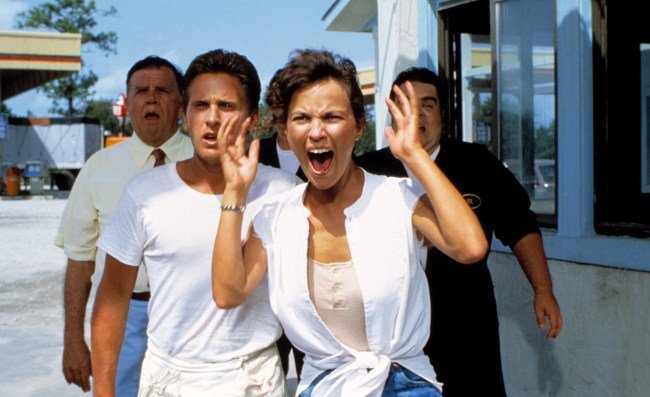
“You can’t get there from here,” declares ex-con hero Bill Robinson (Emilio Estevez), while trying to outsmart a supernatural fleet of alien-possessed trucks in “Maximum Overdrive.” In context, he’s philosophizing about an escape route for himself, his hitch-hiking love interest Brett (Laura Harrington), and the rest of the survivors of the Dixie Boy truck stop massacre. But watching King’s one and only feature film ahead of its 40th anniversary later this year, the line rang true in a different sense.
Despite the countless conveniences of modern entertainment, there’s no direct route from our current cultural moment to the unique chemical conditions that so graciously allowed us to behold King’s delirious directorial debut from the summer of 1986. That’s partly what makes his movie so electrifying to discover now. Good, bad, or as I put it in my notes, “Holy shit, the best thing I’ve ever seen in my entire fucking life!!”, the more interesting question about “Maximum Overdrive” is whether contemporary Hollywood could even manufacture something this shaggy, tactile, and alive today.
“Maximum Overdrive” (1986) ©De Laurentiis Group/Courtesy Everett Collection
Watching little leaguer/soda-can-beating survivor Deke (Holter Graham) weave his bicycle through a destroyed suburban neighborhood — lawns littered with bodies, each savagely mauled by some piece of machinery that suddenly sprang to life in their homes — it’s obvious you’re witnessing the work of America’s foremost horror novelist. The sequence combines the kid-hero spirit of something like “It” with the campy grotesque carnage of “The Mangler,” as King sets the stage for a bloody adventure that’s populated not just by memorable victims, but an unseen alien force with a remarkably bright personality.
From a goblin-faced eighteen-wheeler running down a creepy Bible salesman, to a sentient arcade cabinet going toe-to-toe with Giancarlo Esposito pre-“Breaking Bad,” the cosmic invaders’ crackly persona radiates through every frame of King’s foul-mouthed horror comedy. There’s even a bizarre sense of selective morality hard-wired into the possessed machines, as the trucks appear especially eager to punish humans who are cruel or greedy. Even with that drive-thru speaker broadly announcing, “Humans here!”, you get the impression that King’s invaders operate under some private logic — one that, despite being unintelligible to audiences then and now, made sense to the filmmaker at the time.
The result feels less like a serious plan for a major movie than it does flecks of inspiration that King might have scribbled into the margins of a map on a road trip. But as far as cult film journeys go? That looseness has aged beautifully. Modern franchise filmmaking too often feels terrified of critique, with a level of visual polish that leaves otherwise compelling narratives oddly devoid of life. More than ever before, characters in tentpoles seem to exist exclusively to move the plot along efficiently, while the emotional beats they endure are routinely watered down for generic sales success.
“Maximum Overdrive” (1986) ©De Laurentiis Group/Courtesy Everett Collection
But “Maximum Overdrive” is packed with ideas that are so weird, horny, and specific that it’s hard to imagine King’s script surviving contemporary IP filtration today. Even coked out of his mind, the writer remains a singular empath here — with nude centerfolds hanging inside rest stop cabins meant for truly lonely nights, and diner waitress Wanda (Ellen McElduff) running into the truck lot drunkenly screaming, “We made you!” not once but twice, with no coherent plan either time. Even the toilet paper truck draping the set in streaming white ribbons feels curiously and organically inspired.
In that sense, “Maximum Overdrive” has become an increasingly elegant fit for its name. King’s, in every sense, singular effort recalls a time when explosive crowd-pleasers felt less optimized and more inhabited. That quality will only grow more valuable in sci-fi as technology becomes less visible, and even following in the repertory tire tracks of John Carpenter’s “Christine” from 1983 (another King story, that one about a murderous Plymouth Fury), the notion of killer trucks was once truly absurd to audiences.
“Maximum Overdrive” (1986) ©De Laurentiis Group/Courtesy Everett Collection
Now, we live alongside real autonomous vehicles and so much AI slop that not even AC/DC can make those things feel mythical. Which is why it’s so impressive to see King’s film hold up this well across four decades, and at the same time, genuinely sad to think he never directed again. The failures of “Maximum Overdrive” are clear, but looking back, I don’t see an embarrassing anomaly in the author’s career so much as a fascinating artifact of his sometimes overexposed artistic bravery. If Joe Hill ever does direct that rumored remake, I honestly hope he resists the temptation to modernize it too much. The charm of King’s “Maximum Overdrive,” and its dirty, gas-guzzling antagonists possessed by interstellar malice, comes precisely from how retro his understanding of the world now feels in any medium.
“You can’t get there from here,” Bill said. Maybe he’s right. But younger audiences still deserve references for cult movies that sprawl, contradict themselves, and leave behind tonal residue so strange not even their creators can fully explain them. If nothing else, “Maximum Overdrive” proves that even King had his limits — namely, remembering to put “Highway to Hell” on this soundtrack. (Seriously, of all the batshit decisions made during this production, that’s the one that grinds my gears.) —AF
“Maximum Overdrive” (1986) is now streaming free on Tubi.
Read more installments of After Dark, IndieWire’s midnight movie club: