This is your first of three free stories this month. Become a free or sustaining member to read unlimited articles, webinars and ebooks.
Become A Member
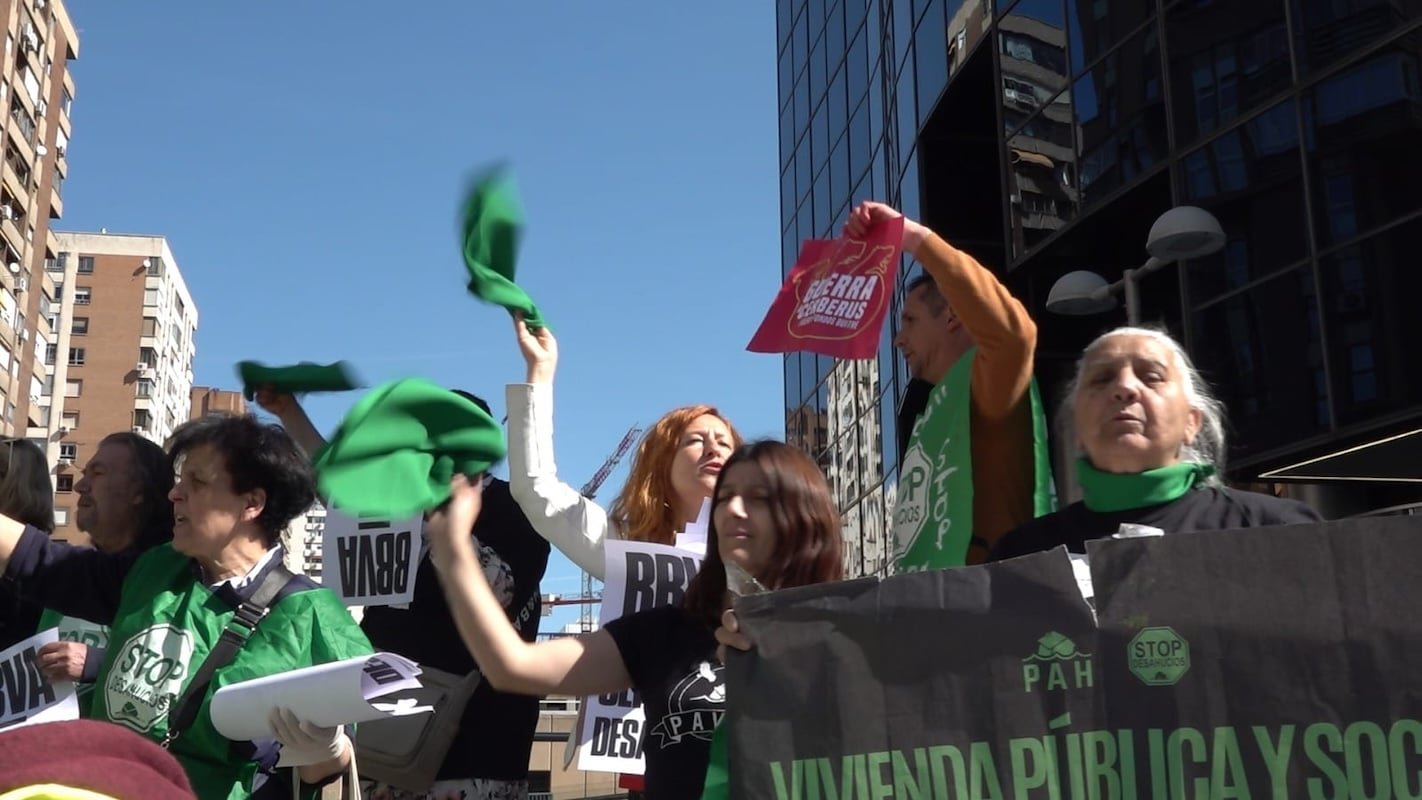
Angelines’s daily life used to be like that of many other housewives: looking after the children at home, taking the eldest to school, then shopping, cooking and tidying the house while looking after her youngest. The first time she saw an eviction being stopped was on television, although it was happening in the very district she lived in, Usera in Madrid.
“Lots of people were talking about it, because the police got quite violent with the people who are now my compas,” she remembers. “But back then, I watched and thought: How can they be throwing people around like that?”
Angelines soon got involved in the housing movement. When her grandmother died, she went to live in her flat — a council house from the Madrid Regional Government — and eventually managed to be officially recognized as a tenant. The difference was that her grandma paid €90 a month, and she paid €500. When the crisis came, Angelines was no longer able to pay the rent, and the authorities threatened to evict her over her debt.
Another mother at her daughter’s school told her about the Usera housing assembly and that led her to Plataforma de Afectadas por la Vivienda Pública y Social (PAVPS Madrid). She’s still at the flat and pays €140 per month, covering the rent and the debt she’s paying off as part of an affordable repayment plan.
Her life looks very different these days. “I’ve changed a lot. It’s no longer ‘drop the kid at school, shop, then go home…’ it’s, ‘take the kid to school, do a sit in at some administrative building, stop an eviction, meet with the housing councilor or the manager of wherever,” she explains. Her youngest was two when his mother began to get involved in right-to-housing activism. One day, the child was asked at school what his parents did and he said that his dad was a builder and his mum worked stopping evictions. “My son has experienced it as a job, because every day I left them at school, I had something to do.”
Founded in 2009 in response to the mortgage scam taking place in Spain, the Platform for People Affected by Mortgages (Plataforma de Afectados por la Hipoteca, or PAH) has become a nationwide civil movement with more than 200 local chapters. After 17 years, our new book Yes, It’s Possible!: A Handbook for Building Power from Below shares everything we’ve learned with anyone who might be inspired by it. Here, we’ve shared some of our key insights on how to effectively organize an assembly-based movement.
Structuring a national platform
Most PAH chapters don’t stop at weekly or fortnightly assemblies but maintain a feverish level of activity all week, which requires a lot of organization. Each local PAH group is autonomous and can decide how it organizes and operates depending on its local context and resources.
But some basic standards are in place. The main one is that the organization must be horizontal to promote collective decision-making, sharing and disseminating information, and sharing tasks and responsibilities. At a PAH, decisions are made at weekly or fortnightly assemblies that are open to all. Operating parallel to that are committees or work groups (which are also open) allowing specific issues to be tackled in greater depth on a more regular basis. These groups are dependent on the assembly and are only authorized to make decisions on certain matters.
At a large PAH like Barcelona, there can be up to 20 committees at any given time, although the overall structure of the organization changes constantly. The committees handle issues as diverse as organizing protest actions, selling merchandise to raise money, speaking at meetings the PAH has been invited to, chairing and mediating assemblies, providing information through social media and the press, developing new strategic proposals, and organizing celebrations.
The problem is that there’s not always enough organizational muscle to keep up with such diverse activities. For instance, Jesús explains that at PAH Berriozar, there used to be several committees, but now that fewer people are involved on a daily basis, most issues are dealt with directly at the assemblies.
Boosting horizontality
For the horizontal approach to work, it’s very important for the assemblies to be properly mediated. This can take very different forms, from sharing the agenda in advance to creating an environment that allows all opinions to be heard. In 2014, the Catalan PAHs produced a facilitation manual based on platform training workshops with help from external collaborators.
“There’s a coordination team inside our PAH that takes responsibility for preparing some of the structure of the assembly so that when it happens, we have the agenda to keep us on track,” explains Rosa from PAH Altea. Saskia from PAH Torrevieja explains that they put the agenda together in a WhatsApp group: “Everyone talks a bit about the issues they want to deal with and then these are addressed when the assembly begins.”
Some PAHs, like Bages and Sabadell, opt for not having a coordination committee in order to decentralize the work. Others, including Barcelona, do have a coordination committee but also have a specific committee for assembly facilitation. Proposals for topics are sent by email so that the committee can send out the agenda — also by email — before the assembly. Some flexibility is allowed so that the final meeting agenda can be adapted to the needs raised by participants and items can be added to the list.
For the meeting to function properly, it’s important for everyone to know which item they’re covering and how long it will last. To help out with this, it’s a good idea to have all of the agenda items written on a board. “We used to find that we would finish Sunday’s assembly at 11 p.m. Considering that we get up at 7 a.m. on Mondays to work, that had to change. And when we put a 9 p.m. limit on the assembly, it still worked,” explains Àlex from PAHC Bages.
“Although it’s hard to grasp it all the first time you come — the committees and ways of doing things — being clear about the structure and repeating it at each assembly allows everyone to get used to it.”
Time slots are also useful for dividing the different parts of the assembly. “We agree to stop at exactly 8 p.m. to deal with actions and evictions, so there are things that have to be left for the following week,” says Edu from PAH Barcelona.
“One of the positives of the PAH is its organizational complexity. Everything is very structured and although it’s hard to grasp it all the first time you come — the committees and ways of doing things — being clear about the structure and repeating it at each assembly allows everyone to get used to it. And over the years, people have been able to explain things they’ve heard before, adapting and passing ideas on,” adds Edu. It’s also very important to take minutes of all the discussions at the assembly and make them available for consultation.
The facilitator’s role is not easy. They must be alert and make sure that everything proceeds according to the plan, while ensuring that everyone can express their opinion. Edu is grateful that his whole assembly shares a kind of sign language.
“As a facilitator, it’s difficult for me to ask people to stop but the signing helps, because if someone gesticulates to show that the person is going on and on or has gone off on a tangent, I can ask them to get back to the point. Sometimes, when the issue provokes a lot of discussion or leads us into a different discussion altogether, we suggest parking the topic and putting it on the agenda for a future assembly.”
Signing also allows the facilitator to take the temperature of the meeting, as the platform aims to avoid votes and seek options with an overall consensus. “The PAH has taught me to respect different opinions because it’s very hard for everyone to agree at a meeting of 60 people. We do what’s decided at the assembly, even if I don’t agree with it,” explains Delia from PAH Barcelona.
“I often say things that go against what everybody else thinks. I don’t hold back, but what I’ve learned is that if people don’t agree, I’m not going to get annoyed,” adds her compa Francisco.
Collective intelligence
The platform aims not only to respect diversity but also to value it. “The main thing that the PAH has shown me, personally, has been the practical potential of collective intelligence,” says Santi from PAH Barcelona.
“It’s astounding how much things can change when it’s not just a handful of people thinking, and things are opened up to everyone. Debates arise and you don’t even remember who contributed what. Sometimes you see an item on the agenda and you think you know exactly how to do it, but then people start talking and you realize that what comes out of the assembly is much stronger than what went in.”
Marcia from PAH Barcelona adds: “The fact that there’s no leadership or coordinator encourages people to get involved and take on a role, especially women, who often facilitate the committees. The platform has a way of boosting our strengths and building something together that empowers women.”
Tasks for the general assembly: Strategic decisions, general organizational decisions, coordination of committees
Tasks for the committees: Operational and thematic decisions
Lucía, who attends the same PAH, adds: “When you come with a housing problem, you have low self-esteem and think you’re worthless and don’t know anything. The assembly makes us feel important and that our viewpoints should be taken seriously, and that’s really special.”
Despite this, it’s a constant challenge to stop hierarchies from emerging. Any organization can produce leaders, and while this is not necessarily negative, it’s important to be aware of their existence so that they don’t distort the horizontal approach to the movement.
“The most empowered people or the ones who dedicate the most time to PAH used to make a group and sit in the same place, next to the board, so we suggested that the same people didn’t always sit there,” says Edu. It’s no good sitting in a circle instead of in lines if all the knowledge seems to come from the same part of the room.
Likewise, Edu suggests that someone with lots of responsibilities, like acting as spokesperson or being involved in several committees, shouldn’t also chair and facilitate meetings. “The assembly has a lot of potential and has worked well but it’s also at risk from polemicists and manipulators, from people who might want to take advantage of PAH’s collective strength for their own gain,” warns Àlex from PAHC Bages. “It’s the assembly itself that draws the line and reacts when someone does weird stuff. But that risk is always there and sometimes it’s self-limiting.”
His compa Bernat explains: “Like it or not, there are people at PAHC who provide a degree of leadership in certain processes, and sometimes they have been asked for a more central role. It’s these very same people who have reminded others that the platform is assembly-based.” Maintaining horizontality is thus an ongoing challenge that groups must remain alert to.
Constantly adapting
PAH is always attentive to any changes required, whether they’re big or small.
“Of course, roles emerge at the assembly, but we don’t have a group of people in charge,” says Santi from PAH Barcelona, who highlights that one of the benefits of collective decision-making is that it’s easier to re-examine decisions made, because nobody feels individually challenged when doing so.
“If the welcome assembly needs to be changed, we do it; if lots of squatting cases start arriving, we look at how to respond to them. We’ve learned how to adapt to different circumstances and I’d say that’s why we’ve lasted so many years,” he goes on.
“Sometimes, issues emerge when we’re having a drink in the bar after the assembly. What we do then is comment on it the following week and suggest a change, and if lots of changes are needed, we call a plenary assembly and spend a whole Saturday thinking how to modify things,” explains Berni from PAHC Bages. Although decisions are made at the assembly, informal meeting spaces are vital for creating bonds and for raising concerns.
Some changes come not from the assembly itself but from external considerations. When indebted people’s flats belong to banks with local headquarters, it’s possible to hold protests, but when they’re owned by global hedge funds, the situation is rather more complicated. Many PAHs now have specific committees to propose longer-term strategies to the assembly. There are also training committees that allow participants to organize workshops to cater to needs that have arisen at the assembly.
Organizing without resources
The ability to adapt is especially important in a movement with minimal resources. Very few PAHs have their own premises, so most have almost no structural expenses. “We operate with very low costs. We tend to work in outside premises, either public facilities or venues belonging to other social collectives,” explains Paco from PAH Murcia.
Expenses include printing posters, making banners and buying megaphones, but, according to Paco, these are paid “from merchandise sales or donations. At our assembly, we keep a money box on the table and each of us makes a contribution within our means. That allows us to operate because there’s nobody who’s paid or any expenses of that kind here. What we have is plenty of willingness among people to give up their time.”
Collective guidance and organizing at assemblies have allowed PAH to operate without paying for professional support. Both mechanisms have been crucial to its survival on minimal funding.
But that doesn’t mean that involving professionals is incompatible with the PAH model. PAH Vallekas, for instance, was able to have an employee for a while thanks to members’ contributions. A few PAHs have at times also received support from human rights and other civil society organizations, which release their teams for part of the working day so that they can actively support the PAH. Other people come to the PAH to do research and get involved as part of the academic work they are paid for.
These examples are few and far between in the movement and tend to be object of internal debate. One thing is clear, though: If someone is able to devote more time to the platform because they’re directly or indirectly paid to do so, they don’t have any more power over decision-making or act as a coordinator: PAH decisions are always taken at the assemblies.
Building a sense of commitment
To keep growing, taking action through disobedience, coming up with new ways to organize and protect members from burnout, one of the PAH’s main challenges is to encourage affected people to get involved with the movement beyond their own case.
“What pushes you to stay is continuing to fight for other families in a similar plight to you, because you remember how much you cried when the letter about your eviction arrived. That makes you want to stay and fight for things to change because you become aware of all the injustice that’s out there,” says Angelines from PAVPS Madrid.
Bonds are often nourished in informal spaces. In Barcelona, for example, there is a Telegram group called PAH Familia (PAH Family). “After people have attended one or two assemblies, we try to incorporate them into the group. It’s a way for everyone to find out about things like evictions and actions, as well as birthdays,” Francisco explains.
It isn’t a decision-making space or an official communication channel because those things already exist; it’s a more informal mechanism involving around 200 people. “I think it works well despite everything, because sometimes you even receive notifications from the group at 1 a.m.!” Francisco says, resignedly.
Maria Antònia from PAH Cardedeu, a municipality of 18,000 inhabitants, thinks it’s easier to build relationships at smaller PAHs: “We have to deal with fewer cases than in a larger PAH and relationships are more personal. You know more about how people feel, what’s happening with their children, whether they have other problems beyond housing…”
Though she values the role of small platforms in helping people feel less alone, she points out that “they have a downside, which is that it’s harder to get people to take on responsibilities for things in small groups.”
“At the beginning, the PAH thought a lot about language, images and clear messages. That helped us reach out to people who had never been involved in any movement and who had very little social relationships, because we’re shut up in our houses and barely even say hello to our neighbors,” says Emma from PAHC Sabadell.
“For many people, PAH was the first time they’d joined an organized mutual aid group where you get to know a lot of people and help each other out. This creates a ‘PAH identity’ where you feel part of a big family that’s always there when you need it.” Very often, it’s that feeling that explains why people still go to assemblies, years after joining the movement.
Some people still feel like part of the movement despite no longer participating. “There are people who haven’t been able to come for four years, for whatever reason, but still feel part of the PAH. Sometimes, they ask us if they can help and I think there are people who’ll never stop feeling the PAH because they’re so grateful, not just for resolving their material issues but because the organization has brought wider change to their lives,” states Jesús from PAH Berriozar.
But he warns: “There are also people who treat the PAH as if it were an investment bank: They never come, but if they need something they turn up.”
Several groups agree that only a small number of the people who come to the PAH end up developing a real bond. But they also share the view that they’d struggle to hold assemblies with thousands of people if everyone who’s come to the advice and support assemblies had stayed.
Another challenge facing the platform has to do with changes in the housing issues it deals with. When most people came with mortgage problems, they were usually caught up in a slower legal process and it was easier to develop bonds in the time that they spent at the assemblies, which was often more than a year. Now that the toughest years of the mortgage crisis have passed, most people affected by housing issues have problems with renting or squatting. Processes in these areas tend to be faster and the PAH must constantly reinvent itself as a result.
How to organize an assembly-based movement
-
Make decisions at open assemblies and organize work in committees or working groups that answer to the assemblies.
-
Organize the assembly by sharing the agenda in advance, displaying this information at the meeting and establishing a time limit for each item.
-
Facilitate discussions to accommodate the full diversity of positions at the assembly while also moving through the agenda, being clear when a discussion is urgent or should be revisited another day.
-
Respect dissenting voices and value collective intelligence as a way of reaching more developed conclusions than the positions that any individual could reach alone.
-
Promote decision-making by consensus instead of always voting to choose the option with the most support.
-
Be careful to avoid and/or counter hierarchical relations that might undermine horizontal decision-making.
-
Question the platform’s strategies and organizational methods whenever necessary to tackle emerging problems or challenges.
-
Create spaces for people to meet up and interact in to strengthen long-term bonds between members.
Excerpt adapted from Yes, It’s Possible! A Handbook for Building Power by João França and The Platform for People Affected by Mortgages, published by Common Notions. Copyright (c) 2026 Common Notions. All rights reserved.