At a Cannes Film Festival that has found filmmakers including James Gray and Pedro Almodóvar fooling around with autobiographical elements in their movies, Bruno Santamaria Razo has put one of the year’s boldest and oddest spins on a personal story. His “Six Months in a Pink and Blue Building” mixes documentary and fictional techniques, withholds key information at times, brings in real family members at other times and includes the director himself getting an on-camera grilling by his other.
A low-budget but high-concept twister of a movie, it may teach you not to trust the filmmaker – but that’s not to say that you won’t embrace his odd little creation.
From the beginning, “Six Months” seems designed to keep an audience off-balance. The film, which premiered on Tuesday in the Critics’ Week sidebar at Cannes, begins with a hand-held camera being carried around a small house in Mexico City, with the Santamaria Razo’s voice saying, “Mom, did you see how the house turned out?” A woman’s voice answers: “I didn’t know there were pictures of us that replaced our faces with the actors.”
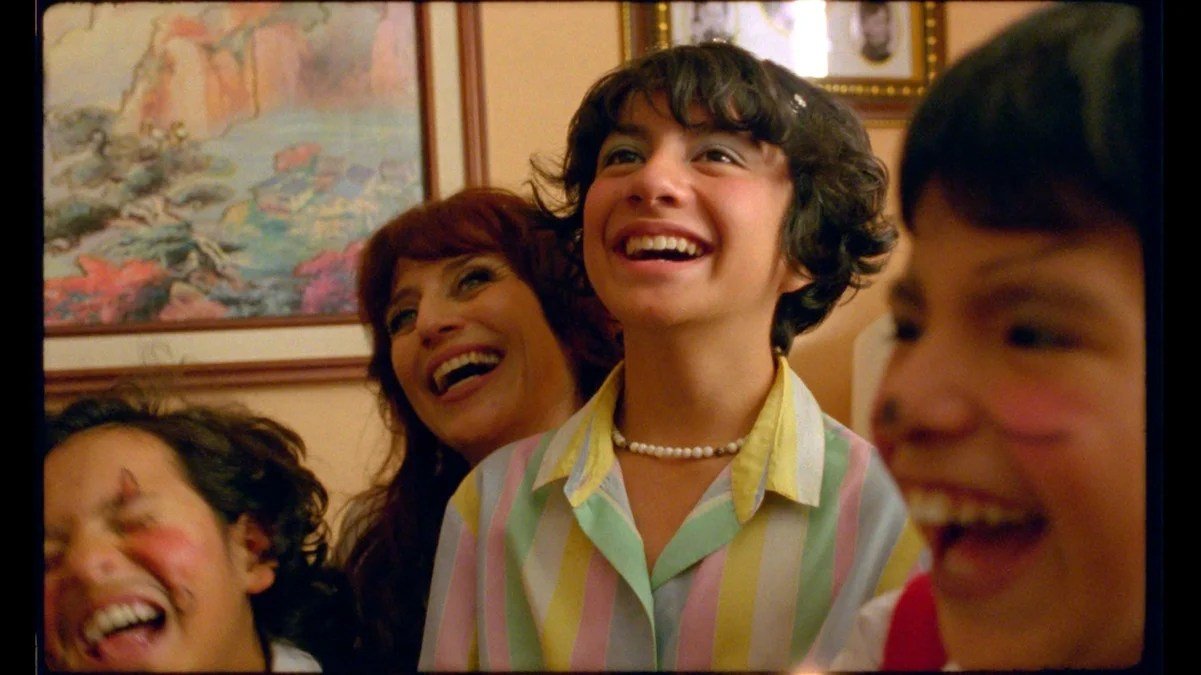
He tells his mother he’s going to interview her, but he’s barely asked her about his father’s illness before we are into a chaotic scene in which the actors playing his family are getting ready for a party. Everybody’s putting makeup on, lots of the children and adults of both sexes are in drag and two young boys, one of them named Bruno (Jade Reyes) and inspired by the director, crouch in a makeshift fort talking about how to French kiss.
It’s Bruno’s messy 11th birthday, with the party captured in hand-held shots that don’t move much, preferring to view the activity from a distance. The music blasts, the camera drops in and catches a snippet of a conversation here and another snippet there, and the big news on the radio seems to be that Baz Luhrmann’s “Romeo + Juliet” is being shot nearby.
But within the family, the really big news is that Bruno’s father has been diagnosed with AIDS, throwing a whole new dynamic into the usual coming-of-age worries. As it’s the early 1990s, people jump to the conclusion that the AIDS diagnosis means death, but also that it means his father probably engaged in sexual relations with men; that could be confusing to a preteen boy experiencing novel feelings for his best friend, Vladimir.
The story comes out in a way that’s not aimless, but it is scattered and fragmentary. The family is hooking up an illegal cable connection in one scene, making giant papier mache heads in the next, and then Bruno is asking what’s going to happen when his dad dies.
“Nothing,” says dad. “You’ll live with your mother and brother. You’ll go to university. You’ll meet a girl. You’ll have kids. You’ll die. Your kids will have kids. They’ll die …”
Long stretches of the film play out against silence, others against pop songs. Bruno and his dad draw on the wall, and their drawings come to life when they leave the room. And every so often, it’ll cut back to Santamaria Razo’s mom, sitting in a chair and answering his interview questions.
And then, an hour or so into the film, there’s a different interview subject sitting in that chair, and a bombshell drops and upends everything we’ve seen so far. It’s too significant a surprise to spoil here, and it’s followed by other revelations, and by the director’s mother turning the tables and coaxing another big revelation out of her son.
Suffice it to say that the homestretch of “Six Months in a Pink and Blue Building” turns a playful blend of biography and fiction into a quirky and more interesting examination of the nature of truth, echoing films as different as Kaouther Ben Hania’s “Four Daughters” and Sarah Polley’s “Stories We Tell.” It slides from weird and charming to weird and charming and provocative, which was obviously the plan all along.